




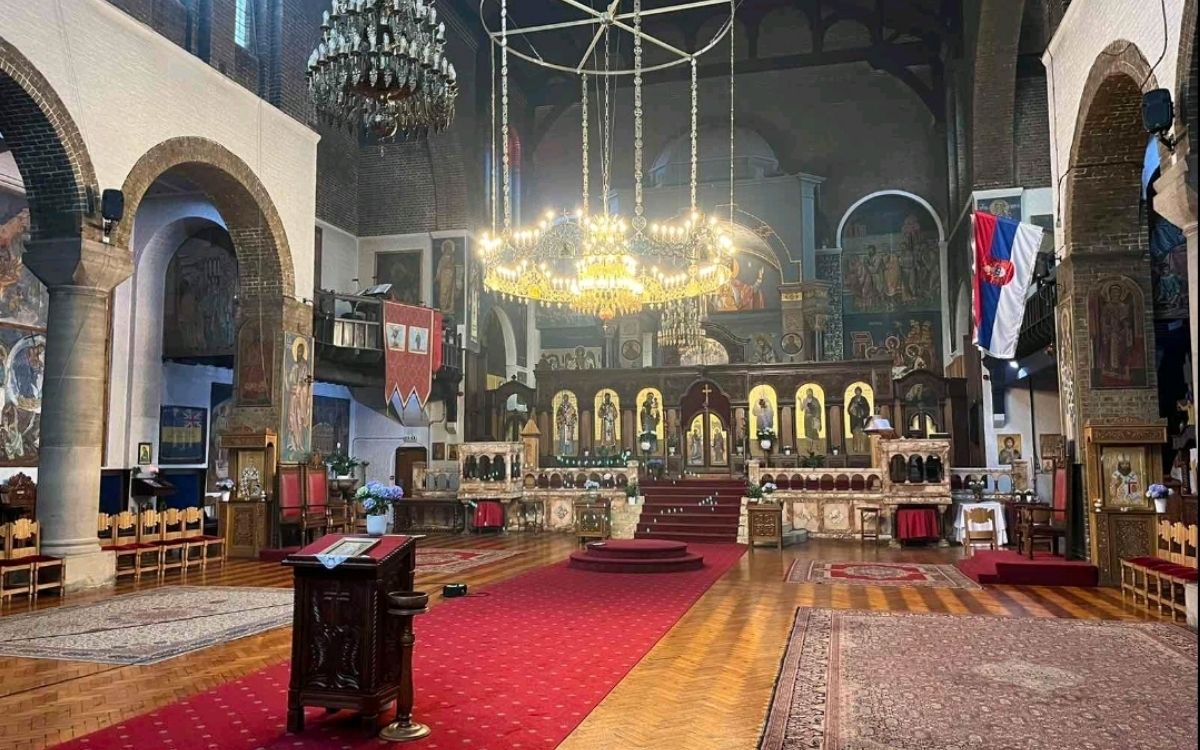
In Lancaster Road, in the London neighborhood of Notting Hill, lies the Saint Sava Church and the Home of Bishop Nikolaj (Velimirović), which for decades have represented a gathering place for Serbs in Great Britain and guardians of cultural, faithful, and national identity. Saint Sava Church in London is one of several Orthodox Serbian churches in Great Britain, and as of 2024, it is part of the Diocese of Britain and Ireland.
Parish trustee Marko Gašić points out for Tanjug that the number of Serbs in London is difficult to determine because, as he notes, people come and go, but what they have in common is that they come to the church parish, which is the center of their gathering in the capital of Great Britain.
“The church community has its own unique history; mostly people from those parts of Krajina, today’s Bosnia and Croatia, came here, whose families perished for their faith and nation. They came here with a high national and religious consciousness, with priests in their ranks,” Gašić said, adding that even today, the church successfully looks after its parishioners.
The church, as he says, also had the task of preserving everything abroad that was, as he stated, considered most endangered.
“This is best summarized when the archpriest of our church asked Saint Nikolaj by letter whether he should place a plaque for General Draža Mihajlović in the church; the answer then was: ‘Of course, you shouldn’t even ask, that should be placed in the church,'” he said, assessing that the church managed to maintain a religious feeling in people, but also that which is national and cultural.
FIND OUT MORE
Saint Sava Church was, otherwise, built in 1903, originally as an Anglican church. It is a spacious three-aisled basilica with a brick interior. After the Second World War, thanks to the help of Queen Maria Karađorđević, and then the Englishwoman Lady Paget, the church was purchased and refurbished for the liturgical use of the Serbian Orthodox Church.
On Vidovdan in 1952, the church was consecrated by St. Bishop Nikolaj (Velimirović). It is decorated with beautiful frescoes that are copies of frescoes from the walls of medieval Serbian monasteries.
Saint Sava Church has been visited by four Serbian patriarchs – on August 14, 1969, Serbian Patriarch German made a canonical visit; on September 29, 2002, Serbian Patriarch Pavle was there during the celebration of the 50th anniversary of the church’s consecration; in October 2016, Serbian Patriarch Irinej visited the church; and in November 2024, Patriarch Porfirije visited the church.
In addition to members of the Serbian Royal House of Karađorđević, parishioners of Saint Sava Church in London included many famous figures: jurist Slobodan Jovanović, writer Miloš Crnjanski, and others.
Next to Saint Sava Church in London is also the Home of Bishop Nikolaj, and Gašić notes that they renovated it four years ago and that it serves various occasions.
“Folklore, Sunday school, weddings, dances, all sorts of events happen there, and besides the hall, there are also offices and apartments. In every way, it can be adjusted as a space for the needs of everyone. We also have requests from other schools and other churches to hold events at our Home of Bishop Nikolaj. It is a very successful story,” he said.
When asked about the image of the Serbian people in London and Great Britain, keeping in mind the negative propaganda of the 90s, Gašić says that it has changed and that the “stain of propaganda that attacked us only occasionally repeats when they want to return to those years and that decade.”
“We are now in a normal situation,” Gašić said, adding that when that propaganda arose, the word “Serbs” was heard, which was not heard during the time of SFR Yugoslavia and was considered pejorative.

Before and after that, the word was, he says, completely normal.
“But when the wave of propaganda starts with the strength with which it started, from those interests that existed then, it was inevitable,” Gašić stated.
Speaking about the preservation of the Serbian language, Gašić said that the church is precisely the place where it is seen that the culture is alive, as is the language, because, as he says, young people can often ask themselves why we speak this language when no one else knows it.
“All of that goes together, and our parish and the parishes in Great Britain are part of that image which has as its goal, which our ancestors also sought to be the goal, the preservation of cultural-national feeling among faithful Serbs, and even the unfaithful, because not all are believers, but again, culture and national consciousness are important in all those examples. So we have our role to help maintain all of that,” Gašić concluded.
He stated that people from other faiths who were seeking God also came to the church “and in our church found the best way for themselves how they can reach Him.”
“Of course, that is flattering to us, but our primary desire is to ensure that those Serbs who are in the city, who do not appear as much or who could appear more often, come as well, because London has enough of our people to fill that church many times over, so it is not necessary for us in London to seek alternatives,” said Gašić.
As he emphasized, it is good that a space exists where people can feel safe and at home. “There are others, but our first goal is to preserve this as a place where Serbs can feel at home even in a distant foreign land,” Gašić underlined.
MORE TOPICS:
“OUR LEGEND, I LOVE YOU SERBIA”: Novak Đoković visited Miha’s family in Rome, Arianna shared photos!
Source: Politika; Photo: Wikimedia Creative Commons / Andrija12345678
 Add Serbian Times as your Google source