




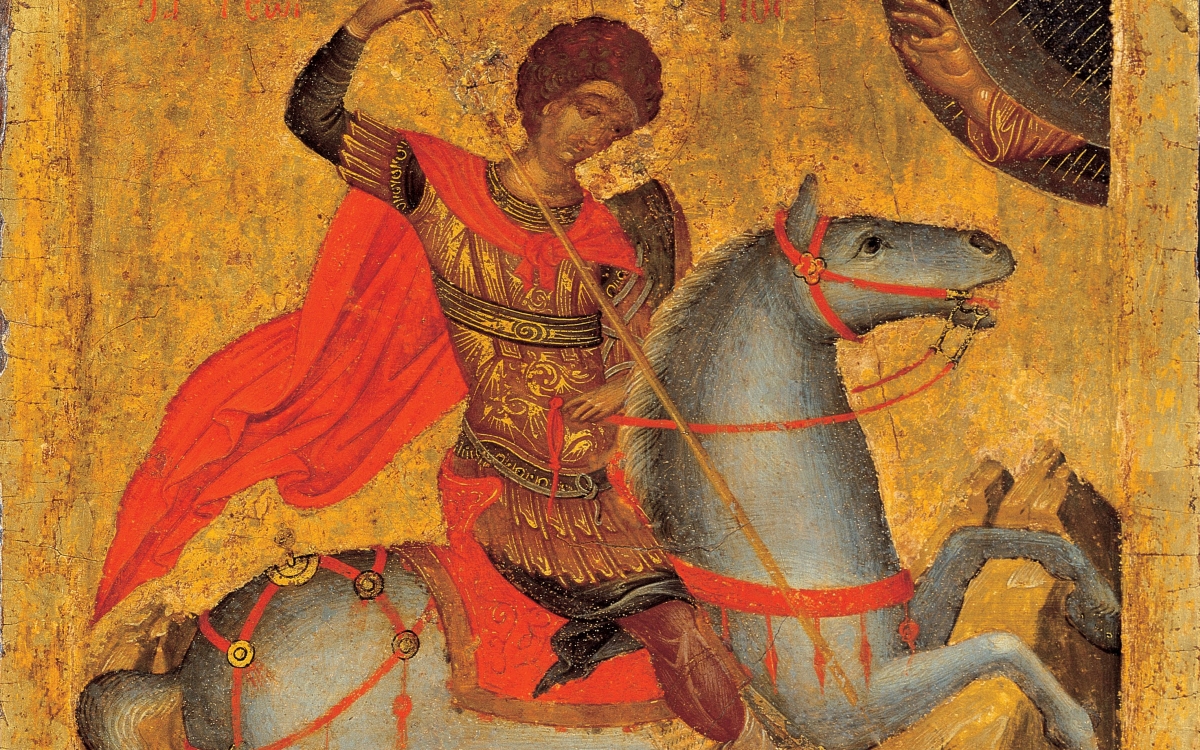
The Serbian Orthodox Church and its believers celebrate Saint George today, one of the nine great martyrs and among the first to suffer for the Christian faith. It is customary to weave wreaths from medicinal herbs which are then thrown into running water.
The feast of Saint George, one of the nine great martyrs and among the first to suffer for the Christian faith, is observed in all temples of the Serbian Orthodox Church and is one of the most common patron saint days (slavas) among Orthodox Serbs.
The glorious saint was born to wealthy parents in Cappadocia. When his father perished as a Christian, his mother moved to Palestine, where the boy grew up. By the age of 20, he had reached the rank of tribune in the service of Emperor Diocletian.
At that time, the emperor began a great persecution of Christians, and the young George stood before the emperor and courageously stated that he too was a Christian. Thus began his suffering for the faith.
The dungeon, shackles, bloody wounds across his entire body, and all other terrible tortures did not shake the young man.
He prayed to God constantly, and God healed him and saved him from death to the great admiration of the people. When George resurrected a dead man through prayer, many embraced the faith of Christ, among them the emperor’s wife, Alexandra.
The emperor finally decided to sentence George and his wife to death by beheading. The empress breathed her last at the place of execution before the beheading, and Saint George was beheaded in the year 303.
Saint George is represented on icons in military attire, on a horse, from which he pierces a terrible dragon with a spear. A bit further from him stands a woman in noble attire (likely Empress Alexandra). The dragon on the icon represents the pagan force that “devoured” numerous innocent Christians.
FIND OUT MORE
Saint George, according to belief, defeated it and, through his martyred death, dealt a fatal blow to “heathenism.”
The victory that Saint George achieved over the dragon likely refers to the cessation of the persecution of Christians carried out by Emperor Constantine.
Đurđevdan is the holiday with the most customs among the Serbian people, which vary in content from region to region.
According to belief, winter and spring meet on this day.
It is customary to weave small wreaths from medicinal herbs which are then thrown into running water.
It is believed that the wreath, as a kind of symbol, brings health to the household members and a bountiful harvest to the fields, protects against the evil eye, grants fertility, and returns love.
Đurđevdan is a holiday for livestock farmers, so the customs have been preserved the longest in mountain regions.
The Roma traditionally celebrate Đurđevdan as one of their greatest holidays, symbolizing the arrival of spring. It is a holiday of joy and happiness, filled with numerous customs.
Willow branches are cut and placed on houses. Children usually come in the evening and take down those wreaths. A wreath stolen from a girl’s house symbolizes that the one who steals it may one day become her future husband.
MORE TOPICS:
“OUR LEGEND, I LOVE YOU SERBIA”: Novak Đoković visited Miha’s family in Rome, Arianna shared photos!
Source: RTS, Photo: Wikimedia Creative Commons
 Add Serbian Times as your Google source