




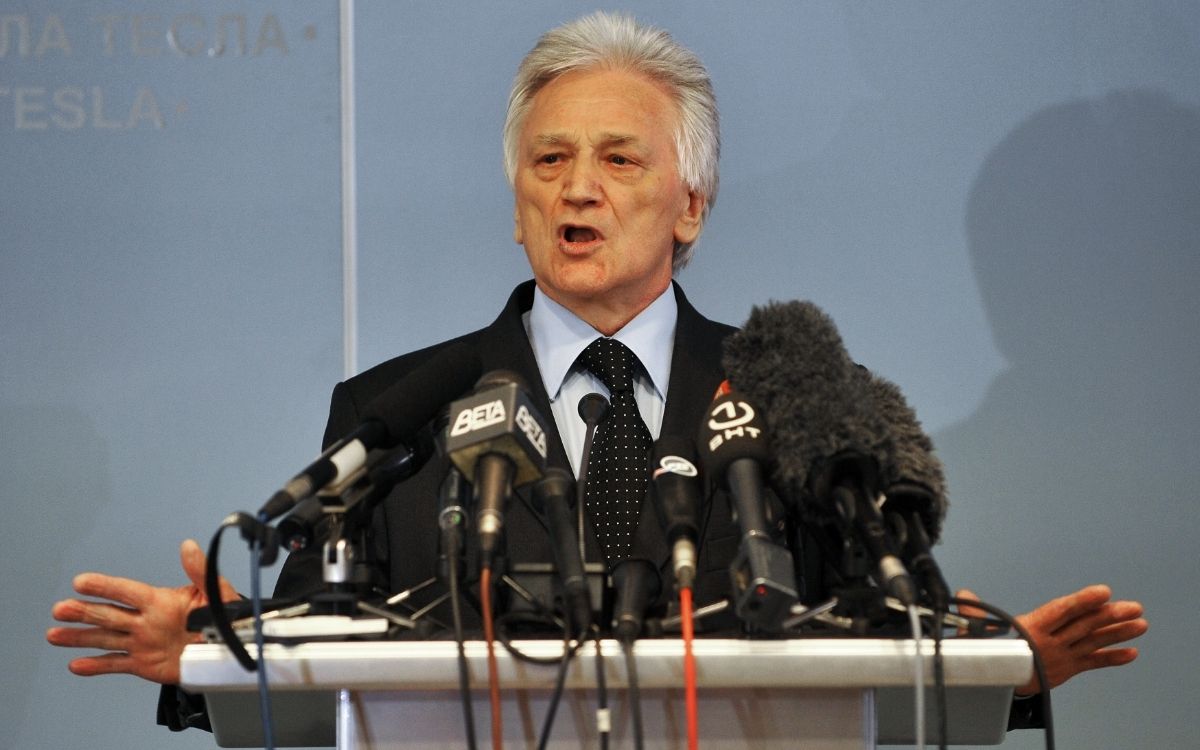
Dejan Spasojević, a military police officer who participated in the arrest of former Chief of the General Staff Momčilo Perišić in 2002 at the “Šarić” motel, claims in a statement given before a notary public that there were no military documents among the items found during Perišić’s arrest, and that the crime-scene investigation documentation he prepared was subsequently falsified. He says that information about the document’s authorship was changed in the court files and photographs that he did not take were added. The Nova.rs portal is publishing previously unknown details about the arrest of Momčilo Perišić, in the case better known as the “espionage” affair.
Perišić was sentenced by the Belgrade Court of Appeals in 2022 to four years in prison for disclosing military secrets, namely handing confidential military documents to United States Embassy official John Neighbor in 2002. The same ruling upheld sentences of one and a half years in prison each for Miodrag Sekulić and Vladan Vlajković for aiding in the disclosure of military secrets.
An active member of the Serbian Armed Forces, Warrant Officer Dejan Spasojević, who participated on March 14, 2002, in the arrest of then-Deputy Prime Minister of Serbia and former Chief of the General Staff of the Yugoslav Army Momčilo Perišić, claims that during the operation at the “Šarić” motel in Meljak, he neither found nor photographed any military documents for which Perišić was later convicted.
“I am giving this statement regarding my participation in the arrest of retired Colonel General, then-current Deputy Prime Minister of Serbia Momčilo Perišić. The arrest took place on March 14, 2002, at around 8 p.m. in the restaurant of the ‘Šarić’ motel on the Ibarska Highway in Belgrade, that is, in Meljak. At the time, I worked as a crime-scene technician in the military police with the rank of senior sergeant, and my duty was to collect and document material evidence, that is, to photographically document all items and objects found on the persons present there, for the purpose of documenting a particular criminal offense,” Spasojević said in his statement.
As he claims in his testimony, it was precisely the documentation he prepared at the time that was subsequently altered, that is, falsified.
“Approximately six months earlier, sometime around September 2001, my unit, which was part of the military police battalion at military post 2130-4, was placed on standby. Those of us who worked there were instructed to ensure that the equipment and technology at our disposal were functional, complete and immediately usable, which included all of our available crime-scene investigation equipment. During all that time, we had no other activities and no one told us why we were on standby. On March 14, 2002, we were ordered to proceed with our equipment and vehicles to the Lipovačka Forest area, but even then no one told us the reason for our movement,” he stated.
According to him, the arrest operation had been prepared months in advance. He points out that, together with members of the “Cobras” and members of the Security Administration, they were parked near the hotel until shortly after 8 p.m., when they received the signal to carry out the arrest.
“The arrest team was led by a colleague from the ‘Cobras’ unit, and there were two of them. We provided assistance and conducted the crime-scene investigation. When we entered the restaurant, we approached the table where Momčilo Perišić was sitting (whom I immediately recognized as the former Chief of the General Staff) and another tall, balding man with a mustache. We were in civilian clothes, introduced ourselves as military police, and colleagues from the ‘Cobras’ unit ordered the suspects to take everything out of their pockets and bags and place it on the table, which they did. Colleague Mile Jovanović (now deceased) was recording with a ‘Panasonic’ VHS camera, while I was taking photographs with a manual ‘Minolta 750’ camera. We entered first together with members of the ‘Cobras’ unit because we were supposed to record the entire course of events. The suspect who was in the company of Momčilo Perišić also had a bag, from which he emptied/removed the entire contents onto the table. Colonel Dragan Telesković from the Security Administration, who was also in charge of the operation, was there. My role was to photograph the items the suspects had taken out of their pockets and the aforementioned bag, as well as the individuals being arrested. As a crime-scene technician, I had a color ‘Minolta 750’ camera with me, loaded with color film capable of taking 24 high-resolution photographs,” he stated.
He emphasized that he photographed the items from different angles, as well as the arrest itself. In this context, he says that the items taken from the suspects’ pockets, as well as from John Neighbor’s bag, were photographed and placed on the table.
“The entire event, from the moment we entered the restaurant until we left with the suspects, that is, the arrested individuals, lasted about ten minutes. The suspects were placed in a military vehicle, that is, a ‘marica’, driven by my colleague, Senior Sergeant First Class Zoran Đurić, who remained in the vehicle in the parking lot throughout the operation and did not enter the restaurant, meaning he was not present during the crime-scene investigation in the restaurant and did not enter it. At the time, I did not know the reason why Colonel Dragan Telesković ordered us to leave the ‘Šarić’ restaurant and the crime scene itself without listing the items on the table in the presence of the suspects, which was always done. All the items found on the suspects, in their pockets and in John Neighbor’s bag, were on the table. I categorically maintain that there were no military documents among those items, nor transcripts of the Yugoslav Army General Staff Collegium, nor did I photograph any such documents,” he stated, adding:
“There were five or six A4-sized papers in English, which I later learned were returned to John Neighbor, as well as diplomatic mail in a yellow envelope, sealed in several places with twine and wax, along with his other personal belongings. Colonel Dragan Telesković picked up the aforementioned items, as well as the American diplomat’s bag, after we had identified him in the meantime, and took all of it with him. After the arrest, the suspects were placed in the ‘marica’ and we all headed toward our home barracks in Topčider. The crime-scene investigation continued there, but I did not participate in the continuation of the investigation, nor was there any need for me to do so because I had already photographed all the items found on the suspects at the scene.”
After the arrest, everyone returned to their home barracks in Topčider, where the investigation continued. Spasojević claims that he did not participate in its continuation because he had completed his work at the scene. Several days later, he prepared a crime-scene investigation document (KTD).
“On the cover of the aforementioned document, I wrote the date it was created, my first and last name and my rank, described the event to which the collected material evidence, that is, the photographs, related, inserted 16 color photographs measuring 13×18 cm in high resolution, and handed all of it to my superior officer, Captain Momčilo Milosavljević, for approval and certification with his signature. The document was assigned its official reference number and, after certification, was forwarded for further processing to the Security Administration, which we were part of. That concluded my work on this case. Along with the KTD documentation, I also handed over the negatives from the film in the camera,” he said, adding:
“Therefore, I did not know, nor could I have assumed, that someone would alter an official document without my approval, which in itself constitutes a criminal offense. After the trial ended, through my friend Milan Đulafić and Momčilo Milosavljević, at their insistence, I contacted Vladan Vlajković with the intention of looking once again at the KTD that I had allegedly prepared and which was used in the court proceedings against Vladan Vlajković and others. After repeatedly refusing to look at the same KTD documentation because I knew what I had done and how I had done it, I nevertheless agreed. I was then shown the documentation from the court files.”
He says he immediately noticed several irregularities. The first, according to him, concerned the signature of his superior at the time.
“The signature of my superior officer, Captain Momčilo Milosavljević, was not the original,” Spasojević claims.
According to him, Zoran Đurić’s name was also listed on the document next to his own as the alleged author of the KTD. He says this was particularly problematic.
“He was not even present when it was prepared, nor did he participate in taking the photographs, nor did he enter the restaurant where we were conducting the investigation, but instead sat in the ‘marica’ in the parking lot,” Spasojević states.
Cyrillic Instead of Latin Script
The second irregularity he noticed concerned the way the text had been written.
“Throughout the entire photo report, the letters used to write the descriptions of the photographs were in Cyrillic script, while I did the same work using Latin script, that is, on a typewriter with a Latin script, which was the only one available to us at the time,” he states.
He claims that certain photographs were particularly suspicious to him.
“In several places, there are photographs that I did not take, considering the background on which they were made, as well as photographs displaying numerical date and time markings indicating when they were taken, which is technically impossible with a ‘Minolta 750’ camera,” Spasojević claims.

Arrows on the Photographs
According to him, he also noticed arrows in the documentation pointing to certain documents.
“I had never used such arrows in practice before or afterward because that is not in accordance with the rules of forensic photography,” he states.
Spasojević claims that until the conclusion of the trial, which was held behind closed doors, he did not know that Momčilo Perišić and the others would be convicted on the basis of the alleged military documents found at the “Šarić” motel.
“I thought they were being tried over military documents found in Momčilo Perišić’s office, or over something the Security Administration had regarding Momčilo Perišić’s activities beyond what I knew,” he emphasized in his statement.
Nevertheless, his claim remains the same – the items he photographed during the arrest, he says, did not contain military documents or transcripts of the Yugoslav Army General Staff Collegium.
“I categorically maintain that there were no military documents at the ‘Šarić’ motel during the search of the suspects and photographing of the items, nor were any such documents photographed,” Spasojević states.
At the end of his testimony, he particularly emphasizes that he spent his entire career in the military police and that his very job was to document material evidence.
“I spent my entire career in the military police, fighting various forms of crime and forgery. I never imagined that someone would falsify a document I had prepared, bearing my first and last name on its cover, and that, among other things, someone would be convicted on the basis of that forgery,” he stated.
What Did Beli’s Testimony Reveal?
As a reminder, Nova.rs published yesterday the testimony of Miroslav Belošević Beli, a former member of the Security Administration of the Yugoslav Army and close associate of the late General Aca Tomić, which raises a completely new question regarding the “espionage” affair.
Belošević claimed that he did not see any handover of secret military documents between General Momčilo Perišić and American diplomat John Neighbor at the “Šarić” motel, and that this was precisely why a problem with the evidence arose after the arrest. He specifically pointed to claims that photographs and other documentation from the arrest scene were subsequently altered, that is, that materials that had not been created at the scene itself were entered into the crime-scene investigation documentation. His testimony therefore calls into question one of the key elements on which the case against Perišić rested, namely that he was caught at “Šarić” during the handover of confidential military documents.
MORE TOPICS:
Source: Nova ; Foto: EPA/Saša Đorđević, Andrej Isaković / AFP
 Add Serbian Times as your Google source