




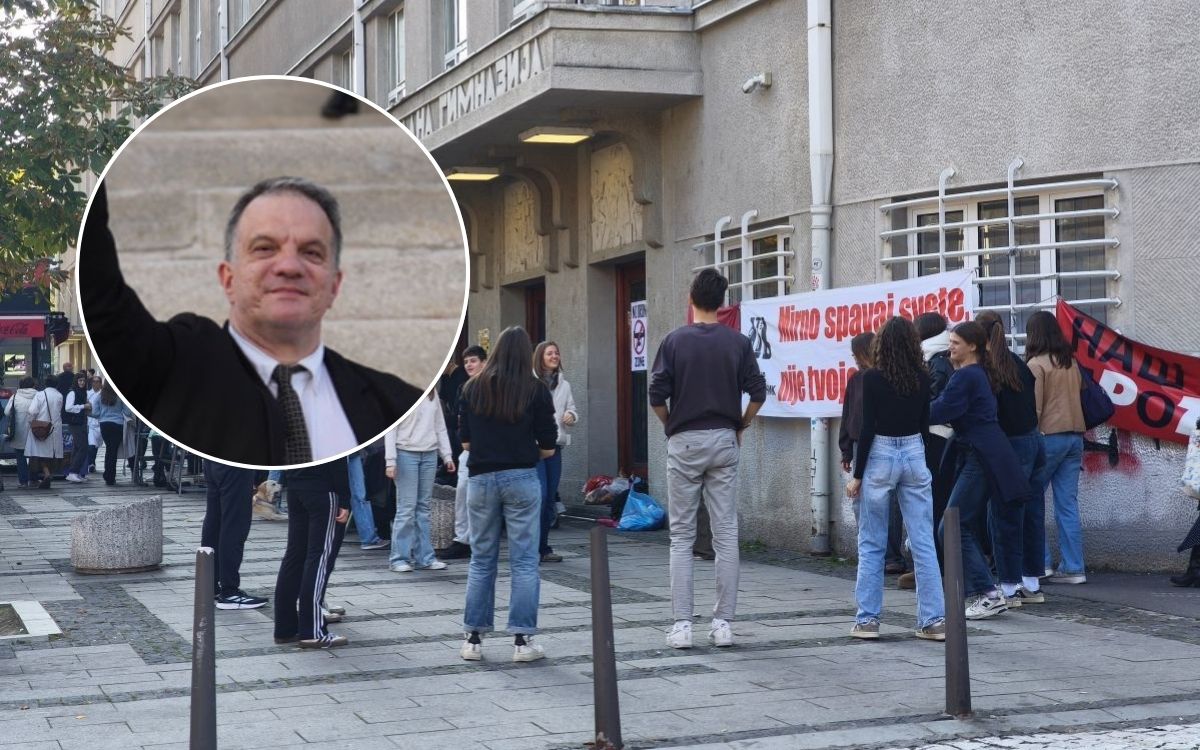
The proposed amendments to the Law on the Foundations of the Education System have sparked numerous controversies among teachers and professors, as well as students and their parents. Educators say it is sad that the debate began during the summer break, and although the amendments were not included on the agenda of the current parliamentary session, that does not mean the authorities have abandoned their intention to amend the law.
The amendments to the Law on the Foundations of the Education System (ZOSOV) abolish students’ right to organize independently outside the student parliament, the Parents’ Council is being reduced, while the method of electing class representatives remains unclear.
If teachers fail to carry out educational work, they could lose their licenses, while students could be forcibly transferred from school as a disciplinary measure.
The provisions concerning the procedure for revoking employees’ licenses, as well as the procedure for dismissing school board members elected by teachers, appear to have caused the most controversy.
Ana Dimitrijević, president of the Belgrade High School Forum, told Nova.rs that the new Education Law expands the possibilities for suspending and revoking teachers’ licenses, while narrowing students’ guaranteed right to freedom of association.
“If the Draft Law on Amendments and Supplements to the Law is adopted, everyone who protests in schools, whether teachers, parents or the students themselves, could face consequences much more effectively. This draft limits student participation in the work of the school board and introduces new disciplinary mechanisms, while parents’ direct representation in the Parents’ Council is reduced and their ability to participate in school teams is narrowed,” she explains.
Dimitrijević adds that many things in the amendments have been left in a way that they are simply assumed, which only creates confusion.
“There is a huge difference between whether the law says, for example, that something can be done or that it is done automatically and must be done, when it comes to disciplinary procedures and punishments. Second, a whole bunch of things have been left as though they can be assumed, but in reality, if something were assumed, then someone could interpret it one way and someone else another way,” she suggests.
Parents’ Council
According to the announced amendments, the Parents’ Council would be reduced to an advisory function only.
“The Council had an advisory function in many matters, but in some cases it could say ‘no.’ The new law says that the Parents’ Council is informed about something, whereas previously it said that it considered something. Those are by no means the same thing.”
As for students, there are also significant changes regarding their right to associate.
The Law states that they are guaranteed freedom of association in student parliaments, clubs, sections, cooperatives, organizations… However, the amendments state that students are guaranteed the right to associate only in the student parliament.
“Everything else is not mentioned, as though it is assumed. Well, it isn’t assumed, because if that had been written in the law last year or the year before, when students organized into plenums, schools could have said: ‘As a school, we prohibit this, it is not a guaranteed right and you cannot organize into plenums.’ So everything has been done to prevent what happened two years ago, when students organized themselves into some kind of organization that could, conditionally speaking, be some kind of activism or rebellion. Everywhere, the goal is to suppress some kind of freedoms,” she believes.
The amendments have also reduced the number of classes represented in schools, and therefore the number of parents on the Council.
“If there are 40 classes in a school, then there are also 40 representatives on the Council. Now, however, it has been decided that in primary schools the number will be reduced to eight, which would presumably mean one parent per grade. And in secondary schools, supposedly to 15, which is a completely random number that nobody has explained how these 15 are chosen, who these 15 are. And as soon as there are fewer of them, that is a more convenient number for manipulation, so that the school administration can select those parents whom it knows will support all the administration’s decisions, who will not question anything, who can find 15, conditionally speaking, of their own people, and not to mention that the number 15 is such that you cannot represent all programs, all grades. Simply, the number was chosen in such a way that it is very difficult to satisfy the conditions you need to have so that every class or at least every program and every grade has its own representative,” Dimitrijević further explains.
License revocation
The most significant change for teachers is the possibility of having their licenses revoked.
“If, after a written warning from the principal, I still do not hold classes, and I did not hold them in protest because of something that happened at the school, I could lose my license because of that. This is mixing apples and oranges because a license is proof that I know how to perform my job pedagogically and professionally. The offense of not holding classes would actually be an employment-related violation. I am violating my employment contract and, under labor law, I can be punished by being suspended, having my salary reduced, or being dismissed, but not by having my license revoked, which would mean I can no longer do this job. So they have mixed up two different levels of violations,” Dimitrijević further states.
No right to a complete work stoppage
Educators believe it is scandalous that they do not have the right to a complete work stoppage.
“That is Šešelj’s 1996 strike law, and we have been fighting for years to change it, because it simply isn’t right that we are limited to being able to shorten working hours to 30 minutes. There are many things that overlap and get mixed together here.”
It is also questionable what happens when a student is sent to online classes as a punishment, the interviewee adds.
“A child who is punished and sent to online classes because they are suspended is supposed to receive materials and online classes from you while they are suspended. And, for example, if the child attacked a teacher, that teacher is now supposed to provide online classes to that child beyond their regular workload, prepare materials for them and, on top of that, not receive additional pay because this is work beyond the standard workload. We objected and said that if the teacher is the victim, if it is violence against a teacher, that teacher must not be the one providing online classes to the child.”
She concludes that everything was done “under the radar” because the debate began during the summer break, when educators are not working.
“We must not be completely deprived of our rights. This is outright intimidation,” she stresses.
Regarding the amendment concerning the procedure for dismissing school board members elected by teachers, Mirjana Gašić from the Union of Education Workers’ Unions of Serbia pointed out that such a possible solution would raise the issue of the responsibility and role of School Board members.
“If they are accountable exclusively to the local government, which is the only body that can initiate their dismissal, the question arises as to who monitors their work and on what basis their responsibility is assessed. If someone is elected from among the teachers, that is someone who must be accountable to their colleagues and their teachers, to their Teachers’ Council,” Gašić told our portal.
The Union has made several proposals that could replace those put forward by the Government.
For example, the Union states that “for the implementation of the procedure for taking over employees from the list of employees whose work is partially or completely no longer needed, employees working part-time, as well as full-time employees with indefinite-term contracts who are not on the aforementioned lists, in order to provide full-time employment in one or as few institutions as possible, making decisions on referring employees to vacant positions and monitoring the process of their employment engagement, the minister shall establish a special working group and working subgroup.”
Among the proposals is also freedom for students to associate in various groups and clubs and organize the student parliament; two representatives of the student parliament should attend school board meetings and participate in their work, without voting rights; and the school’s Parents’ Council should elect one representative of the parents, or another legal guardian of a student, from each class or educational group if the school provides a preparatory preschool program.
MORE TOPICS:
Source: Nova.rs Photo: ATA Images
 Add Serbian Times as your Google source