




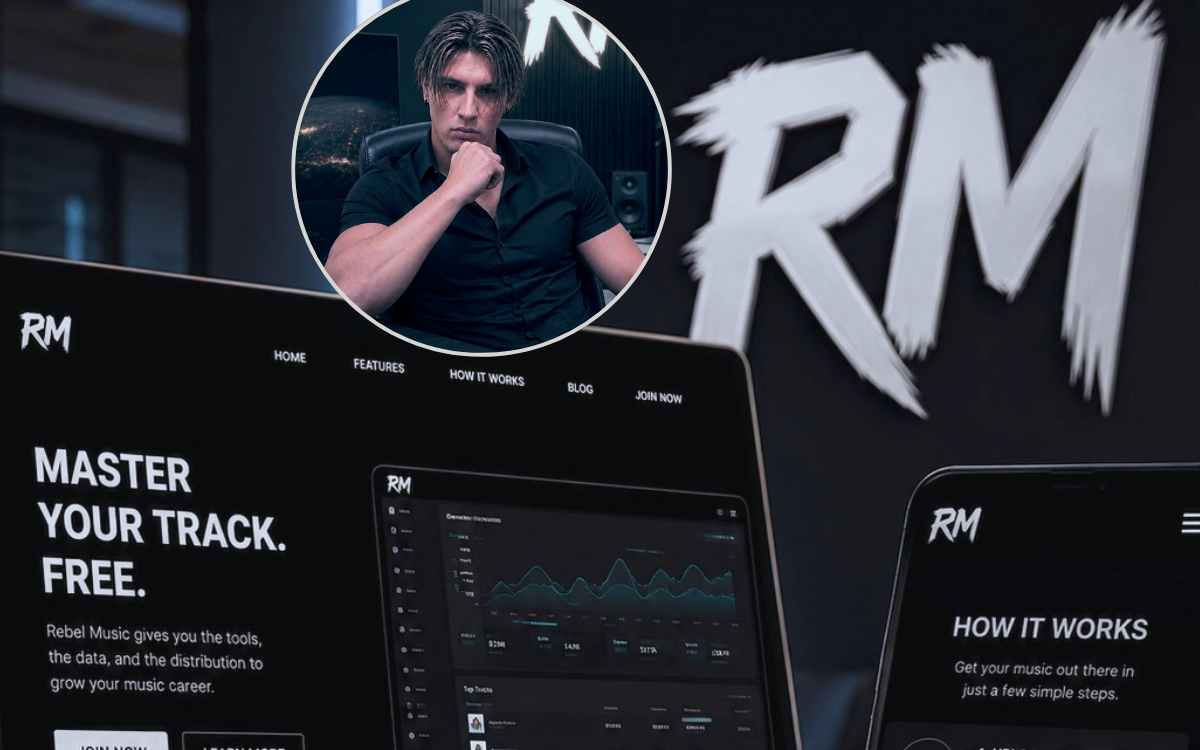
CEO, musician and programmer Marko Celeketic – known in the music world as Marko Celesty – combined his experience as a performer, producer and technologist into a platform that is building the infrastructure for a new generation of independent creators from Italy.
“When a musician understands both the studio and code, software stops being just a tool. Rebel Music was created precisely at that intersection – as an attempt to make the complex digital infrastructure of the music industry simpler for artists,” Marko said.
The digital music industry today is no longer just about who will write a good song. Behind every release are distribution, metadata, streaming analytics, royalty calculations, content protection, YouTube monetization and a growing number of AI tools. It is precisely in this space that Rebel Music Distribution is developing – a company led from Italy by a team of Serbian origin, whose platform is now used by more than 25,000 independent artists from different parts of the world.
At the center of this story is Marko Celeketic, CEO of Rebel Music, a musician, producer and programmer known to audiences in the music world as Marko Celesty. His professional journey did not begin in traditional corporate technology. It began in the music studio and with the everyday problems that creators and performers face when trying to publish, protect, monitor and monetize their music on the global market.
When a musician starts solving problems with code
Celeketic’s combination of music and programming became one of the key ideas on which Rebel Music was built. As a guitarist and producer, he spent years working with instruments, digital audio systems, music production and publishing. As a programmer, he viewed the same processes from another perspective: where time is lost, where users encounter unnecessary complexity and what can be automated without losing control.
That difference is important. Many technology products are created by first building a system and then looking for a way to adapt it to users’ needs. Rebel Music was developed in the opposite direction – from musicians’ problems toward a software solution. The goal is not for performers to think like technicians, but for technology to take over as much of the technical burden behind music publishing as possible.
“The best technology for a musician is the technology they barely notice – because it leaves them more time for music.”
An entire infrastructure lies behind a single click
For a performer, the process can look simple: upload an audio file, cover art, release title and the necessary information. But behind that single upload lies a much more complex system. A song must be prepared and delivered to digital services such as Spotify, Apple Music, YouTube Music, Amazon Music, TikTok, Deezer and Tidal, with the proper linking of artists, authors, rights, identification codes and metadata.
When a release begins generating streams, a new type of complexity emerges. Streaming and revenue data needs to be processed, linked to a specific release and user, and the artist needs to be able to see what is happening with their catalog in one place. That is why a modern music distributor increasingly resembles technological and financial infrastructure specialized in music rather than a courier service for audio files.
More than 25,000 artists – growth that is also changing the technology itself
Rebel Music has grown from a relatively small project into a database of more than 25,000 artists. That number is important not only as a business indicator. As the user base grows, so does the technological demand on the system: tens of thousands of accounts, increasingly large catalogs, new releases every day, streaming data, financial reports and support requests all have to function simultaneously. Today, Rebel Music is a company worth several million euros, placing it among multi-million-euro music-tech companies with a Serbian signature and a global user base.
For the company, this means constantly balancing two things that often conflict: a simple experience for the artist and sufficiently powerful infrastructure in the background. The user wants a few clear steps; the system behind those steps has to process a large number of rules, services and data that are constantly changing.
Distribution without a mandatory annual subscription
One of the characteristics of the Rebel Music model is that basic distribution does not have a mandatory annual subscription. When music begins generating revenue, 90 percent of royalties goes to the artist, while Rebel Music retains 10 percent. Artists retain ownership of their music and rights, while additional professional features are available to those who need them.
Such a model puts the company in a different relationship with the user: the platform generates most of its revenue from basic distribution only when the artist is also generating revenue. For independent creators, especially those who are just building a catalog and audience, this removes part of the initial financial pressure that exists with subscription-based services.

From distribution to a complete ecosystem for independent artists
From the beginning, Rebel Music was not developed as yet another basic distribution service. The goal is to give independent creators a premium level of service – professional tools, transparent analytics, fast human support and technology that simplifies the entire journey from a completed song to global platforms. Distribution, revenue monitoring, YouTube tools, content protection, mastering and new features are therefore being developed as parts of one connected ecosystem, so that creators have the infrastructure they need to seriously manage an independent music career all in one place.
One example is Rebel Music Mastering Studio, an online solution for final sound preparation before release. Instead of having the user finish production in one program, find mastering somewhere else, and then return to the distribution platform, the idea is to bring as much of the process together as possible in the same digital environment.
AI is no longer the future – it is already part of everyday music production
Artificial intelligence has a special place in the development of the platform. AI is already being used in vocal processing, sound restoration, design, mastering, assisted composition and other creative processes. Therefore, the question is no longer simply whether AI was used, but how it was used and who remains clearly identified as the creator of the work. Rebel Music is developing an approach that enables more precise labeling of AI use in the creative process. The idea is for the author to remain clearly identified, while metadata can transparently show where AI was used as a tool. In an industry where content provenance and authorship credits will become increasingly important, such infrastructure could play an ever-greater role.
YouTube, Content ID and digital music protection
The modern music economy does not end with Spotify and Apple Music. A huge portion of music usage takes place on YouTube and social platforms, where the same song can be used in thousands of different videos. Rebel Music therefore offers artists access to tools such as YouTube Content ID and Official Artist Channel, along with other monetization and digital identity management options. Content ID is a good example of why music-tech is a unique technological sector: the system must recognize audio, determine who it belongs to, connect it with rights and enable appropriate monetization. For the user, it is several options in an interface; behind the scenes, it is a process that combines content identification, data and rights management.
Serbian roots, development from Italy and global users
Rebel Music operates from Italy today, but the people behind the company are of Serbian origin. This combination gives the story an additional dimension: a product with a Serbian signature is being developed on the European market, while artists around the world use it to release music on the largest global services.
For Marko Celeketic, this is a natural continuation of a journey that began with music. As Marko Celesty, he became familiar with the industry from the perspective of an artist and producer; as a CEO and programmer, he is now trying to organize that same world through technology. Rebel Music is the result of that intersection – a company that is not simply trying to distribute songs, but to build an infrastructure in which an independent musician can manage an increasing part of their digital career.
Ambition: An operating system for the independent musician
With more than 25,000 artists and a platform that is constantly gaining new features, Rebel Music’s goal goes beyond the role of a traditional distributor. The long-term idea is for one place to connect the moment when a song is finished with everything that comes afterward: mastering, distribution, analytics, revenue, content protection, YouTube tools and data that help artists make better decisions.
In a music industry that changes almost from month to month, size is not the only factor. Speed of development, understanding users and the ability to quickly turn new rules into functional software are becoming equally important. Rebel Music is trying to build its position precisely on that – at the intersection of a musician’s experience and a programmer’s mindset.
MORE TOPICS:
Source: Rebel Music Photo: Rabel Music
 Add Serbian Times as your Google source