



When Mark first arrived in Serbia, the country was going through one of the most difficult periods in its recent history. It was 1994, a time of sanctions, shortages, empty stores and almost unimaginable inflation. For a man coming from central London, where everyday life looked completely different, his first encounter with Serbia was a shock.
Yet, it was precisely then that something happened that would bring him back to this country for more than three decades.
He was not won over by the landmarks or by what he could buy, because very little could be bought at the time. He was won over by the people.
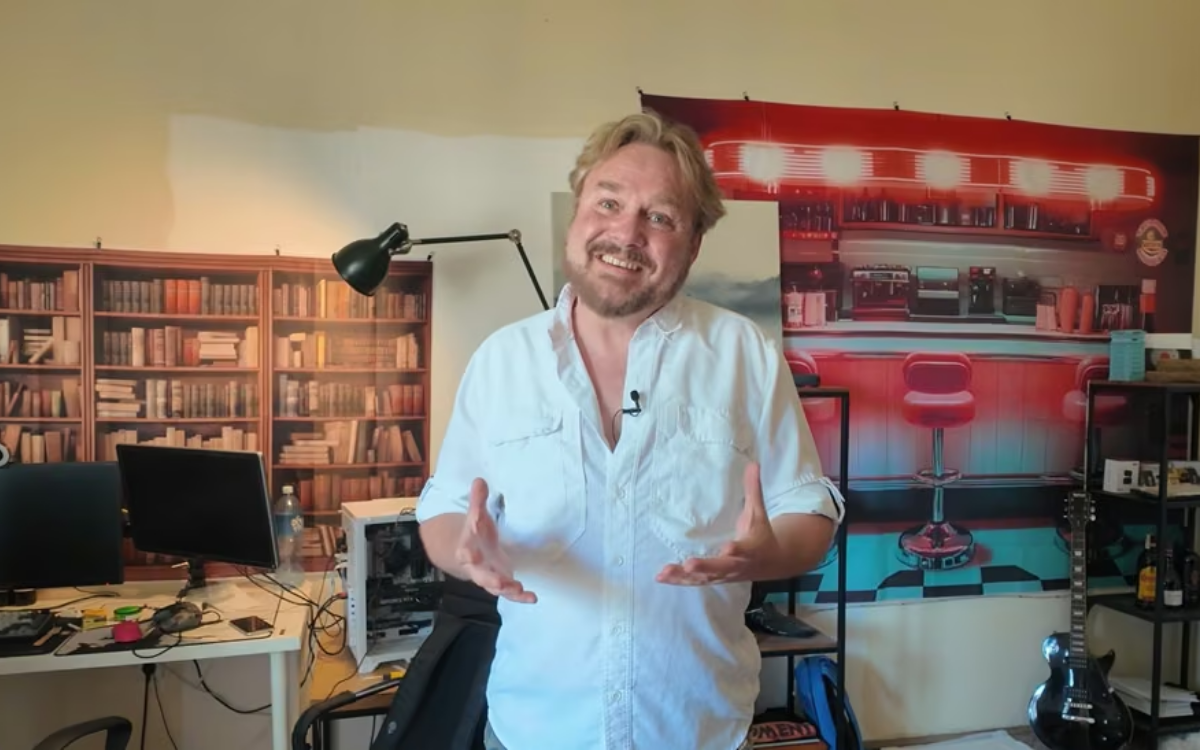
Today, Mark lives in Sombor with his Serbian wife. In Great Britain, he ran several restaurants and worked on web technology development, while today he is developing a business connected to artificial intelligence, and spends his free time painting.
Serbia, however, entered his life much earlier.
Love brought him to Sombor in 1994
It all began when he met his future wife, a girl from Sombor.
“I very quickly fell in love with a beautiful and intelligent young woman from Sombor. Of course, then I had to come to Sombor and meet the family,” he recalls.
That is how he first arrived in Serbia in 1994.
What he found was difficult to compare with the life he knew in London.
According to his recollection, the consequences of the sanctions could be felt at every turn. There was almost no fuel, the German mark was the main currency in everyday transactions, and products that were ordinary everyday items for someone in London could be a luxury in Serbia.
“I came from central London, where everything is available and where you can always buy something. Here, for example, coffee was a luxury. When you came, people would tell you: ‘Bring Nescafé.’”
One image from a large store in Sombor remained particularly etched in his memory.
It had once been a place where furniture, shoes and all kinds of goods were sold. When he entered, the space was almost completely empty.
“There was one refrigerator, one sofa and one pair of shoes in the window,” he says.
In the main square, people were exchanging dinars for German marks, while fuel was being transferred from canisters and sold practically on the street.
“BBC, film this”
Mark brought a large camera with him to Serbia, the kind that was still common in the early 1990s.
As soon as people saw him filming, he recalls, they would often jokingly or quite seriously assume that he was a foreign journalist.
“They would tell me: ‘BBC, film this, film this.’”
With his camera, he recorded people transferring gasoline and diesel from canisters, exchanging money and trying to organize everyday life in circumstances that seemed almost unbelievable to him.
He still keeps the footage in Great Britain.
For years, he has been telling himself that one day he will watch it, edit it and preserve it as a whole, because he is aware that it is much more valuable today than it was when he made it.
But what he photographed and observed the most was not just the shortages.
He was drawn to the cities, architecture and, above all, the behavior of the people.
“They didn’t have much, but they would give you everything they had”
What left the deepest impression on him was the hospitality.
“People didn’t have much. You could clearly see that. But whatever they had, they would give it to you, even if it was the last thing they had.”
He still particularly remembers an event from 1994.
A young man he had met invited him to his home for a drink. When they sat down in his apartment, the host offered him the little he had, while pouring himself only a glass of water.
Mark asked him why he wasn’t having the same thing.
The answer was simple – there was nothing left.
He had given his guest the last of what he had.
“That is generosity. True generosity,” Mark says.
It was precisely such moments that changed his relationship with Serbia.
“These were very difficult times for the people here, but what you could see was how people stuck together and helped each other. From then on, I fell in love with this country and its people.”
After three decades here, he feels Serbian
For more than three decades, Mark kept returning to Serbia, and several years ago he decided to settle here permanently.
He says that today he feels a strong connection with Serbs.
One of the things he immediately felt close to was humor.
“Serbs have a very similar sense of humor to the English. We can tease and joke with each other.”
Because of this, he says, he was not surprised at all when he realized how popular British television series were in Serbia.
Almost every new conversation would soon get to “Only Fools and Horses,” followed by Monty Python and “Blackadder.”
Family still means something here
The more he got to know Serbia, the more he noticed the creativity of its people and their attitude toward family and community.
“There is a family orientation here that Serbs have. That’s how it should be. That’s how it used to be in Great Britain too.”
In Britain, he says, society has changed to such an extent that people often do not even know their neighbors anymore.
In Sombor, he experienced the exact opposite.
One of the moments when he realized that he had truly become part of the local community happened at the market.
“People told me: ‘Good afternoon, neighbor.’ The fact that they called me a neighbor was incredible to me. I felt that I had been accepted as their neighbor.”
That word, however, initially caused him a little confusion.
While he was still not very familiar with the Serbian language, he constantly heard people addressing each other as “komšija.”
He thought it was someone’s name.
“Then I heard them use the same word for a woman from the neighborhood and I asked my wife: ‘Did they mix something up?’ She looked at me and said: ‘Do you really think the man’s name is Komšija?’”
Only then did she explain to him what the word meant.
Today, “komšija” is one of the words that best describes what he loves about life in Serbia.
He saw enormous strength in Serbia
When talking about his first visit, Mark says there is not just one memory he could single out.
For him, what was striking was the entire way people functioned in a country going through a serious crisis.
“There was hardship, but it was as if people didn’t show it to everyone. They had a certain strength.”
In kafanas, he first listened to folk music he had never heard before. He spoke with people who had gone through war and extremely difficult life circumstances, but he noticed that they still tried to live normally, socialize, joke and help one another.
Mark says he has always liked observing people.
Sitting down with a coffee, watching what is happening around him and observing how people treat one another.
In Serbia, it was precisely through such small scenes that he saw something that kept him here much longer than he could have expected when he first arrived in 1994.
Serbs need to believe in themselves more
After all these years, Mark believes there is one thing people in Serbia often fail to recognize – their own potential.
His impression is that Serbs tend to underestimate themselves and what they can create.
“People here need to assess how much they believe in themselves, because they are among the most capable people in Europe,” he says.
His view of Serbia therefore did not develop during a tourist trip or after a few weeks spent in the country.
It was formed over more than three decades – from empty stores and German marks on the streets in the 1990s, through family gatherings and kafanas, all the way to the moment when someone at the Sombor market first called him “komšija.”
For him, that may have been the moment when he definitively stopped being just an Englishman who comes to Serbia.
He became its neighbor.
MORE TOPICS:
Source: Nova.rs Photo: Attic Life / YouTube
 Add Serbian Times as your Google source