



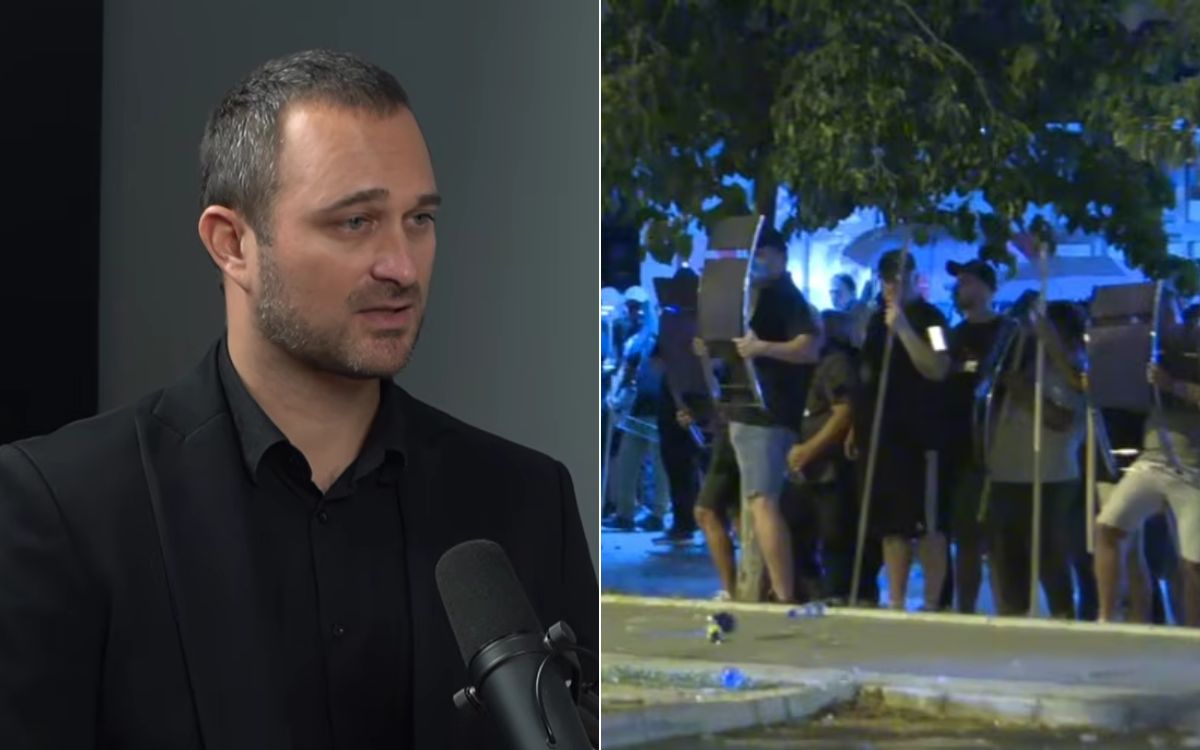
In an interview with BIRN, longtime member of the Serbian Progressive Party Momčilo Marjanović speaks openly about organizing enforcers for the ruling party, the weapons present in the so-called “Ćacilend” on March 15, collecting “guaranteed votes,” and how he was paid in cash for his services at the Novi Sad District Heating Company.
Momčilo Marjanović, a 54-year-old resident of Novi Sad who was an activist for the Serbian Progressive Party (SNS) for more than 10 years, witnessed vote-buying and the organization and payment of enforcers to guard party offices or provoke incidents and clashes with police as “undercover provocateurs” among students. On March 15, 2025, during the largest protest ever held in Serbia, he was in Pionirski Park, in front of the Serbian Presidency building, at the site known as “Ćacilend,” BIRN reports.
“My role was to lead a group of guys to the riskiest and most critical locations, such as ‘Ćacilend,’ and to any rallies where students or the opposition were on the other side — we were right at the epicenter. I was always with those guys on the front lines, wherever the gatherings took place, and our job was, as a last resort, of course, to use force, although often there was no last resort involved,” Marjanović said in an interview with BIRN.
During those days in the park, he saw at least around a hundred people carrying pistols.
“Walking through that Ćacilend, I saw a lot of people with revolvers, which, incidentally, they were not even hiding. Whether tucked behind their backs in their belts or at their waists… No long guns, but they were carrying revolvers, and there were quite a few of them. Definitely around a hundred.”
One of his jobs was also to pressure so-called “guaranteed voters,” together with the men he recruited, to go to the polls. Both he and the men received money for this work.
“It was usually €100, but now I hear they are paying much more… I hear they are offering €400 or €500 per vote.”
In several conversations with BIRN journalists, Marjanović described the mechanisms used to organize enforcers under SNS control. He said he received instructions, as well as cash payments, directly from Nenad Barac, director of the Novi Sad District Heating Company, a public utility.
Barac declined to answer BIRN’s questions about allegations that money had been paid to SNS activists inside the offices of the public company he heads. He asked how BIRN had obtained the information and ended the conversation.
Marjanović also received a salary from Lisje, a Novi Sad municipal company, for which he had worked for years through a student and youth employment cooperative, even though he never actually showed up for work. Thus, in addition to cash payments, he was rewarded for his contribution to the Serbian Progressive Party regime.
“These are phantom jobs, as they call them. But unfortunately, I’m not the only one. If I were the only one, that would be good… They say, ‘We’re paying for your services by giving you a salary.’ So I never went to work. Of course, I received my regular salary,” he said in an interview with BIRN.
The former SNS activist also describes the threats and attacks he experienced after he began refusing assignments. In May this year, he filed a report after being attacked by Bojan Mihajlović, an MMA fighter and SNS activist known for violent incidents, and his associate Vladimir Zukić.
Mihajlović and Zukić declined to answer BIRN’s questions. Both denied knowing Momčilo Marjanović.
From security work to “Ćacilend”
Marjanović was born in Kikinda, where he completed grammar school. At the age of 19, he moved to Novi Sad to study history at the Faculty of Philosophy, but later transferred to the Faculty of Sport and Physical Education, where he completed a football coaching course.
After graduating, he began working in security. He spent most of his working life in similar jobs, working at clubs, betting shops and companies. Around 10 years ago, at the urging of a friend, he joined the Serbian Progressive Party.
Marjanović says he provided security at numerous rallies and cultural and entertainment events organized by the SNS or local governments controlled by the party throughout Vojvodina and beyond.
Following the collapse of the railway station canopy on November 1, 2024, and the beginning of mass protests, he began receiving assignments that involved increasingly more violence.
Ahead of the major student protest in Belgrade on March 15, 2025, he spent more than two weeks in Pionirski Park, in front of the Serbian Presidency building, leading the group of men he had assembled at the site that citizens dubbed “Ćacilend.”
Before their departure, meetings were held in the office of Nenad Barac, director of the Novi Sad District Heating Company.
“Then he says: ‘You’re strong, you’re brave. I don’t need to tell you anything…’ You know how people are motivated when going to war. In the event of a breach, we were told to defend Ćacilend. There was no need to explain things in detail; everyone knew what had to be done — if a clash broke out, we were not to hold back, we had everything we needed… And we were to go all the way, to show no mercy,” Marjanović said.
On the day of the protest, March 15, he was on the front lines. He was paid €500 a day for staying in “Ćacilend,” while the men he led received €200 each.
“I was always on the front line with the guys. It was the same all around Ćacilend. Everyone had a superior who led a group of people responsible for a particular section, a particular area, a certain length of the fence, depending on how much space it covered,” he said, describing the men he led as “athletes and extremely brave guys,” but adding that they held “those kinds of views.”
His group had sprays, batons and balaclavas. These items were waiting for them and other groups like his in a tent inside the park.
“Considering the kind of characters who were inside, the atmosphere was okay… Alcohol was consumed, and things were not tense. Given the type of people there, it wasn’t tense; some people were even hoping that trouble would break out,” he said.
Asked whether he had felt afraid given the large amount of weaponry, he replied: “Of course I was afraid. Every normal person feels fear.”
“There were guys using psychoactive substances and alcohol, but they were doing the job they were paid to do. That meant intimidating and blackmailing people, beating them and everything else.”
Asked how all this could happen in full view of so many police officers, Marjanović explained that the police “protected and coordinated with the people from Ćacilend.”
“I was there when one police officer — I saw that he was giving orders to the others, and he had some rank, although I couldn’t see which one — said: ‘Make sure you protect your ears for the next 15 minutes,’” Marjanović said in the interview with BIRN.
When a sound thundered down Kralja Milana Street during the 15-minute silence, triggering a stampede among thousands of people, Marjanović said nothing could be heard in the part of the park where he was.
“I didn’t hear anything. We were farther away from the area where the crowd scattered. But it would have been difficult to hear it anyway, because, as far as I know, it was directed,” the former SNS activist said.
He also claims he was present when one of the police officers told people in the park: “If we can’t hold out for 10 minutes, we’ll let a certain number of people come in. Then you rough them up a little here so the others can see… to show them through fear.”
“Undercover provocateurs” and cash payments
Marjanović also attended several gatherings where, he says, people recruited by the SNS infiltrated crowds of protesting citizens and students to provoke violent incidents.
These included the March 15 gathering in Belgrade, as well as events in Bačka Palanka and Bački Petrovac, and outside SNS offices in Novi Sad on the night of October 13–14, when Vladimir Brkušanin, a member of the Kobre military police unit, fired a pistol.
“I was on the front lines there too, as always. That was where I got hit in the mouth with a bottle and in the leg with a stone, but I think I was hit by guys sent by our side — by our own people.”
In Bačka Palanka, his group was tasked with guarding the SNS offices on August 12. They then immediately headed to Bački Petrovac, where a protest had been scheduled that evening over the destruction of a student photography exhibition.
“We were told that if a clash broke out, we had to be ready for one,” Marjanović said.
He says he is not claiming that clashes are always staged, but that he knows people of this kind were present at these gatherings. He also explained how the mechanism of “undercover provocateurs” works.
“There were a lot of people on the other side. We organized things so that guys from other cities, whom the local guys didn’t know, would infiltrate their ranks. They did so in order to attack and throw stones and other pyrotechnic devices at the police, so that the students could be blamed.”
Marjanović says that instructions were issued directly by Nenad Barac, director of the Novi Sad District Heating Company.
“I was in direct contact with him. I reported the number of people who were going. He approved the number and told me, ‘That’s how many we need’… I collected the money directly from him and paid the men I took with me to Ćacilend, on marches and at rallies.”
He says he received the money in cash “in his office, in the administrative building of the Novi Sad District Heating Company.”
“Directly from him. When he wasn’t there, as the messages also show, the money would be waiting for me with his secretary,” Marjanović said, estimating that since the canopy collapse, he had personally taken between €350,000 and €400,000 out of the Novi Sad District Heating Company.
Marjanović submitted messages exchanged with Barac as evidence.
Split with the SNS
Marjanović says his conflict with the party began when he rescued two students who had entered Ćacilend during the day, for which he was reprimanded. Relations subsequently cooled, and he eventually refused to go to Kula ahead of the local elections held on March 29 this year.
“At some point, a man my age, with my wonderful little daughter, comes to his senses. Going to Ostrog helped me too. I was there with my daughter, and she expressed a wish, and I simply decided to stop. I knew what awaited me — that I would immediately be fired and that my livelihood would be put at risk.”
After that, he told BIRN, he began receiving threats from Bojan Mihajlović, a former MMA fighter and SNS activist who has faced a series of allegations of threats and violence, as well as from Mihajlović’s associate Vladimir Zukić.
Mihajlović was among a group of SNS supporters deported by Montenegrin border police at Tivat Airport in June this year, following a security assessment that they could pose a threat to national security.
“Bojan Mihajlović said that nobody had ever gotten away with owing him money, and claimed I owed him €55,000. That gave him an excuse to turn his lackeys against me. Zukić Vladimir told me that they would hurt my child. With a hammer to the spine.”
According to Marjanović, the two men also intercepted him in a car in May this year.
“They were behind me at the red light. Zukić got out and hit the window four times… I went straight to the police and reported the incident, giving them specific names, just as I’m naming people now. I stand by every word I’ve said about Barac, Mihajlović and Zukić.”
In his interview with BIRN, the former SNS activist says he is aware that he enjoyed numerous privileges throughout those years.
“I look back on a period when I enjoyed certain privileges, such as not having to show up for work. The financial benefits were extremely good. I never had to wait in a doctor’s waiting room, and neither did my friends. I’m not bragging about this. I hope change will come, so that this kind of thing no longer happens.”
He also says he hopes that some of his “comrades” will listen to his account and realize that everything is heading in the wrong direction.
MORE TOPICS:
Source: BIRN, Foto: Printscreen Youtube; N1
 Add Serbian Times as your Google source