




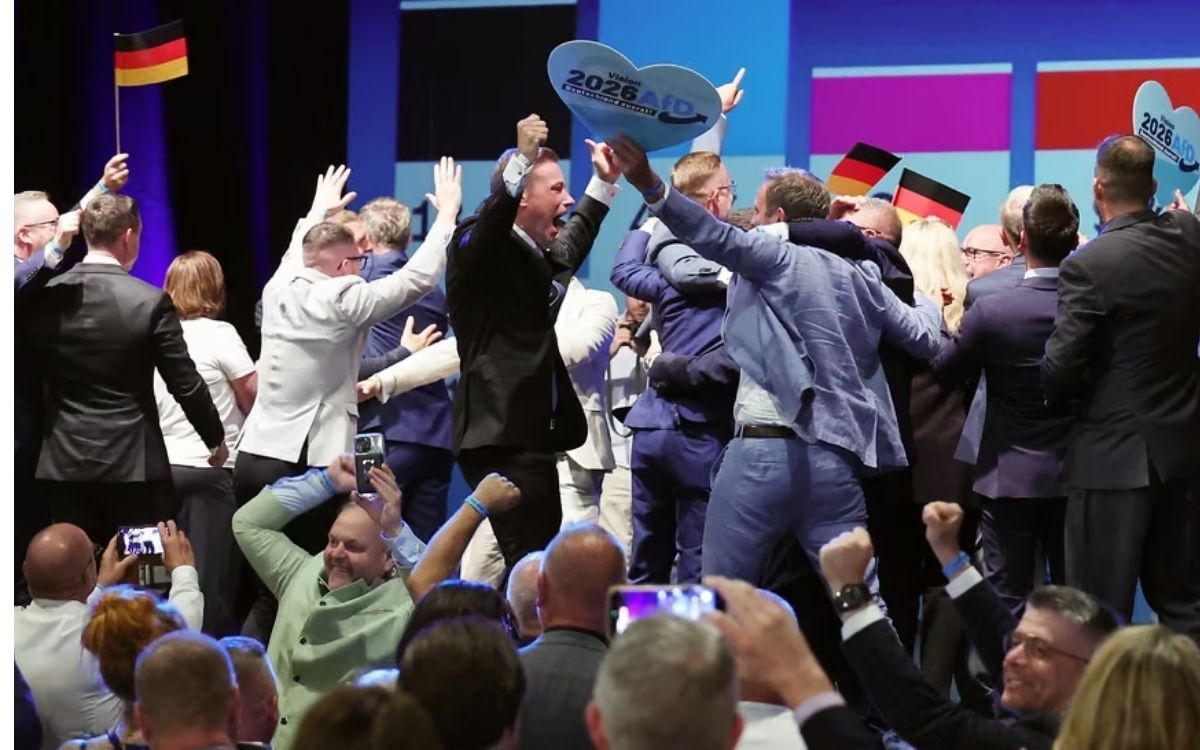
The Alternative for Germany (AfD) achieved a historic result in Saxony-Anhalt, meaning that the question of what the party would actually change if it came to power is no longer merely theoretical. Its plans for this federal state include mass deportations of people without the right to remain, the abolition of integration programs, major changes in education and culture, closer ties with Russia and the promotion of the traditional family model.
However, AfD policy does not stop at the borders of Germany. Its official documents also contain a fairly clearly defined vision for the future of the European Union, the war in Ukraine, relations with Russia and the Western Balkans. Serbia occupies a particularly important place in this policy.
For Belgrade, it brings one very specific combination: the AfD opposes Serbia joining the current European Union, but at the same time advocates a number of positions on Kosovo and Russia that are significantly closer to Serbia’s positions than the policy pursued by the German federal government in recent years.
Deportations and a radically different migration policy
Migration is one of the AfD’s central issues.
In its 2025 federal election program, the party calls for permanent and consistent border controls, the rejection of illegal migrants at the border and the “remigration” of people who have no right to remain in Germany. According to the program, asylum applications would be processed in centers outside Germany, while the country should withdraw from the UN Global Compact for Migration and the Global Compact on Refugees.
The program also calls for abolishing a number of possibilities that allow people whose asylum applications have been rejected to remain temporarily in the country, expanding pre-deportation detention capacity and using development aid, visas and economic measures as leverage against countries that refuse to accept their own nationals.
The AfD in Saxony-Anhalt is even more specific. Its program for the state elections announces a “deportation offensive,” while €100 million had previously been earmarked for its implementation. The party also wants aid for asylum seekers to be provided more consistently in kind rather than in cash.
DW reports that the program envisages “deportations from the first minute,” more pre-deportation detention, mandatory work for asylum seekers, the abolition of state funding for integration programs and a special working group for “remigration.”
Fewer foreign workers, return of Germans from abroad
Saxony-Anhalt has a serious demographic problem and a shortage of workers, but the AfD does not want to primarily address it by bringing in foreigners.
The party wants a program to encourage Germans living in other countries to return. A “returnee bonus” is also planned, which would make it easier for them to find housing and places for their children in kindergartens.
At the same time, the AfD wants small and medium-sized enterprises to invest more in automation, artificial intelligence and digitalization in order to reduce dependence on additional foreign labor.
Nuclear power, coal and the end of the current green policy
At the federal level, the AfD is calling for a major shift in Germany’s energy policy.
The party wants to return to nuclear power and expand electricity generation from coal. At the same time, it calls for the abolition of the CO2 emissions charge, lower energy taxes and an end to subsidies for renewable energy sources.
The AfD also opposes the European Green Deal, which it considers part of excessive interference by Brussels in the economic policies of member states.
In Saxony-Anhalt, among other things, the party wants to prevent the construction of large solar power plants on agricultural land.
READ MORE:
The traditional family as the foundation of demographic policy
The AfD wants to address the problem of the low birth rate primarily by encouraging Germans to have more children, rather than through immigration.
The federal program provides for financial support for parents during the child’s first three years of life, tax breaks for families and reduced costs for childcare and starting a family.
In Saxony-Anhalt, the AfD wants completely free nurseries and kindergartens from the first child, as well as free school meals.
Major changes in schools
The state program also provides for fundamental changes to the education system.
The AfD wants to end the current model of inclusion and expand special schools for children who need additional support. Digital tools should not be widely used in primary schools, while smartphones would be banned through the tenth grade.
Special classes are planned for refugee children without a permanent right of residence. The AfD also wants to ban rainbow flags in schools, place greater emphasis on German national history and adopt a different approach to the way the Nazi period of German history is taught.
Civilian patrols and a different approach to domestic security
The AfD in Saxony-Anhalt also proposes establishing voluntary civilian patrols as an additional element of local security.
The program states that the police are overburdened and that voluntary patrols would represent a “third pillar” of the local security structure.
At the same time, the party wants to change the state’s Office for the Protection of the Constitution. According to the program, it should be reformed into a more traditional domestic intelligence service, while the office’s current reports would be abolished.
The AfD wants a completely different European Union
At the federal level, the changes proposed by the AfD would go much further.
The AfD believes that the EU has become too centralized and has taken too much sovereignty away from member states. In its 2025 federal election program, it identifies a transition to a “Europe of homelands,” meaning an alliance of sovereign nation-states, as its goal.
The party wants to replace the current EU with a new European economic and community of interests. Its main common functions would be the single market, protection of external borders against illegal migration, security cooperation and preservation of Europe’s national cultures and identities.
In the version of the program prepared for the 2025 elections, the AfD was even more explicit: it stated that it believes its reforms cannot be achieved within the current EU and that Germany therefore needs to leave the Union and create a new European community. According to the document, the transition should be agreed upon with other European countries, while the decision would require a referendum and an amendment to the relevant provisions of the German Constitution.
Russia: Lift sanctions and restore trade
One of the biggest foreign-policy shifts would concern Russia.
In its official program for the 2025 federal elections, the AfD calls for the immediate lifting of economic sanctions against Russia and the restoration of the Nord Stream gas pipeline, along with the re-establishment of unhindered trade relations.
As for the war, the party sees Ukraine’s future as that of a neutral state that is a member of neither NATO nor the European Union.
In its long-term foreign-policy positions, the AfD states that easing the conflict with Russia is a prerequisite for lasting peace in Europe and advocates including Moscow in a broader European security structure. At the same time, it describes NATO as an alliance that should once again be primarily defensive and whose operational area should be limited to the territory of member states.
And where does Serbia fit into all of this?
The AfD’s position toward Serbia and the Western Balkans is more precisely defined than might be concluded from its general program.
The AfD opposes Serbia and other Western Balkan countries joining the current European Union.
In its foreign-policy documents, the party describes the Western Balkans as an important part of Europe, but instead of EU membership proposes a “privileged partnership” with the countries of the region. One of the party’s programs explicitly states that EU enlargement is “categorically rejected.”
This has not remained merely a programmatic principle.
The AfD parliamentary group submitted an official proposal to the Bundestag in 2023 calling for abandoning the prospect of EU membership for Western Balkan states and instead establishing a privileged partnership with the countries of the region. (Source: German Bundestag)
Thus, according to this policy, Serbia should be a close European partner, but not a member of the current European Union.
In the same document, the AfD directly mentioned Serbia.
The parliamentary group called on the German government not to pressure Serbia into joining the European Union’s sanctions against Russia.
This is in line with the AfD’s general policy, as it also advocates lifting sanctions against Moscow for Germany itself.
Its positions on Kosovo are even more specific.
In its proposal to the Bundestag, the AfD called for strengthening the rights of the Serbian community in Kosovo. The formation of the Association/Community of Serbian Municipalities with executive powers was identified as a “short-term minimum goal.”
The AfD also called for a special governance regime for Serbian churches, monasteries and holy sites in Kosovo, with guarantees from the United Nations.
Some demands of the parliamentary group went even further.
The AfD parliamentary group’s then foreign-policy spokesman, Petr Bystron, said in January 2023 that Germany’s recognition of Kosovo had been a mistake.
He described the 1999 NATO bombing of the Federal Republic of Yugoslavia and the separation of Kosovo as unlawful and, on behalf of the parliamentary group, called on the German government to apologize to Serbia for Germany’s participation in the bombing and withdraw its recognition of Kosovo.
Several months later, Bystron also stated that Kosovo should not be admitted to the Council of Europe and called on the German government to stop supporting its membership.
Another parliamentary group official, Markus Frohnmaier, called in May 2023 for an end to the participation of the German military in KFOR and the withdrawal of German troops from Kosovo.
The ties did not remain limited to parliamentary documents.
AfD co-chairman and parliamentary group leader Tino Chrupalla visited Belgrade from October 28 to 30, 2024, where he met with Serbian representatives, including Ivica Dačić and Milica Đurđević Stamenkovski.
According to a statement from the AfD parliamentary group, the talks focused on the position of Serbs in Kosovo, the challenges of Serbia’s EU membership, illegal migration and cooperation between the Serbian border police and Frontex.
Following the visit, Chrupalla thanked the Serbian Government for what he described as the active protection of the borders and its commitment to peace and free trade in Europe, and said that the AfD wanted cooperation “in the interests of the citizens of Germany and Serbia.”
MORE TOPICS:
Source: Nova ; Foto: EPA/ Filip Singer
 Add Serbian Times as your Google source