




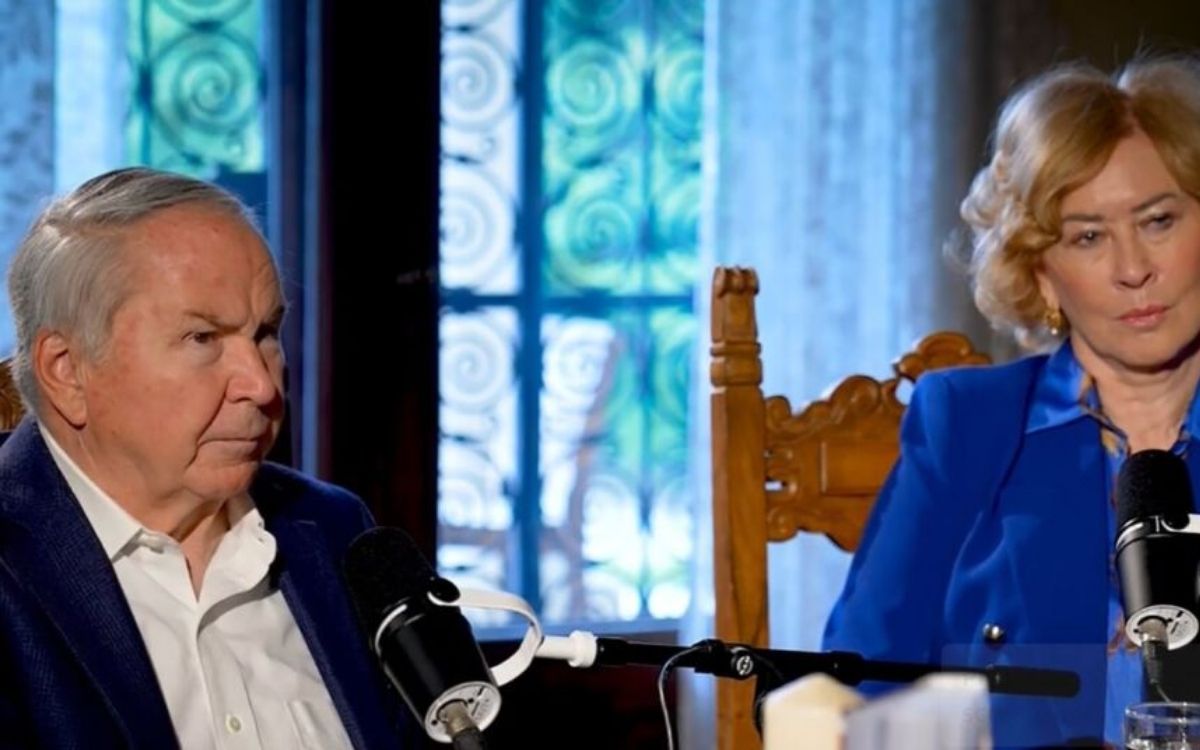
Former US Ambassador to Serbia William Montgomery and Lynn Montgomery, appearing as guests on the podcast “Perspectives” on K1 television, hosted by Prof. Čedomir Antić, looked back on the political circumstances that preceded the breakup of the former Yugoslavia, speaking about nationalism, the atmosphere of fear, and the role of political leaders during the 1990s.
William Montgomery spoke on that occasion about Slobodan Milošević, whom he believes played a key role in the events that followed.
“If you had to choose the one person most responsible for the violence and even the breakup, it was Slobodan Milošević. I knew him well when he was a banker. But he was a politician and he saw the path to power through the use of nationalism. He went to Kosovo, stripped them of their independent status, as well as Vojvodina, and gave a famous speech there, where he told the Serbs from Kosovo that the Kosovo Albanians would not beat them anymore, and he became a nationalism practitioner. That, I think, is the main reason why it happened the way it did,” said the former American ambassador.
The former Ambassador of the United States of America to Serbia, William Montgomery, expressed his view on the future of Bosnia and Herzegovina, assessing that the current arrangement is unsustainable and that a long-term solution could be the formation of three entities with the possibility of a referendum on independence after a certain period.
“What I would do is form three entities – one for the Croats, and then leave a period of five years to see how those entities function and get along with each other. After five years, the entities would have the opportunity to organize a referendum on independence or remaining in the community. I think that is a logical way to proceed, instead of trying to hold together three entities that do not agree and have major differences. Bosnian Muslims believe they fought to protect the whole of Bosnia and that therefore everything belongs to them, because they made the greatest sacrifice. I believe that the Serbs would want independence, that is, they would want Republika Srpska to join Serbia or to be independent. In any case, that is my simple solution, which is probably easy to say but very difficult to put into practice, because the Bosnian Muslims would fight to their last breath against it. For something like that to be realized, strong support from the international community would be needed,” he said.
The former US Ambassador to Serbia spoke about the events in Kosovo during the 1990s, the relations of the American administration with Slobodan Milošević, and the West’s fear of the conflict spreading beyond the borders of the former Yugoslavia.
“Milošević stripped Kosovo of its status as an autonomous province, which also meant that children in schools could not speak Albanian. The point is that we cared more about Kosovo during those ten years or so than you can imagine. What we saw was that the violent wars in Croatia and Bosnia were of a limited nature. They were terrible, but they did not spread beyond the borders of those two countries. Yes, there were refugees, but the war was basically within those borders. But if you look at Kosovo, with its history and borders with Albania, Macedonia, and proximity to Greece and Bulgaria, all those countries have experience in relations with Kosovo. We had a terrible fear that if war actually started in Kosovo, as was the case in Bosnia and Croatia, it could spread far beyond Yugoslavia. That was our fear and we felt it very strongly. During the first few years, I was very involved in negotiations with Ibrahim Rugova, who was the leader of the Albanians. He was a peaceful guy. We talked to him, then we went to talk to Milošević, and we made no progress. Neither on the issue of schools, nor on anything else. Then the Kosovo Albanians got weapons from their compatriots working in Western Europe, especially in Switzerland. That turning point came in 1993 or 1994. At some point, it turned into a guerrilla war. We had an envoy who said that the KLA was a terrorist organization. That was a stupid press release. It became a guerrilla war. Unfortunately, I think it was not a classic war where all sides had to win to survive. Like now in Iran. Iran does not have to defeat the US, all Iran needs to do is stay in the game and thereby win. It was the same in Kosovo. The Albanians would fire a few bursts at a military jeep passing through a village, and then your troops would come with a very harsh response. That looked like causing great damage in response to what the Albanians did,” he explains and continues:
“Madeleine Albright, who truly hated Milošević for our foreign policy, appointed a man who was in charge of what was happening in Kosovo. It is very well known that he announced that a massacre had occurred in the town of Račak. That was news that spread very quickly around the world, and it was precisely that kind of reporting that led to the bombing, which was a bad outcome. Both sides completely misunderstood the other. Milošević thought the bombing would last a few days and then stop. We thought we would bomb for a few days, scare Milošević, and he would back down. And we were all wrong. Thus, we had to convince NATO to join the bombing. Many countries, especially Greece, did not want to join. But they agreed to start the bombing, and then we had to continue and realized that if we stopped, we would never be able to start it again. That was stupid, because every day they had to find new targets,” he adds.
FIND OUT MORE
Reflection on the conflicts in Israel
During the conversation, Montgomery also spoke about the current conflicts in the Middle East, emphasizing that the situation affects him particularly due to the fact that his daughter lives in Lebanon.
“What is happening there is shameful. None of us are in favor of what Israel is doing. Our daughter is in Lebanon and because of that, I have even more reason to be dissatisfied. But the fact that Israel is not doing this alone, but is using bombs they bought from us or that we gave them, that drives us crazy. I feel powerless to stop it, but it is a terrible thing,” Montgomery said.
Lynn Montgomery on the atmosphere of fear at the end of the eighties
Lynn Montgomery spoke about the political atmosphere that prevailed at the end of the 1980s in the former Yugoslavia at the time and assessed that the rhetoric of fear played a major role in the subsequent conflicts.
“I would say that perhaps in the region at the end of the eighties you had a kind of triple failure, not only in Serbia, but also in Croatia and Bosnia. It wasn’t just rhetoric from here, the rhetoric was everywhere. I see a bit of an allegory with the situation in the US today as well. If you cause fear in people, if you tell them that different groups of people are different, against you, and that they will hurt you, then you create an atmosphere of division,” she said.
She added that during her stay in Croatia at the end of the eighties, tension and fear could be felt among the people.
“I was in Croatia at the end of the eighties, and at the beginning of the nineties you could feel the fear after the war. You could feel that people had done all sorts of things and said all sorts of things. Their lives had completely changed. They were thinking about what had happened to ordinary people. I think that the rhetoric of fear and differentiation of ethnic groups was the dominant feeling at the beginning of that war,” Lynn Montgomery said.
Their statements once again opened up the question of the responsibility of political leaders, but also the influence of nationalism and political rhetoric on the events that marked the breakup of the former Yugoslavia.
MORE TOPICS:
SERBIA HAS A EUROPEAN TAEKWONDO CHAMPION: Stefan won gold in Munich!
Source: Blic, Photo: Printscreen K1
 Add Serbian Times as your Google source