




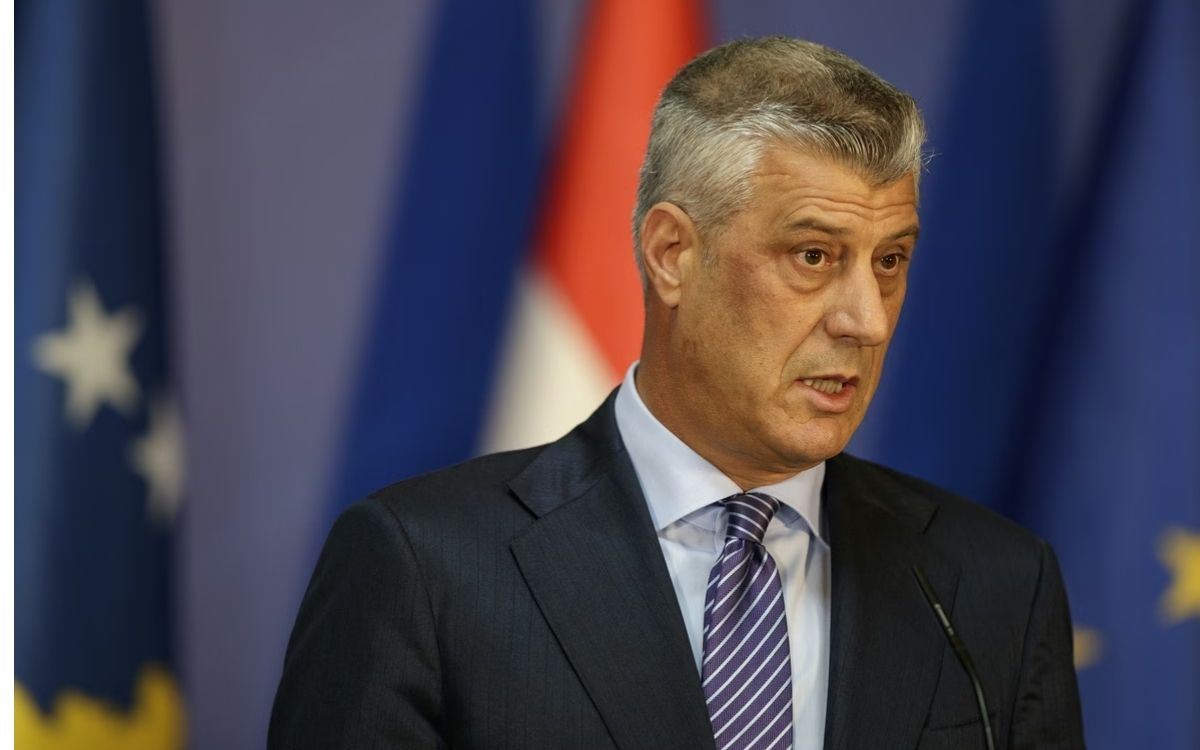
The presiding judge of the judicial panel of the Kosovo Specialist Chambers in The Hague announced today that the prosecution had proven beyond a reasonable doubt that former leaders of the so-called KLA Hashim Thaçi, Kadri Veseli, Jakup Krasniqi and Rexhep Selimi committed war crimes against at least 385 people. He also stated that the prosecution had not proven crimes against humanity.
The judicial panel is presided over by Charles Smith from the United States (US).
Thaçi is attending the reading of the verdict.
The court heard 273 witnesses during the proceedings, admitted more than 5,400 pieces of evidence and included 156 victims in proceedings comprising nearly 30,000 pages of transcripts. Nevertheless, the trial itself was marked by significant pressure, which was also pointed out by the presiding judge.
Crime against humanity not proven
The Specialist Chambers panel, on the other hand, concluded that the prosecution had not proven beyond a reasonable doubt that there had been a systematic or widespread attack directed against the civilian population, which is one of the requirements for establishing crimes against humanity.
The verdict states that KLA members, from no later than April 1998 until August 1999, committed acts of violence and mistreatment against civilians throughout Kosovo and in certain parts of northern Albania that were under KLA control. The panel assessed that these acts constituted an attack that was both systematic and widespread, but that it had not been proven that the attack was directed against the civilian population.
“As regards the existence of a systematic or widespread attack against the civilian population as a requirement for crimes against humanity, the panel concluded that the prosecution had not proven beyond a reasonable doubt, within the meaning of Article 13 of the law, that there was a systematic or widespread attack directed against the civilian population,” the verdict states.
The panel, it added, established that the acts of violence and mistreatment constituted an attack that was “both systematic and widespread,” but concluded that the prosecution had not proven beyond a reasonable doubt that the attack was directed against the civilian population.
The presiding judge stated that the panel had established the existence of a non-international armed conflict between the so-called KLA and the FRY, that is, Serbian forces, which lasted from no later than the end of March 1998 until June 20, 1999, as well as that the criminal offenses in the indictment were committed in the context of, or were otherwise associated with, that conflict.
“The panel concluded that, from no later than the end of March 1998 until June 20, 1999, or approximately that date, there was a non-international armed conflict between the KLA and the FRY, that is, Serbian forces. The conflict was fought in Kosovo, but certain parts of northern Albania that were under KLA control are also subject to the provisions of international humanitarian law governing that conflict. The panel further concluded that the criminal offenses in the indictment were committed in the context of the non-international armed conflict, or were associated with the armed conflict, thereby satisfying the nexus requirement,” the presiding judge said.
He added that the panel also found that the victims were persons protected under the applicable norms of international humanitarian law, since they were not actively participating in hostilities during the relevant period.
However, the panel concluded that the general requirements under Article 14 of the Law had not been met with regard to those criminal offenses, which, according to the court’s reasoning, meant that they could not legally be classified as war crimes.
Based on the evidence presented, the panel concluded that KLA members arbitrarily deprived at least 385 people of their liberty between April 1998 and June 20, 1999, after which they were held in numerous detention facilities under KLA control in Kosovo and at certain locations in northern Albania.
Unlawful or arbitrary arrest and deprivation of liberty
As stated in the reasoning, KLA members, including military police, arrested victims and took them to KLA-controlled facilities. Many were arrested in their homes or on roads and then taken into detention.
According to the panel’s findings, some victims were beaten and subjected to severe verbal abuse during their arrests, had their hands and feet bound, were blindfolded and had their personal belongings taken away. Those arrested were often labeled “Serbian collaborators,” “collaborators,” “spies” or “traitors.”
The victims were held in locked rooms or under the guard of armed KLA members, while some detainees were restrained with chains, ropes or handcuffs, or held at gunpoint.
War crime
The panel concluded that between April 1998 and June 20, 1999, in 14 municipalities in Kosovo and at certain locations in two areas of northern Albania, KLA members intentionally engaged in acts and omissions that resulted in the unlawful deprivation of liberty of at least 385 people.
As stated, these were people who were not actively participating in hostilities and who were deprived of their liberty without legal grounds and without regular judicial proceedings, which led the panel to characterize the arrests and deprivation of liberty as arbitrary.
“For these reasons, the panel concluded that the prosecution had proven beyond a reasonable doubt that the war crime of unlawful or arbitrary arrest and deprivation of liberty under Count 3 of the indictment was committed against at least 385 people,” the presiding judge said.
Gatherings ahead of the verdict
Albanians gathered today in a square in Pristina, where they followed the verdict.
Meanwhile, according to media reports, police in The Hague called on those gathered around the Specialist Chambers building, who had come to support the former leaders of the so-called KLA ahead of the verdict on war crimes, to leave the area around the building.
Police also confiscated sticks from some of those gathered in The Hague.
As a reminder, Hashim Thaçi, Kadri Veseli, Rexhep Selimi and Jakup Krasniqi are charged before the Kosovo Specialist Chambers with war crimes and crimes against humanity committed during 1998 and 1999.
Crimes against at least 407 detainees
According to the indictment, the crimes were committed against at least 407 detainees, at least 102 of whom lost their lives.
The four former KLA members are charged with six criminal offenses relating to crimes against humanity — persecution, imprisonment, other inhumane acts, torture, murder and enforced disappearance. They are also charged with four types of war crimes: unlawful or arbitrary arrest and deprivation of liberty, cruel treatment, torture and murder.
The trial began on April 3, 2023.
The indictment covers the period from at least March 1998 to September 1999, and the crimes concern multiple locations in Kosovo, as well as the areas of Kukës and Cahan in northern Albania.
The prosecution alleges that the victims were civilians whom the KLA considered opponents or collaborators with the Serbian authorities.
According to the indictment, Thaçi, Veseli, Selimi and Krasniqi bear individual criminal responsibility through various forms of participation in an alleged joint criminal enterprise.
All four have pleaded not guilty to all counts of the indictment.
MORE TOPICS:
Source: Nova ; Foto:EPA-EFE/VALDRIN XHEMAJ
 Add Serbian Times as your Google source