




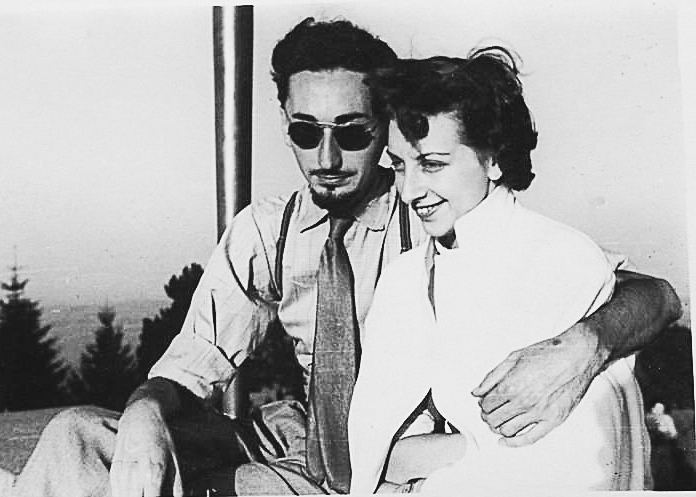
He was so devoted to writing that there were times when the phone would ring while he was home alone. He had to answer it, and someone would ask for our daughter. Later she would ask him who had called, and he would say: “I don’t know.” “Why didn’t you write it down?” “How could I write it down when at that very moment I was in Byzantium?” the writer’s widow recalls.
Ljiljana was married to Borislav Pekić for 34 years, and today she lives on Borislav Pekić Street. When the Vračar municipality asked her which street should bear his name, Mrs. Pekić replied: “It would be best if it were a small one that wouldn’t bother anyone.” It was, in fact, the street where he had lived.
Since his passing 25 years ago, she has devoted her life to listening to his tape recordings and publishing his works. She says that is what saved her life. Rabies (Besnilo) was first published 32 years ago, and every season it appears in several new editions. Judging by its continued popularity, many more are yet to come.
“The first year without him was terrible. I couldn’t bring myself to leave the house. Then a doctor friend advised me to start walking. I’d make it to the first park, burst into tears, and come straight back. What was I supposed to do among people when I cried all the time? It was even harder because I couldn’t really be with our daughter either—we had nothing to do together except sit and cry. Then I found hundreds of those tapes, recorded diaries, and notes for The Golden Fleece*. That helped me survive because I was constantly listening to his voice. I imagined he was calling me from Belgrade. It’s priceless, especially because he recorded them only for himself, so I was hearing them for the first time. I don’t know what I would have done. I’m not one of those women who cope by cooking lunches and dusting furniture.”*
DEFYING THE DIAGNOSIS AND HIS FINAL DAYS
“By nature I am an optimist and I never believe in the worst outcome. I thought he would pull through, that everything would be fine. I often close my eyes to bad news, or my mind immediately interprets it in a better way. Even when the doctors said he had six months left, I waved it off, convinced they were wrong. In reality, he had only one month. During the last three weeks he barely spoke. He didn’t want to discuss the illness or anything else. He just watched films, especially westerns.”
He was so absorbed in writing that even ordinary moments disappeared from his awareness.
“The phone would ring while he was alone at home. Someone would ask for our daughter. Later she’d ask who had called. ‘I don’t know.’ ‘Why didn’t you write it down?’ ‘How could I? At that moment I was in Byzantium.'”
“It wasn’t hard to guess what he would die of because he smoked two packs a day,” Mrs. Pekić says as she lights a cigarette.
“He smoked heavily and knew lung cancer awaited him. He even roughly predicted the year. In his diaries he wrote that he had big plans, but only until the age of 60. He died at 62. He contracted tuberculosis in prison, and doctors say it never completely disappears. He went for regular checkups, but bronchial cancer is very deceptive because it’s usually discovered too late.
He loved alcohol. When we had money, he drank whisky. Back in Belgrade it was usually brandy or rakija. He preferred strong drinks because wine didn’t suit him. He did everything intensely, including drinking, yet he handled alcohol remarkably well. Perhaps that was simply how his body worked. I think he often drank out of boredom—sitting with people talking endlessly while he didn’t feel like leaving. In London, where he enjoyed complete freedom and no one harassed him, he drank much less.
He was so immersed in his work that the phone could ring while he was home alone. Someone would ask for our daughter. Later she’d ask who had called. ‘I don’t know.’ ‘Why didn’t you write it down?’ ‘How could I? At that moment I was in Byzantium.'”
DIFFICULT CHILDHOODS BROUGHT THEM TOGETHER
Besides being soulmates and lifelong partners, Ljiljana and Borislav shared another bond—they both had difficult childhoods.
“I had a comfortable and privileged beginning. I traveled abroad with my parents during the holidays. But when I was twelve, tragedy struck. My father was killed in 1944, and I adored him. For me, it was the end of the world. I thought I would kill myself because I couldn’t imagine life without him. Then we were brutally thrown out into the street with nothing. My mother, although a lawyer who spoke perfect French, couldn’t find work for eleven years. We survived thanks to friends and relatives. I suppose that’s when I toughened up, so everything that came later didn’t seem quite so devastating.”
Borislav was born in Podgorica in 1930. His father, a district administrator, was frequently transferred, so the family lived in Podgorica, Knin, Bečej, and finally Cetinje before World War II, where Borislav attended school. When the war began, his father, Vojislav, an advocate of Serbian-Montenegrin unification, was expelled from Montenegro.
“They moved to Bavanište near Pančevo, where my mother-in-law’s family owned land. They spent the war there. He was an only child, surrounded by his parents’ love. Then they endured five terrible years, from 1948 to 1953, while he was imprisoned as a member of the illegal student organization Union of Democratic Youth of Yugoslavia.”
After Pekić’s death, writer Slobodan Selenić wrote in Politika about their friendship:
“We were friends for many years. I know I loved Bora dearly—how easy it was to love him!—yet we never addressed each other informally.”
When Ljiljana married him, someone offered her this advice:
“You probably won’t have much money. Life will probably be difficult. But with him you’ll never be bored, and boredom is what destroys every marriage.”
Literary historian Predrag Palavestra later wrote that Pekić was much warmer with his childhood friends than with fellow writers, among whom he deliberately maintained “the refined distance of impeccable manners.”
ALWAYS “YOU” IN THE FORMAL SENSE
“He addressed many people—even close friends—with the formal ‘you,’ and never abandoned that habit, even after heavy drinking loosened every other restraint. Once, in 1983, we were traveling together from London to Lancaster to visit Dušan Puvačić. We were standing in line at Euston Station when he leaned toward me and quietly whispered: ‘Would you be so kind as to keep my place and watch my luggage? Otherwise I’m going to soil myself right here.’
He spoke the same way to Mihiz, although they had been close friends for more than half their lives and Mihiz was always the first to read his manuscripts. Everyone respected this peculiar habit.”
Selenić also recalled:
“We were friends for a long time, and I know I loved Bora deeply. Yet we never switched to the informal form of address. I don’t know why it suited him, but I gladly persisted because it reminded everyone that I was speaking to a gentleman. Bora was a true gentleman, effortlessly, as if he were an impoverished nobleman of royal blood who never spoke about it.”
Pekić always addressed Svetlana Velmar-Janković as “Mrs. Svetlana,” yet, to everyone’s surprise, he used the informal form with poet Miodrag Pavlović, who was famous for his cold reserve. When Pavlović stayed with the Pekić family in London, no windows could be opened because of his fear of drafts, despite both Bora and Ljiljana being heavy smokers. Whenever Danilo Kiš came from France, they doubled their supplies of tobacco and whisky.
WITH KIŠ, THEY TALKED ABOUT EVERYTHING EXCEPT BOOKS
Pekić and Danilo Kiš could talk from eight in the evening until eight in the morning—and never about books. Books, they felt, were “boring and repulsive.” They were insufficient.
Pekić later wrote:
“The last time we were together, we were alone in my Belgrade apartment—my cell, my refuge. Always by chance, always at some crossroads, always in passing, always with the feeling that this would be our final meeting. It is night, our time. We are both creatures of darkness. The moon is full, and I trust it, because the Moon belongs to me… At the end, in that haze between waking and shame, one of us said: ‘Perhaps life itself doesn’t hurt. Perhaps what hurts is knowing it isn’t being lived the right way.’ The other replied: ‘Maybe that is life.'”
When Kiš died on October 15, 1989, Pekić phoned his friend and editor Radoslav Bratić in tears. They spent the next fourteen hours moving from one tavern to another, talking only about Kiš and crying all the while.
Late that night, at the Writers’ Club, Jaša Grobarov—already quite drunk—approached Pekić and shouted:
“Shame on you! You should have died instead of Kiš, whom I loved so much!”
Without hesitation, Pekić replied:
“My dear Jaša, I’ve been dead for a long time. You just didn’t know it.”
Grobarov was left speechless, turned around, and walked away.

DEMOCRACY AND OTHER PASSIONS
Three years before his death, together with twelve other intellectuals, Pekić helped re-establish the Democratic Party and soon became a member of its Main Board.
“Founding the Democratic Party was our shared dream. I didn’t have his energy or influence as an architect, but he had authority because of his books. He always pushed things to the limit—and whenever he could, he moved that limit a little further. I stayed in London, and he regularly called me from Belgrade to tell me what was happening within the party.”
Asked what he would think of today’s Democratic Party, Ljiljana smiled.
“He would have left it long ago. But judging from what he wrote, he never expected democracy to be easy. When he addressed students at the 1991 rally, he said: ‘Don’t keep looking at your watches. It won’t happen today or tomorrow.’ He knew we were not ready for democracy because living under dictatorship from 1944 onward inevitably left deep scars.”
From the book by Aleksandar Đuričić “Čuvarkuće – udovice pisaca”
You can order the book here www.samizdatb92.rs, or here goo.gl/jmbevL prize is 8 USD + PDV.
MORE TOPICS:
FROM AMMUNITION TO DRONES: How Serbia became one of Israel’s most important partners in Europe!
Source:
 Add Serbian Times as your Google source