




Former head of the Municipal Police, Nikola Ristić, was named in the ombudsman’s report on the illegal demolition of buildings in the Savamala neighborhood, according to a 2018 report by the Danas portal. The reason was calls made by citizens to the Municipal Police on the night of the demolition, between April 24 and 25, 2016.
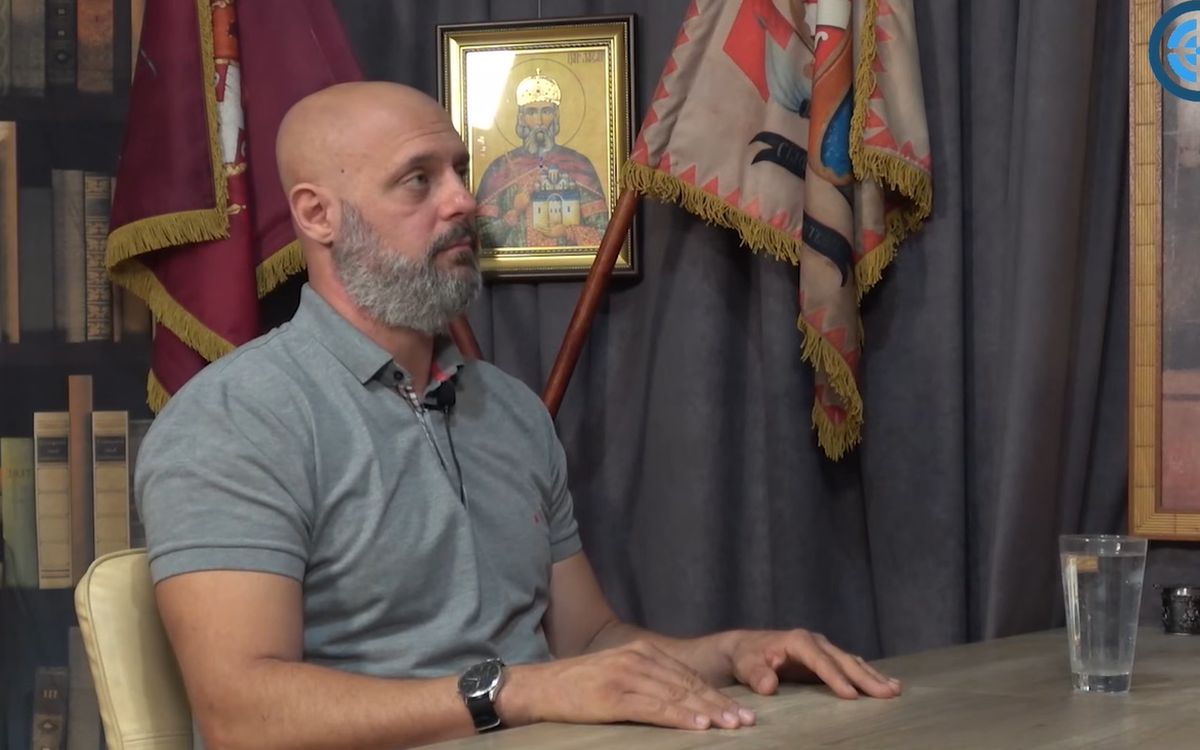
Ten years later, Ristić, who is also known for physically preventing KRIK journalists from filming the Municipal Police in action that year as they tried to ask the mayor of Belgrade a question, spoke on the Srbin.info podcast about the political and operational background of the demolition in Savamala.
On the podcast, Ristić described the roles played by then-mayor Siniša Mali, Interior Ministry officials and private actors on the ground, pointing to coordination mechanisms and subsequent attempts to shift institutional responsibility.
He admitted that he was aware of his complicity in everything that happened that night, but said the real causes did not lie with members of the Ministry of Internal Affairs (MUP) or the city authorities, but rather that decisions were being made “at a higher level.”
Although no pressure had been exerted before the demolition, Ristić emphasized that, from his perspective as the head of the Municipal Police at the time, the operation was entirely a state project.
“Everything was being handled at a level above us. Legally, with all the projects, it was above the City of Belgrade. At some point, the city became involved through the Savski Venac municipality because the area falls within its territory. Things were resolved quite quickly, but whether they were resolved in accordance with the law, I don’t know,” Ristić said.
He worked in Savski Venac for 10 years as a member of the MUP. As he recalls, the area where the demolition took place in April 2016 was not abandoned, but economically very active.
He says that several commercial buildings, as well as a railway connection and large warehouses, were located in this part of Hercegovačka Street.
Preparations for the demolition
Two days before the demolition, Ristić had his first contact in which part of the project was presented to him. At a meeting with Siniša Mali, then the mayor of Belgrade, he was told that Luka Tomić, a member of the mayor’s cabinet at the time, would provide him with all the information.
“I was told there would be a demolition and that it had to be carried out, but not during the day. I was already wondering why we were having these conversations in the first place. A lot of things had already been demolished there, and excavators were there every day. Several times, they had asked the police, including the Municipal Police, for assistance in cordoning off the area and so on. Everything had been done during the day, never at night,” Ristić recalled.
He explained that, at the time, paperwork often arrived only after the work had been carried out, so the lack of documentation and the nighttime operation did not particularly alarm him. Nevertheless, he asked a question skeptically and received no answer.
“Why aren’t we doing this during the day, whoever is carrying it out?” the then-head of the Municipal Police asked.
The information he received was that the demolition was scheduled for two days later, that the paperwork would be completed afterward, and that the matter was urgent. He was also told that the head of the prime minister’s cabinet — Aleksandar Vučić at the time — had been informed.
According to Ristić, Veselin Milić, the former head of the Belgrade Police Department, informed him that, alongside Aleksandar Vučić’s cabinet, Nebojša Stefanović, then the interior minister, was also involved in the entire plan.
“At the moment Milić told me the full scope of everything, when I saw that this was an operation organized at a much higher level and that Nebojša Stefanović was also aware of it and had been brought into it, I decided to go to the site so that nothing would go wrong, at least as far as my department was concerned,” Ristić said.
The demolition in Hercegovačka Street
According to his account, two semi-trailer trucks blocked access to Hercegovačka Street, while an excavator owned by Millennium Team was ready to begin demolishing the buildings after they had been searched.
According to Ristić, Ivan Bošnjak, one of the representatives of Millennium Team, was also present at the scene, along with a member of Siniša Mali’s cabinet who was coordinating the demolition.
Around midnight, a group of approximately 15 masked individuals arrived in vehicles with concealed license plates and began searching the buildings. During the operation, one security guard at the site and several citizens were detained. They were later released.
After half an hour of searches, the demolition began. “They left just as they had arrived, and then the excavator started demolishing the buildings,” Ristić said.
According to his testimony, the workers and all the machinery belonged to Millennium Team.
“I had three options. I could personally stop the operation, pretend I had never been there, or try to remedy some of the things as much as I could. I chose the third option, even though I was aware that this made me an accomplice. With that decision, I became an accomplice. At the time, I was the head of the Municipal Police, and I was fully aware of the wrongdoing I was participating in,” Ristić testified.
He watched the demolition throughout the operation, while the member of Siniša Mali’s cabinet and Ivan Bošnjak remained at the scene. Once the demolition was completed, Ristić informed Mali that the job was done. He received no reply to his message, although, according to his claims, Mali had seen it.
Reactions and the lack of an investigation
After the demolition, a “media storm that the City of Belgrade was unprepared for” began. Institutions remained silent, while members of the MUP tried to contain the fallout.
The main problem was the MUP’s failure to intervene at the scene despite receiving calls. Ristić testified that, in attempts to contain the situation, Dijana Hrkalović contacted him in an effort to make the Municipal Police take responsibility.
“She first tried indirectly, and then directly, to find a way for the Municipal Police to take responsibility. I refused, and even if I had wanted to, I had no way of doing so. People were tied up by men wearing hoods. How could that be the work of the Municipal Police? That falls under the jurisdiction of the MUP, not the Municipal Police,” Ristić emphasized.
Ristić says Mali actively advocated at a meeting of the Serbian Progressive Party’s city committee that Ristić should be the one to take responsibility. When he failed to secure Ristić’s agreement, “they swept the entire case under the rug through Goran Stamenković.”
The only institution that requested a report from the Municipal Police was the Ombudsman, which asked whether the department had received calls that night. Due to certain errors, this could not be established precisely, although Ristić points out that the Municipal Police had no jurisdiction over the events of the night between April 24 and 25, 2016.
As a reminder, on election night in 2016, masked individuals demolished private buildings in Hercegovačka Street. No one was held accountable for the demolition in the following years, and Belgrade Waterfront now stands on the site.
In statements to the media, government representatives initially denied involvement. However, in May of that year, Serbia’s then-prime minister, Aleksandar Vučić, said that whoever had ordered the demolition was a “complete idiot.”
Several years later, in 2023, Vučić said that he was personally responsible for the demolition in Savamala.
The only person to face criminal liability was Goran Stamenković, the police shift commander on duty on the night of the demolition.
MORE TOPICS:
Source: Izlaz Foto: Printscreen YouTube
 Add Serbian Times as your Google source