




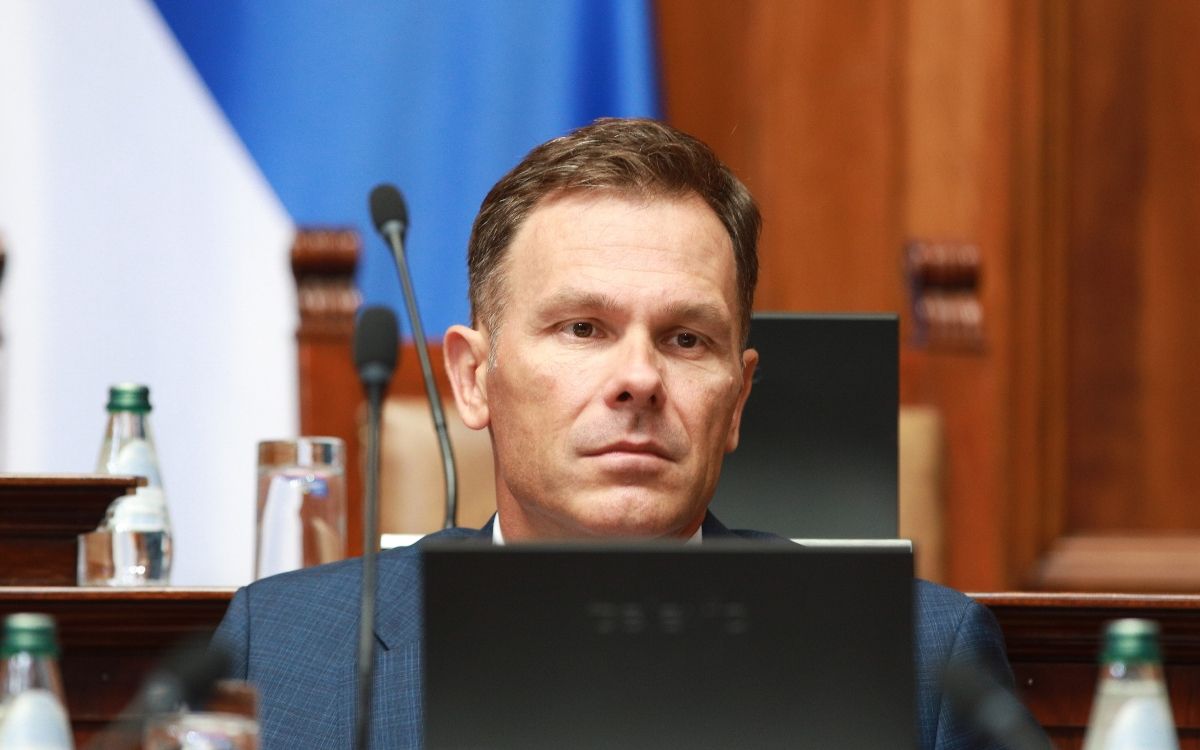
News in Serbia has been unfolding at an astonishing pace in recent days. Yet amid the constant flood of images and information, one man is conspicuously absent. And it is not the person most people immediately thought of. Where is acting Finance Minister Siniša Mali, and what is he doing? This is the question many are waiting to have answered, while the repeatedly voiced theory that he could become the “ideal protected witness” is once again gaining traction in the background. Nova’s interlocutors are now raising that possibility again.
From Aleksandar Vučić’s statement on the night of October 25, when he said, “We lost these elections,” until today, Siniša Mali has appeared in public only twice. Once at the Serbian Progressive Party’s patron saint celebration, and again at a session of the Main Board held on October 31.
According to Zoran Stojiljković, a retired professor at the Faculty of Political Sciences and one of the future MPs from the Student List, this is telling and could be part of a broader strategy.
“Between winning the elections and having power that has not yet been institutionally established, various strategies are being employed. On the one hand, when it comes to the election winners, because of the enormous enthusiasm and expectations of the people, you cannot wait for the government to be formed before taking action. Instead, through a combination of public pressure, the authority of the students, and internal resistance and liberation within institutions, you change the balance of power. You are operating in an environment where all the resources of power remain in the hands of a narrow circle. You have won parliamentary power and may eventually form a government and go to presidential elections, but that is not enough,” Stojiljković says.
The former government also has its own strategy in all of this, and Siniša Mali’s role in current developments could be significant.
A candidate for protected witness status — or perhaps not
“Having acknowledged the election results, because the margin was too large to do otherwise, the former government is now trying to retain as many of its power resources and officials as possible — people it installed over the past 10 to 12 years. It is also trying to remain united under Vučić’s authority, as he formally returns to the helm of that organizational clientelist network. And one thing strikes me as particularly telling: at the moment, no one is appearing in public except him. One symptom of this is the absence of Siniša Mali, whose testimony and insight into how things work would be invaluable. I believe we have heard numerous suggestions in public, even before these changes, that he could perhaps be the most interesting candidate for protected witness status,” Stojiljković assessed, adding:
“If anyone knows something about that regime, it is him. Siniša Mali was also a senior figure in the so-called ‘yellow’ administration. As the ironic saying goes, he is a man for all seasons.”
According to Stojiljković, whether this happens will depend on internal relations within the SNS — specifically, whether the party suffers a lasting loss of influence or manages to return to its position as the leading opposition party.
However, this brings us to a separate aspect of the story involving the long-serving finance minister and Vučić’s loyal “keeper of the purse strings.” Siniša Mali’s name did not appear on the SNS electoral list, meaning that once the new government is formed, he will effectively lose any form of parliamentary immunity.
Lawyer Jovan Rajić believes that Siniša Mali is “a notorious criminal who must end up behind bars for many years” and that he should not be offered cooperating-witness status.
“I think that would be disastrous, because he is a man who stands just one rung, or half a rung, below the Vučić brothers in the chain of responsibility. He is the chief financial officer of the organized criminal group known as the SNS. All the flows of money, everything related to finances, went through him. And in that sense, you can draw a clear distinction,” Rajić says, comparing the case with that of Alta Bank and Davor Macura.
“Macura was also involved in finance, just like Siniša Mali, but he was an implementer, not an organizer. So Macura might perhaps qualify for cooperating-witness status, depending on what he knows and what information he is willing to make available to the competent authorities. Siniša Mali cannot, because he is the architect of the chaos and corrupt structure that siphoned millions and billions out of the Serbian state budget over the past several years. At most, and even that would be a privilege, he could be the third defendant in that organized criminal group, after the Vučić brothers. But I believe that, after Aleksandar Vučić, he may be the person most responsible for the state of the country,” Rajić argues.
He also recalls the various scandals in which Mali has been involved.
“Starting with Savamala, where the constitutional order of the Republic of Serbia was overthrown. That was not a scandal — it was a criminal act committed there. Then you have the apartments in Bulgaria, his fake doctorate, and the General Staff affair, where more and more details are now coming to light about what actually happened. Then there is the Expo corruption affair, and you have Grenell and his associates. In other words, he is a notorious criminal who must end up behind bars for many years if this society is to have any chance of recovering and if we are to reintroduce the word ‘accountability’ into our system of values, political life and public life — whatever you want to call it. So he cannot be a cooperating witness. That is the essence of the matter.”
In the bunker with Vučić
Asked why Siniša Mali has disappeared from the media, Rajić replies:
“During this campaign, he was, how shall I put it, a kidnapped man. They dragged him into the campaign, and when you see him dancing with municipal sanitation workers, dancing with pensioners in nursing homes, going around those tents, sweating, kissing and hugging singers, and mingling with local residents, you can see that he is sick of it, that he literally feels like throwing up. But you know how it is: when you are a member of an organized criminal group and you are being blackmailed, you have to play along. You have to roll around in the mud if your boss tells you to,” Rajić says, concluding:
“Mali would certainly like to get out of that game, but of course, that is now impossible. Their boss has forbidden all of them from going anywhere. Just as everyone stayed with Hitler in the bunker until the very last day, these people will also have to remain with Vučić. They will have to stay there with him and play this game of Russian roulette until the UKP or some other police authority comes for them.”
Everything should become clearer by the end of the year
In any case, Professor Stojiljković believes that by the end of the year we will have a much clearer picture of the fate of Siniša Mali and other key figures from the former regime.
“Based on my experience, including my time on the board of the Anti-Corruption Agency, the easiest way to establish someone’s responsibility is to follow the money and start determining the origins of the assets held by people whose legal income cannot account for the value of their property and their level of spending. That process has begun, but it will take time,” Stojiljković says, concluding:
“Just look at it: is it really possible that only seven or eight days have passed since the elections? The process will move forward, but it will reach a more normal pace once the Parliament is constituted and then the government is formed. I do not think the maximum deadlines allowed for these procedures will be used. In the meantime, we will also have presidential elections. So, just as happened after October 5, I believe that within two or three months the pyramid of the former government will be substantially dismantled.”
MORE TOPICS:
Source: Nova.rs, Foto: Milos Tesic / ATAImages
 Add Serbian Times as your Google source