




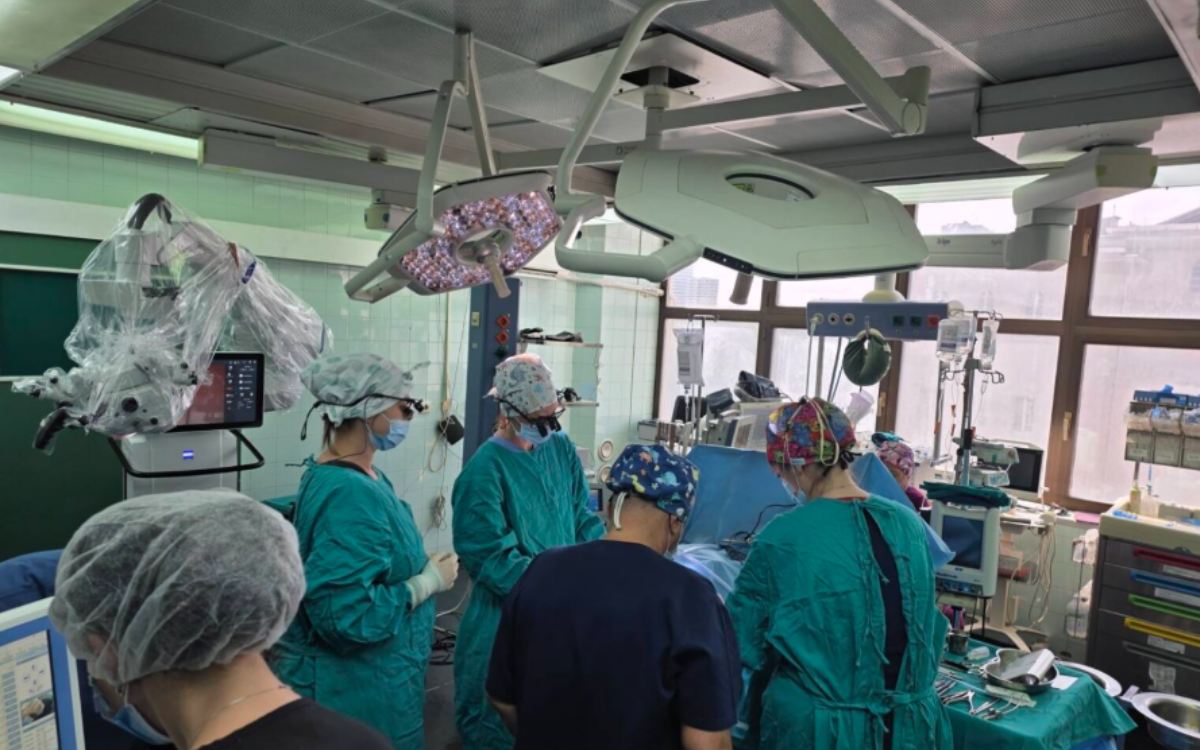
At the University Children’s Clinic in Tiršova, surgeons have performed Serbia’s first-ever bilateral cerebral revascularization surgery on a child suffering from Moyamoya syndrome, a rare and serious chronic progressive disease of the brain’s blood vessels that can lead to strokes. The operation was carried out under the mentorship of Dr. Edward Smith, Director of the Neurovascular Center at Boston Children’s Hospital, one of the world’s leading centers for treating this disease, which has the largest number of Moyamoya syndrome patients in North America and, according to some data, in the world.
This is an extremely complex surgical procedure involving the blood vessels of the brain in children, and such operations are performed in only a handful of European countries, including the United Kingdom and Switzerland.
Pediatric neurosurgeon Dr. Bojana Rankov Petrović said the procedure was performed using the same technique applied at Boston Children’s Hospital, along with an identical approach to perioperative patient care.
“This operation was performed in our country for the first time. It was carried out in cooperation with colleagues from Boston Children’s Hospital and Harvard, who developed this technique. We learned from them and followed their methods, applying the same perioperative treatment and surgical procedure,” Rankov Petrović said.
She noted that the operation was completed without complications and emphasized that the most important achievement is that Tiršova Hospital has now established the conditions necessary to treat children with such highly complex conditions.
“This makes it possible for children to be diagnosed and treated here in Serbia, without having to travel abroad for treatment,” Rankov Petrović said, stressing the importance of a multidisciplinary team approach throughout the preparation and the operation itself.
She also expressed special thanks to the entire team that participated in the procedure.
She highlighted the importance of teamwork throughout the perioperative preparation and surgical process, particularly praising the contribution of neurologists, especially Dr. Nikola Ivančević, whose team continuously provided information about the child’s condition.
According to her, Ivančević and his team monitored the child’s intraoperative EEG and neurological condition throughout the procedure.
Pediatric anesthesiologist Ivana Petrov described the surgery as a major achievement, noting that the procedure lasted seven hours.
“As for the postoperative phase, the child was awakened immediately after surgery and is currently receiving intensive care. The patient is conscious, communicative, and we hope that tomorrow the child will be transferred to a regular ward for further treatment,” Petrov said.
Chief physician Dr. Ivan Vukašinović explained that this is an exceptionally complex surgical procedure involving the blood vessels of the brain in children and that such operations had never before been performed in Serbia.
“Until now, children with this condition were referred abroad for treatment, most often to Switzerland, where these procedures were carried out,” Vukašinović said.
He added that Health Minister Zlatibor Lončar initiated the formation of a team of specialists in May that would be capable of performing these operations in Serbia.
Following that initiative, Dr. Rankov Petrović, who gained experience at Harvard, and a team of Serbian doctors visited the Boston center in June and established a specialized team to perform the procedure.
During the operation, the Harvard professor specializing in the treatment of children with Moyamoya syndrome participated via video link and monitored the surgery.
Vukašinović pointed out that these operations are performed in only a few European countries, including the United Kingdom and Switzerland, and expressed confidence that developing this capability will enable Serbia to treat not only its own patients but also children from across the region.
Moyamoya syndrome is a rare condition characterized by the progressive narrowing of the brain’s main arteries and their branches, reducing blood flow to brain tissue and significantly increasing the risk of stroke.
MORE TOPICS:
FROM A CAMP IN SERBIA TO VENEZUELAN LEGEND: How Marija from Kruševac became América Alonso!
THE LOST ISLAND ON THE DANUBE: This is the Forgotten History of Ada Kale and Duke Milenko’s Harem!
Source: Novosadska televizija Foto: Tanjug
 Add Serbian Times as your Google source