




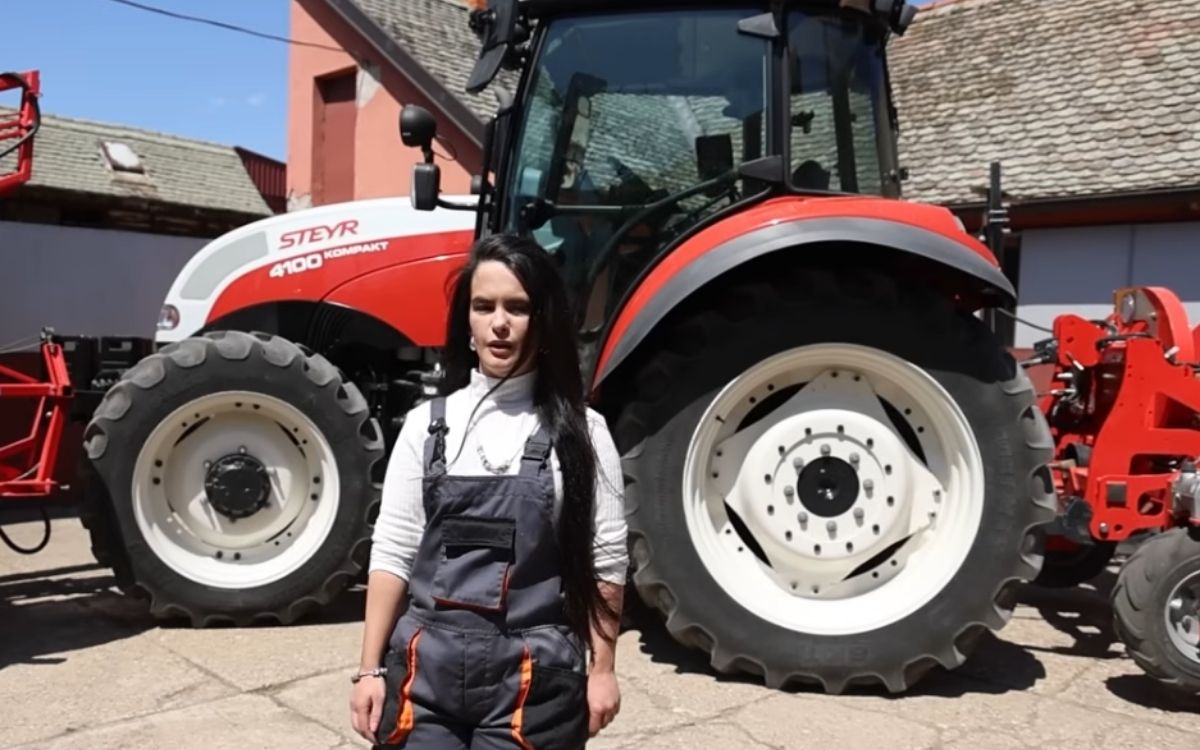
“Women are, after all, the pillar of an agricultural household, and above all, women are the pillar of the Serbian village, and without the Serbian village, there is no life.”
For “Blic Biznis,” Vera Škulić uses these words to speak not just about agriculture. She speaks about a way of life, about work that lasts from five in the morning until late at night, about generations that grew up on the land and from the land, but also about how it is possible to combine TikTok, tractors, and modern agro-entrepreneurship. As one of the most recognizable young women in Serbian agriculture and the first agro-influencer in the Balkans, Vera has managed to do what until recently seemed almost impossible – to bring the village closer to young people and make it visible on social networks.
Her videos from the field and from the family agricultural farm in Starčevo today count millions of views, but behind the popularity lies a much more serious story. A story about a girl who, at one point, due to her father’s illness, took over part of the farm, learned to operate machinery, fought against prejudices, and started a community of women who are today changing the face of the Serbian village.
-I am very proud of being the voice of the village, because I truly try to change the perception of the village and show that it is beautiful to live in the village – Vera tells us.
Family tradition longer than two centuries
Agriculture in the Škulić family is both bread and heritage. Vera says that her family has been involved in crop farming for more than two centuries and that she practically grew up in the field.
-Agriculture educated and raised me – she says.
She began working more actively six years ago, when her father fell ill and she had to take over part of the responsibilities.
-I simply had to take over the job. That’s when I learned a lot from him and over time grew to love that work. I realized what a privilege my ancestors left me and decided to continue the tradition of engaging in agriculture for longer than two centuries.
Her farm today is engaged in crop production – corn, wheat, and sunflowers, while recently they have also been developing beekeeping.
How she became the first agro-influencer
The idea of creating content for social networks arose from the need to find people who understand her way of life. In a world where women in agriculture were rarely visible, she decided to show what her daily life with her father Dragan looks like.
-When I started working in agriculture, I had no company and no one to ask for advice – Vera says, adding:
-I started filming how my father and I manage in that world. People found it interesting because we showed village life both humorously and educationally. Simply, it was interesting to see a father and daughter functioning together in the field.
Today they call her the first agro-influencer in the Balkans, and her content has inspired many women to speak publicly about their work in the village.
-I met not only male colleagues in the world of agriculture but also a lot of women. And yes, all together we created a network where we work together on popularizing not only agriculture and women in agriculture, but also on rural life as a whole. And I believe that the more there is of this online display of the beauty of life in the village, the greater the chances and potential, and the motivation for young people to return to the villages. So, since I started filming, many women now actually speak with pride about being female farmers, working on their farms, and helping their families.
Association of Agro-entrepreneurs of Serbia – support for women in the village
One of Vera Škulić’s most important projects is the founding of the Association of Agro-entrepreneurs of Serbia, an organization that in just a few months gathered a large number of women from different parts of the country who are involved in agriculture and village life. The idea for the foundation arose through communication with women who contacted her daily via social networks, recognizing themselves in her experiences and the problems they face in rural areas.
The goal of the Association is to provide women with greater visibility, education, and mutual support, but also to raise awareness about how important their role is in agriculture and village development. Today, the organization gathers women involved in various branches of agriculture – from crop and livestock farming to the production of homemade products and running family farms.
In a short time, the Association organized educations, connected members with companies, and provided certain benefits for purchasing production materials. Special focus is placed on practical knowledge, modern agriculture, and the use of new technologies, with drone handling training also planned.
An important part of the organization’s work is the promotion of women involved in agriculture. Through media, social networks, and various events, members get the opportunity to present their products, farms, and business stories, which contributes to changing the perception of women in the village and their work.
The Association also plans to organize seasonal conferences dedicated to different areas of agriculture, as well as further connection with institutions and business organizations, with the aim of providing women with more knowledge, support, and space for developing their own businesses.
“The farmer has the smallest profit in the entire chain”
Behind every harvest, full trailer, and product that reaches the market lies much more uncertainty than most people can imagine. While the public often sees only the final result, farmers invest money, time, and labor months before that without a guarantee that anything will pay off. That is precisely why Vera Škulić says that agriculture today is one of the riskiest jobs.
-We are constantly gambling with weather conditions – primarily with weather conditions and with the price of both buyouts and production materials. All of that fluctuates for us. One year is good for us, one year is bad. Somehow, in that gamble, we always win, one way or another, whether we get a larger amount or a smaller one – but we are somewhere around zero. I think society should appreciate the Serbian agricultural producer a bit more and, above all, work a bit more on the popularization and purchase of domestic products. When we see a finished product at the market, people usually come and say: “Oh, it’s expensive, the pepper is expensive, everything is expensive.” They spit on the peasant because he raised the price, but they actually don’t know that the farmer has the smallest profit in that entire chain – Vera is clear.
She particularly highlights last year’s drought, which seriously affected crop production throughout Serbia.
-We had a catastrophic, unprecedented drought and very small yields. If another season like that repeats, many farms will be in big trouble – Vera warns.
Despite that, she says that most farmers continue to invest and work, precisely because entire families live from it and because food production is a job they cannot give up. She also adds that subsidies, contests for purchasing machinery, and refunds of part of the costs are significant help to producers, especially when it comes to modernizing farms and easier survival on the market.
Still, she believes the biggest problem is that the public often sees only the finished product, while the work and risk behind it are rarely noticed. Because of this, she constantly insists that there should be more talk about the real position of farmers and about how important domestic production is.
Through her content and public appearances, she tries to bring closer to people how much effort is needed for a product to reach the market or store, but also how important it is for society to appreciate domestic producers more.
MORE TOPICS:
WELL DONE: Serbia won three medals at the European Armwrestling Championship!
Source: Blic Biznis, Photo: Printscreen Youtube / Stvarne ispovesti
 Add Serbian Times as your Google source