




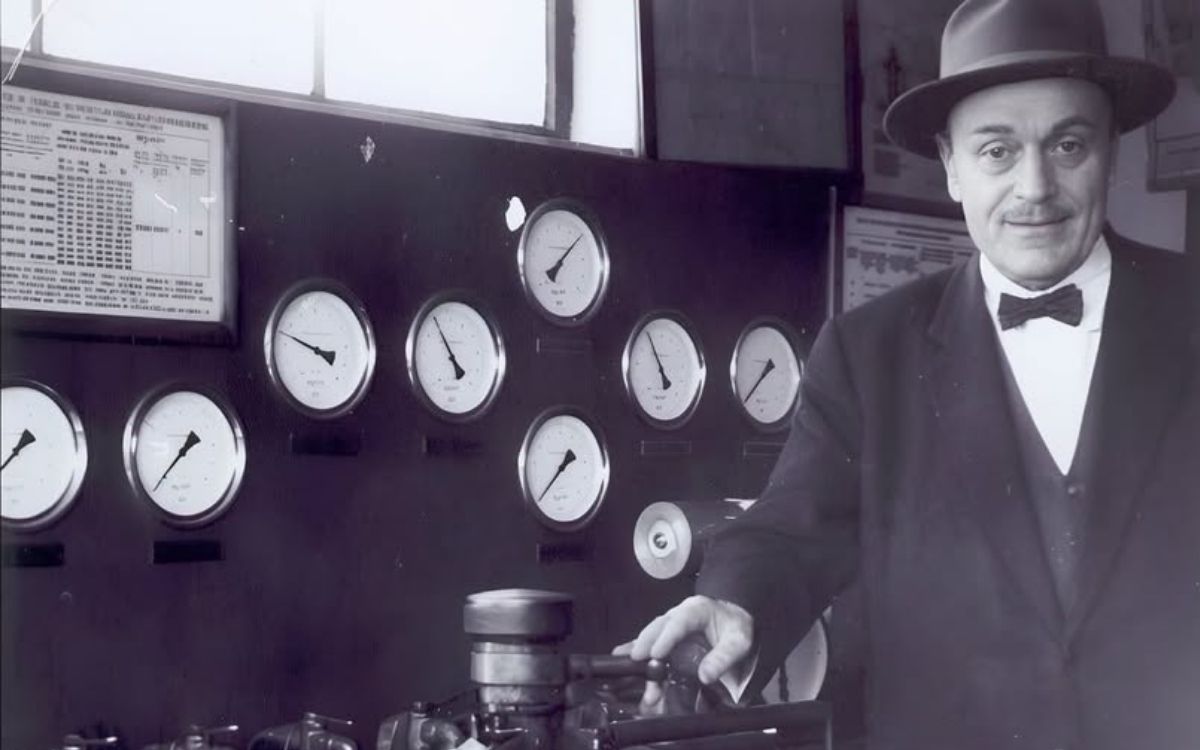
When speaking about Serbia’s greatest scientists and inventors, almost everyone first mentions Nikola Tesla or Mihajlo Pupin. However, there is another Serbian inventor whose innovation is used around the world every day, even though only a small number of people know his name. He is Dobrivoje Božić, a mechanical engineer from Raška and the man who effectively laid the foundations of the modern railway braking system.
Božić was born on December 23, 1885, in Raška. He studied mechanical engineering in Karlsruhe and Dresden, where one of his professors was the renowned Rudolf Diesel, the inventor of the diesel engine. After returning to Serbia in 1911, he joined the Serbian State Railways, where he soon began working on a problem that plagued railway administrations across the world at the time—ensuring safe and reliable braking for increasingly heavier and faster trains.
At that time, nearly all European railways relied on the braking system developed by American inventor George Westinghouse. Although revolutionary for its era, the system had significant limitations as train speeds and lengths rapidly increased. Božić did not invent the air brake itself—it had existed for decades—but he solved the key shortcomings of the existing system and developed a far more advanced solution that enabled safer, faster, and more reliable train braking.
His most significant achievement was the design of a new three-pressure air brake control valve, a device considered the “heart” of the entire braking system. Thanks to this innovation, braking signals could travel more quickly throughout the entire train, braking became more even, gradual brake release was made possible, the system automatically adapted to the train’s load, and safety at high speeds was significantly improved. Experts believe that Božić’s innovations became the foundation of all later European pneumatic railway braking systems.
The International Union of Railways recognized his patent, and engineering circles across Europe began referring to the innovation as the “Božić brake.” His patents were protected in as many as 18 countries, and throughout his lifetime he registered a total of 62 inventions in various fields of mechanical engineering.
Since the Kingdom of Yugoslavia lacked the industrial capacity to manufacture such sophisticated braking systems, Božić sold the patents to the renowned Czech company Škoda. According to the Serbian Intellectual Property Office, he received approximately 400,000 U.S. dollars for them—an enormous sum at the time. Nevertheless, he also looked after the interests of his homeland by ensuring through the contract that the Yugoslav State Railways could use his braking system free of charge.
He did not spend his wealth lavishly. Instead, he invested it in domestic industry and real estate, including his well-known villa on Krunska Street in Belgrade, where his family moved shortly before the outbreak of the Second World War.
His life, however, was far from free of dramatic twists. As a volunteer, he fought in the Balkan Wars and the First World War, including the Battle of Cer. During the Second World War, the Germans attempted to recruit him because of his outstanding engineering reputation, but after the liberation he faced a completely different fate.
The new communist authorities arrested him on suspicion of collaborating with the occupiers, despite there being no evidence to support the accusation. Although he was released after questioning, he lost a large portion of his property through nationalization, including the family’s villa in Belgrade.
Disappointed by the treatment he received from the country to which he had given one of its greatest technological achievements, Božić left Yugoslavia with his family and began a new life in Windsor, Ontario, Canada. Even in exile, he continued working as a leading railway engineer and consultant before later moving to the United States. While his expertise was highly respected and sought after in North America, his name gradually faded into obscurity in the country where he had made his greatest inventions.
After nearly two decades abroad, Dobrivoje Božić returned to Belgrade in 1964. His return was neither triumphant nor accompanied by the recognition he had long deserved. Just three years later, on November 13, 1967, he passed away at the age of 81.
Today, Dobrivoje Božić’s name is rarely mentioned outside professional circles, even though many historians of technology believe that without his innovations, the development of European railways would not have been the same. His solutions became part of engineering standards that were refined over the decades, while the fundamental principles he developed remain embedded in modern pneumatic railway braking systems.
Perhaps that is precisely why Dobrivoje Božić deserves to have his name mentioned alongside Tesla, Pupin, and Milanković.
MORE TOPICS:
FROM A CAMP IN SERBIA TO VENEZUELAN LEGEND: How Marija from Kruševac became América Alonso!
THE LOST ISLAND ON THE DANUBE: This is the Forgotten History of Ada Kale and Duke Milenko’s Harem!
Source: Serbian Times; Foto: Printscreen X
 Add Serbian Times as your Google source