




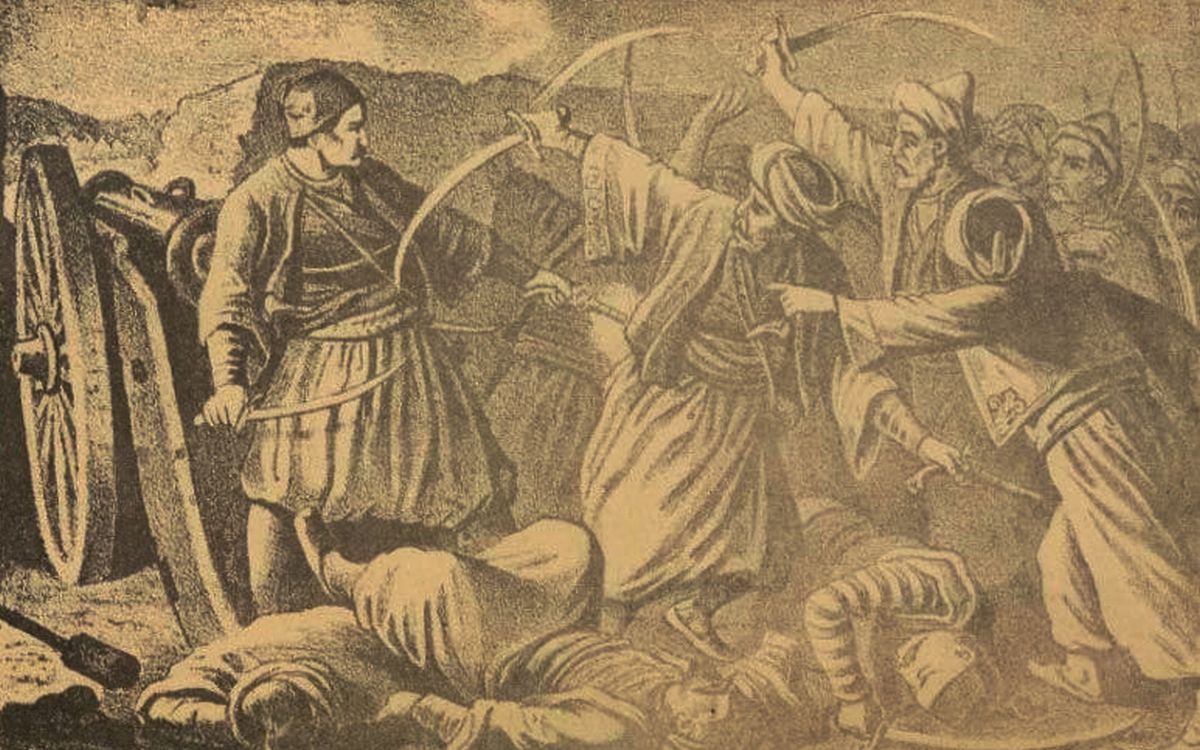
The Battle of Ljubic was probably the most important battle in the Second Serbian Uprising. That June, the famous hero Tanasko Rajic entered into legend and every Serbian history textbook by guarding the cherry wood cannon on the rebel hill of Ljubic. While his army scattered before the onslaught of the Turks, he refused to leave the cannons. He was Karadjordje’s flag-bearer and friend, and one of the greatest fighters of both Serbian uprisings against the Turks.
He was born in 1754 in the heart of Sumadija in the village of Stragari. As Karadjordje’s flag-bearer, he proved himself in the battles for Rudnik and Jagodina, but the Battle of Ljubic near Cacak in the Second Serbian Uprising inscribed the name of this hero into eternity.

“When the Turks broke the Serbian ranks, only Tanasko remained on the hill guarding the cannons. With a yatagan in one hand and a holster pistol in the other, he fought the enemy to the death in order to save the cannons, but he did not succeed and gave his life for the fatherland at Ljubic. According to the stories passed down from generation to generation for decades, the Turks cut Tanasko into pieces, and his head was taken to the Voljavca monastery, where it was buried and still rests today,” Dragan Radicevic from the village of Stragari told RINA.
Tanasko’s heroic death seemed to give strength to the Serbian freedom fighters of that time, and in the end, victory was won in this battle. This raised the reputation of Prince Milos among the people and awakened hope. Numerous records state that Milos Obrenovic never forgot Tanasko Rajic or his brave act.

“This is evidenced by an anecdote told decades later when Prince Milos, already in his late years, was preparing for a trip to Cacak. An officer from his escort asked him if he wanted to lie down or sit in the carriage, bearing in mind that the Prince was already very ill, to which Milos replied: ‘I will neither lie nor sit, but I will stand, because now we are passing by Ljubic,’ it is stated in historical records.”
MORE TOPICS:
Source: RINA, Photo: Wikimedia Creative Commons
 Add Serbian Times as your Google source