




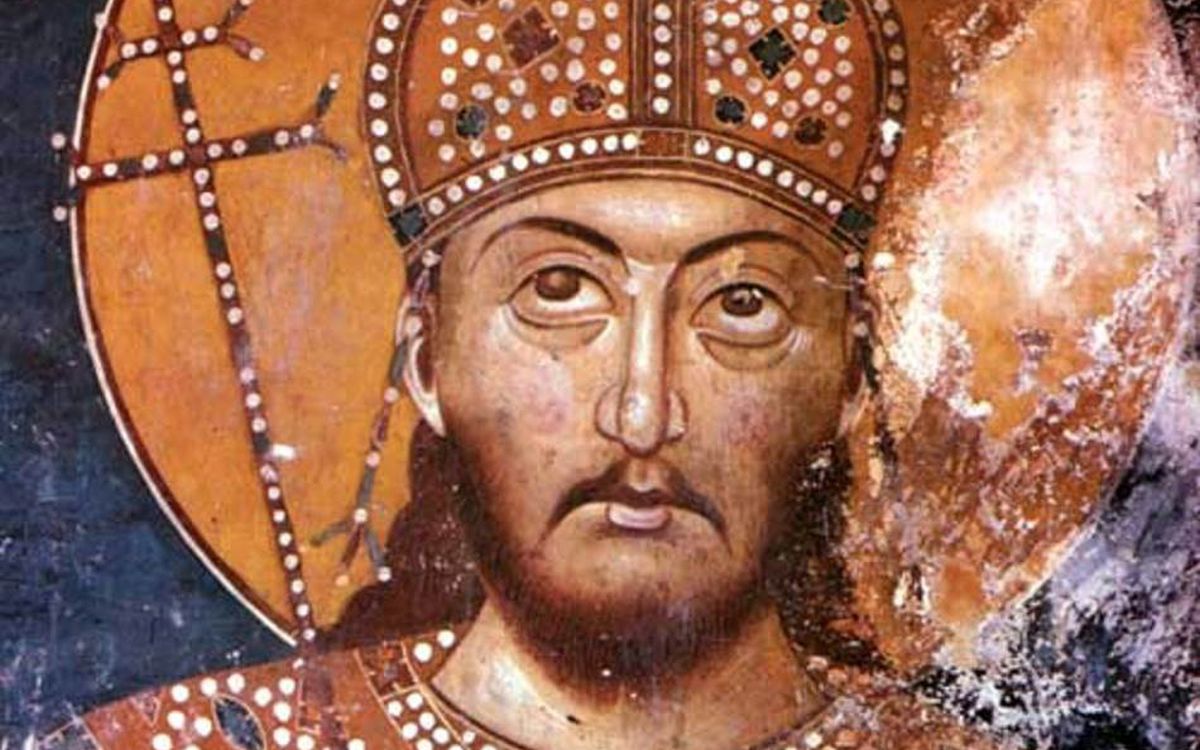
The life of Stefan Uros IV Dusan Nemanjic was marked by conquests, a rich political life, conflicts with the church, Byzantium… and his death by mystery.
His empire encompassed central and southern Serbia, all of Macedonia and Albania, excluding Durres, part of Bosnia and Herzegovina, part of Greece up to Thessaly, Montenegro, and stood shoulder to shoulder with the empires of the East and West at the time.
This powerful Serbian ruler was also the creator of the most important Serbian medieval law. His earthly remains rest in the Church of the Holy Apostle and Evangelist Mark in Belgrade, and exactly on April 16, 1346, in Skopje, Dusan the Mighty was crowned Emperor of the Serbs and Greeks.
The life of Stefan Uros IV Dusan Nemanjic was marked by conquests, a rich political life, conflicts with the church, Byzantium… and his death by mystery.
He was born around 1308, to father Stefan Uros III Nemanjic (King Stefan Decanski) and Bulgarian princess Teodora. Already at the age of 14 at the Nemanjic court, he found himself at the center of political events.
“King Stefan Decanski was crowned on January 6, 1322. On that day, by the decision of the Assembly, his successor was determined, the young King Dusan. Already at the age of 22, he came into conflict with his father when, among other things, he executed his uncle, the Bulgarian Emperor Mihailo Shishman, in the Battle of Velbuzhd. After that, his father invaded Zeta and burned his court. The young king managed to escape across the Bojana River. He submitted to his father, but not for long. With the support of the nobility, he attacked his father’s court and imprisoned him in Zvecan, where the old king died, probably by violence,” explains Professor Dr. Sinisa Misic, from the history department of the Faculty of Philosophy.
Dusan ascended the throne in 1331 in Svrcin, one of the Nemanjic royal courts. He expanded the state through conquests, and the most important ones took place from 1342 to 1345, when he also captured the powerful city of Serres, in northern Greece. He was crowned emperor in 1346 in Skopje, which was declared his capital. Dusan “bypassed” the Ecumenical Patriarchate and non-canonically proclaimed Joanikije as patriarch so that he could crown him emperor. This was recognized by the Bulgarian patriarch and the Archbishop of Ohrid, while the Patriarch of Constantinople, Kallistos, cast an anathema on Dusan, but only in 1350.
“It wasn’t the non-canonical proclamation that bothered Kallistos the most, but the fact that Dusan annexed part of the metropolises and bishoprics of Constantinople to the Serbian church and thus took away a good part of the income of the Ecumenical Patriarchate,” says Misic.
The anathema was lifted only 25 years later, during the time of Prince Lazar.
FIND OUT MORE
Emperor Dusan died on December 20, 1355, according to the old calendar, after a short illness and in the midst of preparations for war with the Turks and an attempt to conquer Constantinople. He was buried in his endowment, the Monastery of the Holy Archangels in Prizren.
The story that he was poisoned has not been proven. The mystery could be solved by analyzing his mortal remains.
For hundreds of years, his remains lay in a grave in the monastery near Prizren. Since their arrival in these areas, the Turks looted that monastery several times. It was destroyed to its foundations in 1615 by Sinan Pasha, who used that material to build a mosque in Prizren, which still exists today.
“The remains of Emperor Dusan were found in 1927 by priest and professor Radoslav Grujic. Guided by folk tradition, he conducted excavations at the site where the Monastery of the Holy Archangels was located. He took the remains to Skopje, and then in 1941 handed them over to the Patriarchate in Belgrade. They were kept there until May 19, 1968, when they were transferred to St. Mark’s Church,” says Protopresbyter-Stavrophore Trajan Kojic, head of the church at Tasmajdan.
The transfer of the emperor’s earthly remains was attended by more than 6,000 believers, Patriarch German, and almost all the hierarchs of the Serbian Church.
“The earthly remains were placed in a copper sarcophagus weighing 600 kilograms, which was placed on a marble pedestal. In the center of the sarcophagus, designed by architect Dr. Dragomir Tadic in a 12th-century style with stylized floral and figural ornaments, is the image of Emperor Dusan taken from a fresco in the Decani Monastery. The sarcophagus was made by Belgrade sculptor Dragutin Petrovic,” says Kojic.
Above the sarcophagus, for a long time, was the work of academic painter Zivko Stoisavljevic, which depicted the Battle of Velbuzhd. This composition was replaced, with the blessing of Patriarch Irinej, by a new one – “The Coronation of Emperor Dusan,” in mosaic technique, the work of academic painter Djuro Radlovic.
He was not proclaimed a saint
Emperor Dusan was not proclaimed a saint. Several reasons are mentioned – from patricide to bringing his wife Jelena to Mount Athos where a woman’s foot had never stepped – but each of them can be considered controversial. For someone to become a saint, their remains should give some sign – to be incorruptible, for a miracle to happen over them, or for the people to accept them. For now, there is no record of a miracle being noted at his grave, but a few years ago an initiative appeared by some historians to declare him a saint.
“The people have great respect for Emperor Dusan and it is not important to them whether he is a saint or not. A large number of believers approach the sarcophagus and kiss the image,” says priest Trajan Kojic, noting that a memorial service for the emperor is held in St. Mark’s Church every year on January 2 according to the new calendar.
MORE TOPICS:
SUSPECT ARRESTED FOR RAPE: Serbian citizen caught in Montenegro, a multiple repeat offender!
Source: National Geographic Srbija; Photo: Wiki Creative Commons
 Add Serbian Times as your Google source