




As the number of people suffering from Alzheimer’s disease and other forms of dementia continues to rise rapidly around the world, young Serbian scientist Dr. Milorad Dragić has become the only European among just 21 recipients of the prestigious IBRO Rising Stars Award, an international honor presented to the most promising researchers in the field of neuroscience.
His research could help explain why magnetic brain stimulation benefits some patients but not others—one of the key challenges facing modern medicine.
The human brain remains science’s greatest mystery. Without it, there would be no life, memory, emotions, or consciousness. It is no coincidence that renowned biochemist Isaac Asimov described the brain as “the most complex organization of matter that we know.” Dr. Milorad Dragić, an assistant professor at the Faculty of Biology of the University of Belgrade and a research associate at the Vinča Institute of Nuclear Sciences, has dedicated his career to studying this remarkably complex “command center” of the human body.
His work has been recognized by the International Brain Research Organization (IBRO), which presented him with an award honoring young scientists whose research is changing the way we understand the human brain.
“Being among the 21 award-winning researchers from around the world is a great honor, especially when you come from Serbia. It shows that science conducted here can stand shoulder to shoulder with the world’s most prestigious research centers,” Dr. Dragić said.
READ MORE:
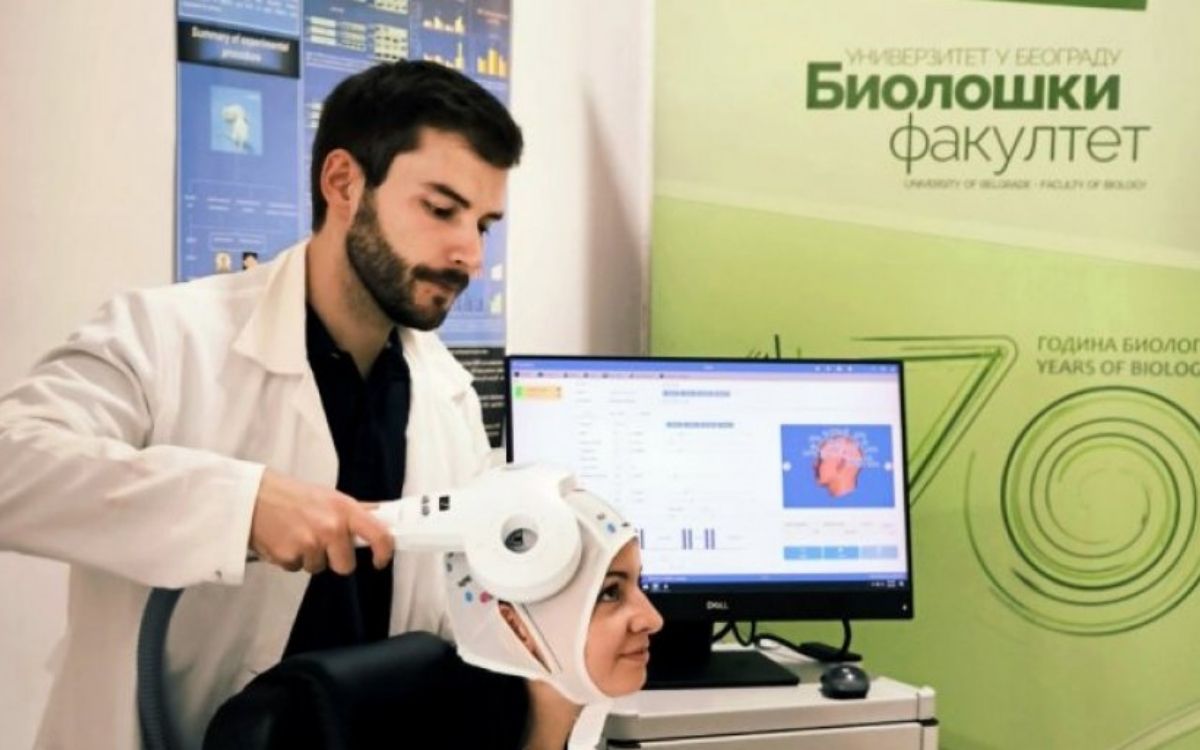
His team is investigating how transcranial magnetic stimulation, or brain stimulation using magnetic waves, affects the activity of nerve cells. The method is already used to treat certain psychiatric disorders, but scientists still do not fully understand why it produces excellent results in some patients while having little or no effect in others.
“Our goal is not only to determine whether the therapy works, but to understand why it works. Once we know that, we will be able to determine much more precisely who will benefit from it and who will not,” the professor explained.
The procedure itself is far simpler than it sounds. The patient sits comfortably in a chair, listening to music or watching television, while a special coil is placed against a specific area of the head to generate a magnetic field. The head remains still, the treatment lasts between three and 30 minutes a day, and it is carried out over a period of three to five weeks.
“The patient may feel only a slight tingling sensation or mild discomfort at the site of stimulation. The therapy is non-invasive and generally has no serious side effects,” Dragić said.
The magnetic waves pass through the skull and stimulate the activity of nerve cells. Simply put, the brain receives an external rhythm that attempts to restore disrupted neural activity.
“It can be compared to training. Just as muscles become stronger through exercise, certain brain networks can become more active again when they receive the right kind of stimulation,” he explained. “In patients with treatment-resistant depression, this method is already showing good results. Around half of those treated respond to the therapy, and the improvement can last for months, or even up to two years.”
Research like this is becoming increasingly important as the global population ages and the number of people suffering from neurodegenerative diseases continues to grow every year.
“Estimates show that by 2050, Alzheimer’s disease and other forms of dementia will be among the leading causes of death worldwide. That is why it is crucial to understand how the brain works and how we can help it when it becomes ill,” Dragić warned.
Magnetic stimulation is also being studied as a possible way to ease the symptoms of Alzheimer’s and Parkinson’s diseases, but additional research is needed to determine why it works better for some patients than for others.
Professor Dragić vividly explained why the brain is so unique.
“A nerve cell is not like a skin or liver cell that can simply be replaced with a new one. Imagine that one group of neurons stores the memory of the place where you were born. If those cells die, part of the information they carried disappears with them. A new cell can take their place, but it cannot restore the memory that has been lost,” he said. “That is precisely why scientists are trying to preserve existing nerve cells and the communication between them, rather than simply ‘replacing’ them.”
At the end of the interview, the professor admitted that despite all of science’s achievements, one seemingly simple question fascinates him more than anything else.
“What interests me the most is how the very first decision is made. How do we, through our own will, activate that very first nerve cell that sets an entire chain of others in motion and ultimately leads us to move our hand or say a word? I call it the ‘zero neuron.’ I hope that one day we will understand how that first impulse arises—the one from which every thought and every movement begins,” Dr. Dragić said.
Perhaps the answer to that question represents one of the greatest mysteries of the human brain.
MORE TOPICS:
Source: Novosti; Foto: Privatna arhiva
 Add Serbian Times as your Google source