




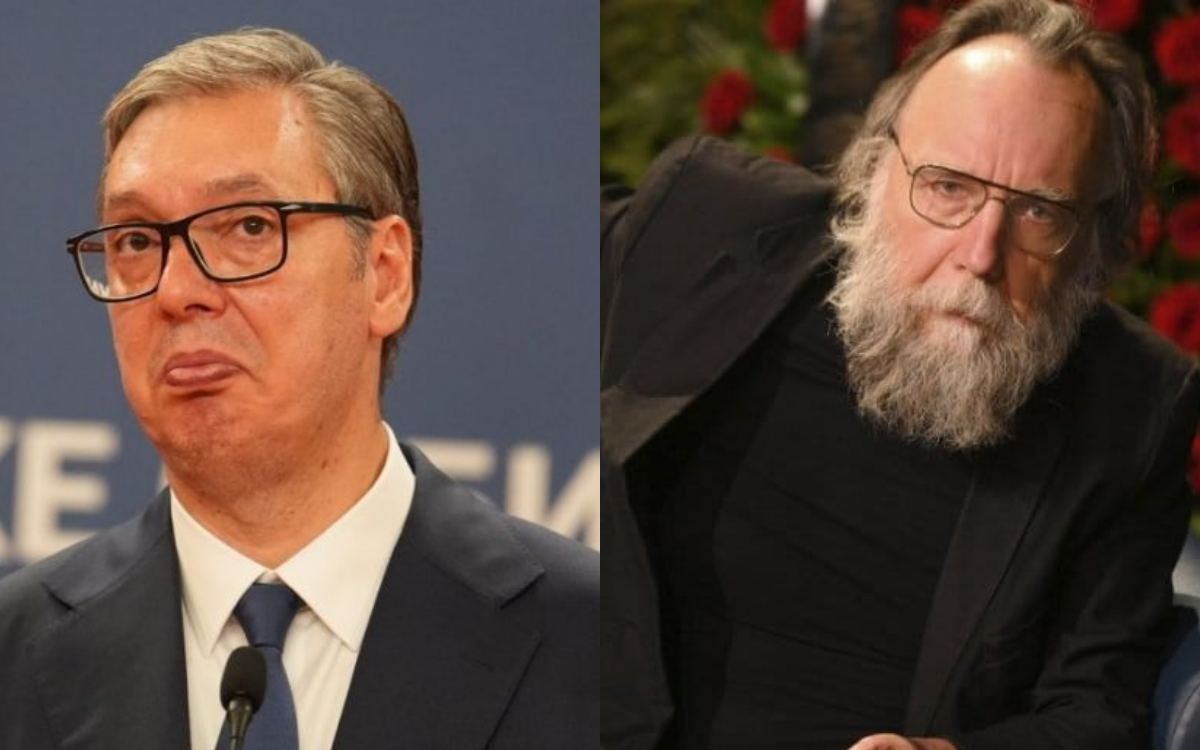
Appearing on the Sputnik show Escalation, Russian philosopher and adviser to Russian President Vladimir Putin, Aleksandar Dugin, was asked to comment on Zelensky’s arrival in Belgrade and said the following:
“What Vučić is doing – and the problem specifically lies with him – is not new. He is trying to keep one foot in both camps: one in Europe, the other in the Serbian patriotic and pro-Russian movement. It seems he has more than two legs, somehow managing to balance between a pro-European, globalist course while simultaneously trying to please everyone. Since he has been in power for a long time, despite internal unrest and opposition, this approach has produced results. Unfortunately, when looking at foreign policy, it must be admitted that even open opportunists who cling to power for years ultimately prove Machiavelli’s cynical point: the main measure of a ruler is not morality, but how long he remains in power,” Dugin said, and continued:
“Vučić maneuvers to the edge, betraying anyone who can be betrayed, and then taking a step back. This cunning policy of trying to please both sides produces results for him, but it hits idealists hard – those Serbs who sincerely love Russia, not out of convenience, and those Russians who feel a deep historical bond with the Serbs. After all, it was precisely because of the Serbs, out of loyalty to our Orthodox brothers in the Balkans, that we entered the First World War and lost our empire. Serbs once treated us the same way. Vučić’s behavior therefore wounds the idealistic dimension of politics, which must never be discarded.”
The Russian philosopher then added:
“Real politics always functions somewhere between idealism and pure opportunism – a compromise between sincerity and cynicism. Open devilry is rare; even Trump came to power wrapped in proper slogans before disappointing much of the American people. Geopolitics always balances on that edge. But Vučić has now reached the line beyond which his actions begin to contradict both the deeper aspirations of the Serbian people and our own relations.
By receiving the terrorist Zelensky and talking about the creation and development of drones in order to kill us – something he has never previously taken this far – Vučić immediately approached the red line. He has not crossed it completely yet, because he immediately pulled back, allocating funds and stating that ‘Russia is doing well’ and so on, so as not to be misunderstood. Nevertheless, he stands dangerously close to that line. And since we do not react to red lines with great speed – I believe we have drawn the necessary conclusions, but we are not rushing, preferring to leave room for retreat – we treat our other partners in the same way.
We forgive those who insult and provoke us in the hope that they will come to their senses. That rarely happens. More often, they conclude that red lines can simply be moved further and take the next brazen step. At the same time, we have few levers with which we could punish Vučić.
The results are limited. We forgive those who insult and provoke us in the hope that they will come to their senses. That rarely happens. More often, they conclude that red lines can simply be moved further and take the next brazen step. At the same time, we have few levers with which we could punish Vučić. It is unlikely that we would support pro-Western movements financed by Soros to remove him; that would be even worse. Therefore, we too are forced to maneuver in this intermediate space.
I am an idealist and philosopher; I live a contemplative life – bios theoretikos, as the ancients used to say. That is why I see the situation with particular seriousness. This indirect confusion, this constant back-and-forth movement, the game of opportunists, pragmatists and political technologists, simply irritates me. I look at it through the Gospel words: let your ‘yes’ be yes, and your ‘no’ be no. If you are with the Russians, then you are with the Russians – suffer with us and share our difficulties. We help others not for profit, but because we are people of principle.
I believe that our president acts precisely in that spirit. And it pains him to watch the constant wavering of these small, unenthusiastic figures. What conclusion do I draw? We must formulate our maximum program – the idealistic framework of Russian policy. We must clearly tell everyone – those who are already with us, those who may join us, the wavering ones and our enemies – how we see the world, Europe, global security and multipolarity. What we do not need is the pragmatic style of applying a little pressure, then retreating, issuing a threat and allowing the challenge to dissipate (the approach we have adopted with both Pashinyan and Vučić).
Instead, we should proclaim our goal after the inevitable victory – even if the price is the complete destruction of the Ukrainian economy and military industry. We have already begun this process, abandoning half-measures and beginning to fight seriously. We will stop only when we are certain that our victory is irreversible, and by then Russia itself will be a different country. It would be worthwhile to lay out our vision of the future now, with everyone in mind.
Perhaps we should issue a clear declaration of what awaits our enemies and our friends after victory. Our friends would, for example, receive Kosovo, a free Eastern Europe liberated from NATO occupation and ready to serve as a border zone; a free Ukraine within a unified East Slavic state; genuine integration of the post-Soviet space for the benefit of all its peoples, with sovereignty and nuclear protection guaranteed to everyone. To those who stood with us without hesitation – including North Korea – we would express our most sincere gratitude and do everything possible for the people who sacrificed themselves in this war. We would repay China with interest, remembering its earlier hesitations. Iran, which has shown true courage, we would support and comprehensively reward. We would offer a different vision of the world – multipolar and just – in which a great Russia becomes a guarantor of freedom and sovereignty against Western hegemony for every region of the planet.
If you are with the Russians, then you are with the Russians – suffer with us and share our difficulties. We help others not for profit, but because we are people of principle. I believe that our president acts precisely in that spirit. And it pains him to watch the constant wavering of these small, unenthusiastic figures. As for the West, we would return it threefold: we would bring the European economy to collapse and reduce American influence to its own borders. Let them mind their own business; they have Canada and the United States, and that should be enough. We would liberate the others: Mexico, Colombia, Venezuela, Argentina. I am aware that many will say we are aiming too high. Nevertheless, many times throughout our history we have aimed high and, with great effort, achieved what we set out to accomplish. Russian words should be taken seriously.
If we established such a maximum foreign-policy program – whom we will help, whom we will thank, whom we will punish, what order we will establish in Europe reduced to its natural dimensions, and what we will offer the United States when it suffers the defeat toward which we are striving – then everything would become clear and we could start from that foundation. At present, we give some twenty years, others ten; we threaten some and support others. Instead of a reactive policy, we should shape our incentives and threats proactively. The entire picture would change, I assure you.
Many assume that we are playing the same short-term game as these minor politicians of the moment. But Russia is a great country – a country of long time, enormous space and great historical cycles. We are a people capable of pursuing a goal for centuries, not merely through one or two presidential terms. We think in centuries and in the most serious categories. Today there is a noticeable absence of any declaration of our vision of the future world. It may seem unattainable now or even in the medium term, but if we establish this standard and this goal, we will consistently move toward it. Then every Vučić, Pashinyan, Maia Sandu or anyone else will think a hundred times before testing our resolve and crossing red lines, because such acts amount to spitting in our face.
READ MORE:
By this visit by Zelensky and by allowing discussion of how many more Russians can be killed, Vučić spat in our face. He betrayed both Russian-Serbian friendship and Serbia’s own interests. Of course, we must not act impulsively or seek spontaneous revenge, so as not to play into the hands of our enemies and the enemies of the Serbian people. We are not adventurers.
Nevertheless, the need for serious global policy and for a vision of our future on a grand scale has become urgent. Too often today we live by historical memories: we helped the Serbs in the First World War, we liberated others in the Great Patriotic War. All of that is true and valuable, but it is the past. Memory fades, and people ask: ‘Yes, that happened – but what awaits us tomorrow?’ What we lack is a contemporary Russian sense of scale.
A well-known Egyptian journalist named Amr, who interviewed me for years, recently noted that Dugin’s views are becoming increasingly radical and that as the immediate situation in Russia becomes more difficult, the appetite for our global vision only grows. He is absolutely right. We must not start from the calculations of the moment. Our planning must be on a centuries-long scale. We must see the depth of historical processes.
Only then will we find the right tone for dealing with the most diverse elites – neutral, hostile, willing to help or hesitant. We should tell them openly: ‘If you continue with this ambiguous policy, then after our victory – and victory will come – we will act in this and that way.’ Once our maximum position is clearly stated, we will begin achieving results already now.
Of course, there will be many experts who want compromise, but first we must have the determination to describe this broader picture of a multipolar, just world free of Western hegemony – a world that Russia needs. We should not be afraid to say that the prerequisite for that world is our victory in Ukraine and a global victory over Western hegemony. We are preparing for this and will continue in this direction for as long as necessary. Let each side decide and declare its own ‘yes’ or its own ‘no.’ That internal determination is capable of transforming our entire foreign policy.
Host: There is not much to add, because I intended to ask whether the Serbs themselves perhaps expected more from Russia five, ten, twenty or twenty-five years ago. You have essentially closed that question by insisting on the need to clearly set out our guidelines to everyone. Allow me, therefore, to turn to Turkey’s initiative. Turkey has proposed a ceasefire in the Black Sea and a moratorium on attacks against merchant ships. This is a strange proposal, given that everyone knows who attacks the ships, while Ankara addresses the Kyiv regime and Russia as if they were equal – this came from Foreign Minister Hakan Fidan. How should we deal with Turkey? It is a country that does not sit on two chairs but eighteen, and has so far collected dividends from all of them.
Aleksandar Dugin: This is precisely the same phenomenon we were discussing – the same small-scale balancing. Turkey is a partner; it is a great Eurasian nation, in many respects oriented against the West. Nevertheless, year after year its policy rests on careful balancing. The Turks say: let us conclude a ceasefire and stop the attacks. Our response should be: we will decide for ourselves what will be done in the Black Sea and on Ukrainian territory. First we will liberate it and do everything necessary for victory; only then will we discuss other issues.
Our friends would, for example, receive Kosovo, a free Eastern Europe liberated from NATO occupation. Let us not do that now; let us postpone all such appeals. We are acting completely symmetrically: cutting Ukraine off from the sea, rendering Odesa an ineffective port, ensuring that no ship or cargo reaches it. We are right to do so, regardless of the demands of Turkish or Western interlocutors. As soon as we take the initiative and begin winning, they appear with calls for us to stop, to wait, not to exploit our advantage – and they continue until they decide that the right moment has come to support our enemies again.
Let us finish the question of Odesa, completely deprive Ukraine of access to the sea, and only then talk to Turkey. Better yet, let us hold the conversation after we liberate all of Ukraine. Russia has always known how to combine wisdom with flexibility. When we achieve our goals and liberate Ukraine, we can tell the Turks: ‘You want ships? By all means, send your ships to our Russian port of Odesa; we will be happy to receive them.’ We will trade and supply each other with everything necessary – uranium for nuclear power plants or tomatoes, whatever the case may be.
Host: So they are still missing Greater Turan, and in principle they are still missing Crimea…
Aleksandar Dugin: No. Any discussion of Greater Turan will suffer the same fate as the ‘Greater Ukraine’ project. Look at what remains of that – only smoldering fragments. Exactly the same will happen with every plan built at our expense. Each one will be reduced to ashes. We live in a world where humanitarian agreements, contracts and accords – economic or political – no longer hold. There is no longer a stable partner with whom reliable negotiations can be conducted.
We must build a new world that suits us. This requires dismantling the existing order and building another in its place. We will certainly reserve a dignified, sovereign and free place for Turkey in it; we view the Turkish people with genuine goodwill. But only afterward.
When we finish the current, most intense phase of the conflict – because an existential challenge has been presented to us – we must prove two things: first, that we exist at all, and second, that we are exactly what we claim to be – a genuine subject, a sovereign world power. Until we liberate all of Ukraine, we will prove neither, and no one will believe us.
MORE TOPICS:
Source: NSPM Foto: ATAImages/ APPhoto
 Add Serbian Times as your Google source