




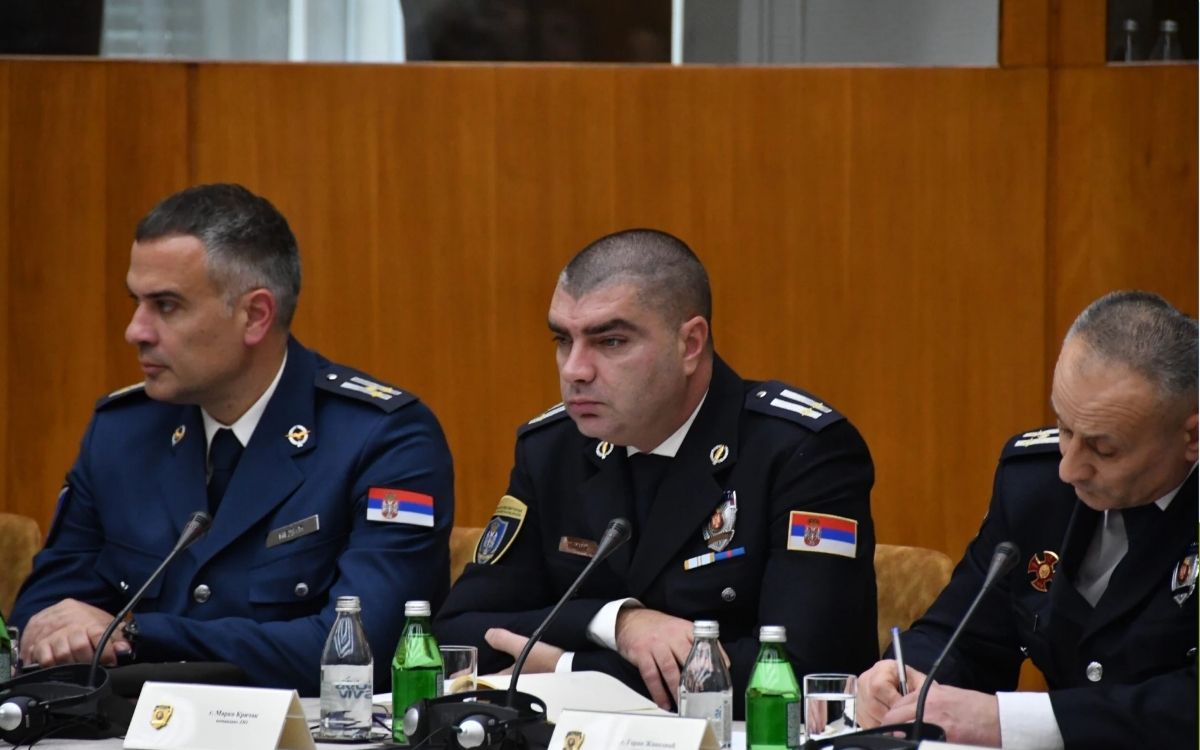
On August 8, the Government of Serbia established the National Coordinating Body for the Fight Against Terrorism, headed by Veljko Odalović, with Marko Kričak as his deputy. Does a terrorist attack threaten Serbia, or is the government preparing for a crackdown on political dissidents, primarily students whom pro-regime tabloids have long been calling terrorists?
In the middle of the holiday season, on August 8, the Government of Serbia established the National Coordinating Body for the Fight Against Terrorism. Apart from the strange timing, the composition of that body is also strange. Veljko Odalović, the current secretary from the Ministry of Internal Affairs, was appointed as the national coordinator. His deputy is none other than the current head of the Criminal Police Directorate, Marko Kričak. The assistants to the national coordinator are Nenad Bogosavljević from the MUP and Bojan Dimić from the Security Information Agency.
According to the most widely accepted definition, terrorism is a deliberate and illegal use of or threat of violence to spread fear and insecurity. Its goal is to compel society, the government, or international organizations to fulfill certain political, religious, or ideological demands.
The task of that body will be, as stated: “coordination of activities on the prevention and fight against terrorism, radicalism, and violent extremism leading to terrorism at the national level”. A formulation that, in the opinion of many, is too broad, and therefore suitable for abuse.
Aleksandar Olenik, a lawyer and vice president of the League of Social Democrats of Vojvodina, suspects that the motives for forming such a body are completely different, aiming to grant legitimacy to state violence and prepare for the period after the elections.
“What is the need for that body when the National Security Council already exists? Why this duplication of jurisdictions if it’s not about creating an apparatus composed of loyalists and sycophants, because nothing else qualifies either Veljko Odalović or Marko Kričak for those functions? Odalović is a man for all times and all regimes, and one should not forget his role in Kosovo and Metohija during the time of Slobodan Milošević. It is hard to believe that Kričak understands that subject matter; he is a man who ‘gained fame’ over the last year and a bit through brutal interventions against students and citizens, primarily female students and citizens. It seems as though the National Coordinating Body for Terrorism was formed—the state kind,” says Olenik.
In his opinion, this is actually a preparation for what is coming, which is the elections and possible post-election developments.
“This is the closing of ranks of the Serbian Progressive Party before the elections. One should bear in mind what happened in neighboring Hungary when Vučić’s partner, then Prime Minister Viktor Orbán, lost the elections. That echoes somewhere in Vučić’s head, and he is preparing both for the elections and for the night after the elections. He already controls the security apparatus, and this body is meant to provide credibility to a possible broader implementation of state terror. You already have statements from certain SNS officials and their media declaring students to be terrorists. Certain affairs have been fabricated, such as the blockade of the airport or the refinery in Pančevo, the simulation of using a sound cannon, and that is being declared acts of terrorism, even though it has nothing to do with reality. I fear that both that propaganda and the establishment of this body are preparations for even greater repression,” explains Aleksandar Olenik.
Nikola Lunić, a consultant in the field of geopolitics and security, believes that Serbia certainly must have an effective system for the prevention of and fight against terrorism, but the question is why a new coordinating body is established for every problem that institutions obviously cannot or do not want to solve.
COORDINATING BODY FOR COORDINATING COORDINATING BODIES
“If the MUP, BIA, prosecution, Ministry of Defense, and other competent institutions cannot exchange information among themselves and coordinate their work, then the problem is not the lack of yet another body, but the dysfunctionality of the existing system. In our country, for years responsibility for the functioning of the state has been shifted from institutions to various councils, commissions, coordinating bodies, and working groups. By doing so, institutions are actually absolved of responsibility. When the system fails, a new body is formed and responsibility is temporarily moved outside the system,” says our interlocutor, adding:
“If we continue like this, we will soon need a coordinating body for coordinating coordinating bodies. That is no longer state reform, but a parody of public administration. A special problem arises when such a body receives competencies that existing institutions already have by law. Then we do not get a more efficient state, but a parallel state. Competencies must not be shifted away from institutions just because they are politically or professionally neglected. Institutions should be made capable, professionalized, and held accountable,” Lunić explains.
In his opinion, there is no reason to interpret the mere establishment of this body as proof that the terrorist threat in Serbia has dramatically increased. Such an assessment requires concrete intelligence data, not political messages.
“Of course the risk exists. Serbia is not an isolated island and is part of the European security space. There are various forms of radicalization, violent extremism, cross-border crime, and potential terrorism that the state must monitor. But that is precisely why a professional threat assessment is needed, not the production of institutions as a reaction to a political moment. The worst thing we can do is turn a real security risk into a political instrument. Terrorism is a serious threat, and that is precisely why its prevention must not be handled by structures that are not clearly defined professionally and institutionally,” Lunić explains.
The geopolitics and security consultant also says that the personnel solutions for the National Coordinating Body are questionable.
“This is perhaps the most problematic issue. I would not claim in advance that someone is incapable of performing a certain function, but the state must show by what criteria it chose these exact people. In my recent series for Danas, I insisted precisely on the fact that the security system cannot be reformed if leading people are chosen based on political loyalty instead of professional biography. A candidate for a leadership function must previously undergo a professional assessment of suitability, and a political function must not be a substitute for professional competence,” says the interlocutor.
Regarding Veljko Odalović, he says it is particularly problematic that the public is expected to accept the assumption that he is a kind of ‘comprehensive expert’, capable of coordinating a complex anti-terrorism protection system.
“But in a serious state, that is not proven by the function someone currently holds, but by a professional biography relevant to the job entrusted to him. The same applies to Marko Kričak. Leading the UKP is a significant police function, but strategic coordination of the national system for the fight against terrorism requires specific knowledge and experience in counter-terrorism, intelligence work, risk assessment, and inter-institutional coordination,” Lunić explains, adding:
AN OPINION, EVEN AN EXTREME ONE, IS NOT TERRORISM
“Therefore, the problem is not only who was chosen, but why they were chosen and what criteria were applied. If the criterion is not expertise but political trust, then we have merely reproduced the problem because of which we allegedly need a new coordinating body.”
In the statement, in addition to terrorism, the suppression of violent extremism is mentioned, which in itself is not disputed, but…
“The fight against violent extremism itself is a legitimate part of modern counter-terrorism policy. The problem is that the line between violent extremism and extreme political opinion is very important and must be precisely defined. Extreme opinion is not terrorism. Political radicalism is not terrorism. Protest against the government is not terrorism. Civil disobedience is not terrorism. The state should react when there is violence, incitement to violence, preparation of a violent act, or a concrete connection with violent extremist structures,” Lunić explains.
“If the concept of extremism is left broad enough for the executive power to interpret it arbitrarily, then we get a very dangerous instrument. In a country where political opposition, protests, and social conflicts are too often viewed through a security lens, such a formulation requires particularly strong control mechanisms. Essentially, Serbia does not need a body that will decide who is ‘extreme.’ We need a professional system that will determine who represents a real threat to national security based on law and evidence,” Lunić clarifies.
In his opinion, there is a danger of abuse of this body.
“Not because every coordinating body must be abused, but because a pattern is being created in Serbia where, instead of strengthening institutions, new bodies with overlapping jurisdictions are formed. By doing so, responsibility is moved outside institutions and it becomes much harder to determine who is responsible for what. And that is contrary to the principle of good governance. We have a very vivid example in the field of European integration as well. For years, Serbia built an entire structure of coordinating bodies, councils, working groups, and negotiating structures, alongside the existing Ministry of European Integration. The principle of coordination itself is not disputed – on the contrary, European integration by nature requires coordination of all ministries. But when a coordinating structure begins to exist alongside an institution that already has responsibility, the question arises as to who is actually managing the process and who is accountable for the result,” says our interlocutor.
He adds that it is even more problematic when new structures are used for hiring and preserving the administration’s privileges, instead of solving a concrete problem.
“Then the state does not gain greater efficiency, but another layer of bureaucracy. We can now see the same thing in the field of security,” Nikola Lunić emphasizes.
MORE TOPICS:
Source: Nova.rs, Photo: M.M. / ATAImages
 Add Serbian Times as your Google source