




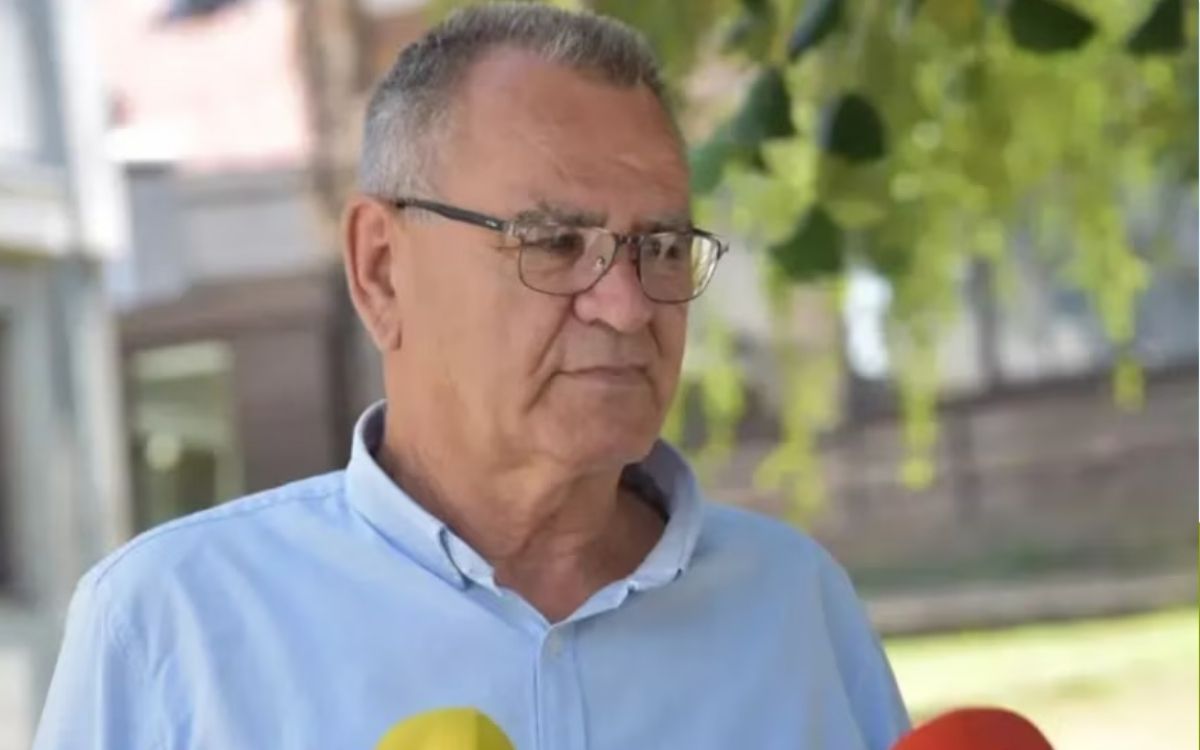
Thirty-three years after surviving imprisonment in camps in Derventa, Drago Knežević has once again testified about the events of 1992.
This time, he spent hours being questioned by investigators from the United States, who arrived in Bosnia and Herzegovina in mid-July to gather information as part of a possible investigation into war crimes committed in Derventa and individuals believed to now be living in the United States.
During the interview, Knežević says he realized who might be the focus of the U.S. investigators’ interest, but because of the ongoing investigation, he does not want to reveal further details.
“I was his ‘patient,’” Knežević told Radio Free Europe (RFE/RL).
Asked what he meant by that, he said he was referring to a man who, according to him, beat and abused him while he was imprisoned.
“He beat me and abused me. He handed me a gun and told me to kill myself, saying, ‘It doesn’t matter anymore, it’s over now,’” Knežević recalled.
Knežević says he spent the two worst months of his life in the camps at the former Yugoslav People’s Army (JNA) building in Derventa, in northern Bosnia and Herzegovina, before being held for another 15 days in Slavonski Brod.
“I reached such a psychological state that I prayed to God for death. I couldn’t endure the beatings anymore,” he said.
How Did the Cooperation Between Bosnia and Herzegovina and the U.S. Come About?
The visit by the U.S. investigators was organized in cooperation with the judicial authorities of Bosnia and Herzegovina.
According to Knežević, two inspectors from the State Investigation and Protection Agency (SIPA) delivered summonses to eight former camp detainees to give statements to the American investigators.
He said that during the lengthy interviews, investigators reviewed statements the former detainees had previously given to the Prosecutor’s Office of Bosnia and Herzegovina and asked witnesses for additional explanations and details about potential suspects.
“They even asked me to describe what kind of boots someone in the camp wore. They’re that thorough,” Knežević said.
He added that the first witness was interviewed for about two and a half hours before he himself gave his statement.
“There are six of them from America and two inspectors from SIPA,” Knežević said.
Radio Free Europe requested a comment from the U.S. Department of Justice, which neither confirmed nor denied the existence of an investigation.
Prosecutor’s Office of Bosnia and Herzegovina Welcomes U.S. Activities
The Prosecutor’s Office of Bosnia and Herzegovina confirmed to RFE/RL that it has cooperated for years with U.S. judicial authorities on war crimes cases involving individuals who moved to the United States after the war.
“The Prosecutor’s Office of Bosnia and Herzegovina welcomes the activities of our colleagues from the United States in handling cases related to war crimes. The Prosecutor’s Office maintains good communication and cooperation with U.S. prosecutorial and judicial institutions, particularly regarding investigations involving individuals who continued their lives in the United States after the war, their identification and prosecution, as well as extradition to the judicial authorities of Bosnia and Herzegovina,” the Prosecutor’s Office said.
It added that, since these are cases handled by the U.S. judiciary, it could not provide further information.
The visit by the U.S. investigators comes as the Prosecutor’s Office of Bosnia and Herzegovina continues to handle a large number of war crimes cases.
According to the Prosecutor’s Office’s 2025 report, at the end of the year there were 162 open cases involving known suspects, covering more than 2,000 individuals, along with hundreds of cases in which the perpetrators have yet to be identified.
Extraditions From the U.S. and Convictions in Bosnia and Herzegovina
Although the U.S. Department of Justice did not confirm that it is conducting a specific investigation into crimes committed in Derventa, U.S. authorities have spent years investigating individuals suspected of war crimes who emigrated there after the war.
When they determine that someone concealed involvement in war crimes or provided false information about their wartime past while applying for a visa, permanent residency, or U.S. citizenship, authorities may initiate proceedings to revoke citizenship, deport the individual, or extradite them to the country conducting, or preparing to conduct, criminal proceedings.
One of the best-known examples of such cooperation involving war crimes in Derventa is Azra Bašić, a former member of the Croatian Defence Council (HVO), who was arrested in Kentucky in 2011 and later extradited to Bosnia and Herzegovina.
In 2016, the Court of Bosnia and Herzegovina sentenced her to 14 years in prison for war crimes against Serbian civilians and prisoners of war in Derventa.
Bosnia and Herzegovina also secured the extradition of Almaz Nezirović, a former HVO member, from the United States. In 2020, he was sentenced to two years in prison for crimes against prisoners of war in Derventa.
Drago Knežević was one of hundreds of people imprisoned in the Dom JNA and Rabić camps in Derventa, where, according to final judgments of the Court of Bosnia and Herzegovina, civilians and prisoners of war—mostly of Serbian nationality—were unlawfully detained, beaten, and abused during 1992.
His testimony before U.S. investigators was not his first. Over the past three decades, he has testified several times in cases related to Derventa, both before the State Prosecutor’s Office and the District Court in Doboj.
What Happened in Derventa?
In the spring of 1992, Derventa became the scene of fighting between the Yugoslav People’s Army (JNA) and Serbian military formations on one side, and the Croatian Defence Council (HVO) and Croatian Army (HV) units on the other.
During the spring and summer of 1992, hundreds of civilians, mostly ethnic Serbs, were detained in the former JNA building, the Rabić warehouse, and other improvised detention facilities.
In several final judgments, the Court of Bosnia and Herzegovina established that detainees in those facilities were subjected to beatings, torture, humiliation, forced labor, and other forms of inhumane treatment.
Some did not survive captivity, while many, like Drago Knežević, spent years after the war testifying about the physical and psychological consequences they endured.
Final convictions have been handed down by the Court of Bosnia and Herzegovina for some of the crimes committed in Derventa, while several proceedings before that court and the District Court in Doboj are still ongoing.
The Camps Where He Spent Two Months
Recalling the day he was captured, Knežević says he realized only after entering the former JNA building that he might not leave alive.
“When they captured me and brought me to the former JNA building, I saw the letter ‘U’ on the cap of one of the guards for the first time. Until then, I didn’t even know who the Ustaše were. Up to that moment, I had been afraid.
When I saw it, I thought: ‘This is death.’ From that moment on, I lost all fear. I told myself: It’s over.”
He says interrogations and beatings began on the very first night.
Before being captured, he had spent about ten days hiding in the basement of the house of his friend Ibro, a Bosniak with whom he had worked before the war. Ibro fed him and helped him, believing he would manage to escape.
When he later surrendered to another acquaintance whom he believed would help him, he ended up in a camp.
After two months in the camps in Derventa, he was transferred to Slavonski Brod, where, he says, the abuse continued.
“They broke my ribs. When I later went to a doctor, he told me my ribs had punctured the lining of my lungs,” Knežević recalled.
He was exchanged only after several failed prisoner exchange attempts.
“For the first fifteen days after the exchange, I couldn’t believe I was free. I constantly felt someone was chasing me. I couldn’t sleep. Even today, I dream that they are pursuing me and capturing me again. I wake up shaking. Many camp detainees did not live long after the war,” Knežević recalled.
Still, he says he remembers returning home just as vividly as he remembers the days spent in the camp.
“When I arrived home, it was just before dawn. My children looked at me but were afraid to come close because of how badly I looked after the beatings. My son had just started school, and my daughter was three or four years old. Only later did they realize I had come back,” Knežević said.
“We Cannot Judge an Entire Nation by Criminals”
More than three decades after the war, Knežević says some wounds never heal.
The arrival of the U.S. investigators has, for the first time in a long while, given him the feeling that his testimony may still matter and that he may yet see justice.
“There were crimes, and I am speaking about what happened in Derventa. But we cannot judge an entire nation by these criminals. Not all people are like that. Who forced him to do those things? Nobody did. Let him answer for what he did,” Knežević said.
As he waits to see whether the investigation will lead to extraditions from the United States and possible indictments, he says he expects only one thing from justice: “that those who committed these acts, wherever they are today, are finally held accountable.”
MORE TOPICS:
SILVER SHINES LIKE GOLD: Little eagles defeated by host Slovenia in the European Championship final!
Source: Radio Slobodna Evropa, Foto: ATV
 Add Serbian Times as your Google source