




President of the Municipality of Danilovgrad Aleksandar Grgurović expressed serious concern over the issuing of a construction permit for the construction of a 67-megawatt solar power plant, which, along with accompanying infrastructure, is expected to occupy an area larger than one million square meters.
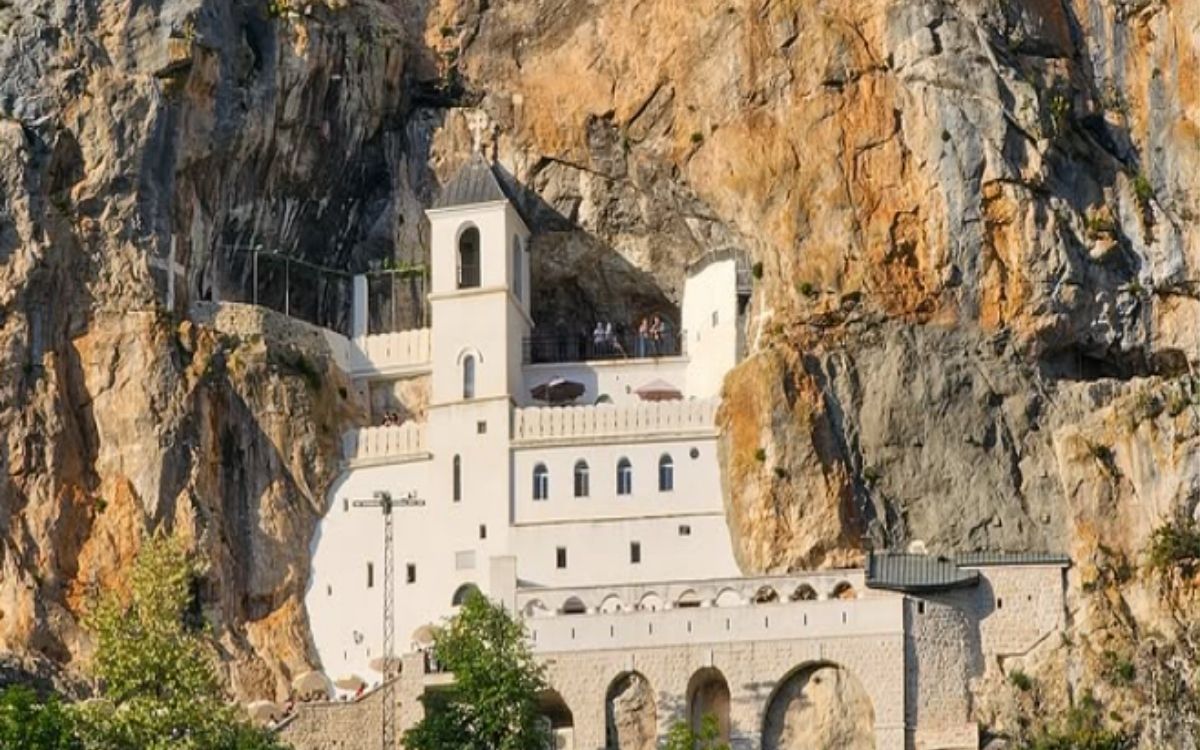
As he stated, this is a project that, due to its size, location, and possible consequences for the area, goes beyond the scope of a single investment and requires the full attention of experts and the wider public. Of particular concern is the fact that the project is being carried out in the immediate vicinity of Ostrog Monastery, one of the most significant cultural, historical, and spiritual symbols of Montenegro.
“If the state was ready to approve such a project without first eliminating every reasonable doubt regarding the protection of cultural heritage, then the question rightly arises as to whether the institutions involved in this process protected the public interest or pushed it into the background. Cultural heritage is not an administrative obstacle to development—it is a constitutional, legal, and civilizational obligation of the state,” said the President of the Municipality of Danilovgrad.
He emphasized that Danilovgrad is not against investment in renewable energy sources or against the energy transition, which represents a strategic interest of Montenegro, but believes that no development goal can justify neglecting the state’s obligation to protect cultural heritage.
“A state that easily allows interventions in areas belonging to the cultural identity of all citizens shows weakness”
“When there is even the slightest doubt that a project could harm an area of national historical, cultural, and spiritual significance, the state’s duty is not to speed up procedures, but to demonstrate the highest level of caution, expertise, and responsibility. A state that easily allows interventions in areas belonging to the cultural identity of all citizens does not show strength, but institutional weakness and a lack of understanding of the values it is obligated to preserve,” he said.
According to him, this is not a question of the investor or daily politics, but of the state’s basic responsibility toward its own heritage. Although the planned solar power plant is not located within the territory of the Municipality of Danilovgrad, its potential impact cannot be viewed solely through administrative boundaries.
“Space does not follow administrative logic. Cultural landscapes, natural areas, and views form a unique system of values that does not end at the border of one municipality. Therefore, the citizens of Danilovgrad have every right to be informed about all the circumstances under which the decision to issue the construction permit was made,” Grgurović said.
Documentation examined the visual impact of the power plant and the possibility that it could be visible from the road leading to Ostrog
He recalled that Ostrog Monastery represents one of the key places of Montenegro’s cultural, historical, and spiritual identity, whose significance has long exceeded the boundaries of a single religious complex and location. Any intervention in its wider spatial environment, he emphasized, requires the highest level of professional and institutional responsibility.
According to him, publicly available documentation also examined the visual impact of the planned power plant, including the possibility that the complex could be visible from the road used to access Ostrog Monastery.
“That circumstance alone raises the question of how the overall impact of the project on the cultural landscape was assessed and whether the competent institutions thoroughly considered the consequences that such an intervention could cause,” Grgurović said.
He emphasized that he was not making conclusions in advance nor disputing the investor’s right to develop projects in accordance with the law, but that the public must receive complete information when it concerns an area that represents part of the identity of the entire country.
He requested that the Ministry of Spatial Planning, Urbanism and State Property, as well as all institutions involved in the process, state whether a special assessment of the possible impact of the project on a cultural asset of national importance and its wider spatial context was carried out before issuing the construction permit, and whether the Administration for the Protection of Cultural Properties participated in the process and provided an appropriate opinion or approval within its legal authority.
“This is not a political issue”
He also requested answers to whether possible effects of the project on the cultural landscape, views, and environmental values of the area surrounding Ostrog Monastery were analyzed, whether publicly available three-dimensional visualizations exist that would allow citizens to see how the complex will look from the most important access routes to the monastery, and whether alternative project solutions or other locations were considered where the same energy goal could be achieved with a smaller impact on the area.
“These are not political questions. These are questions arising from the obligation of institutions to make every decision of public importance fully transparent and properly explained,” he said.
The President of the Municipality of Danilovgrad assessed that the state does not demonstrate its seriousness by the number of permits issued, but by its ability to harmonize development with values that no investment can replace. The energy transition is a strategic goal of Montenegro, but it will not have full social legitimacy if it is perceived as a process in which cultural heritage and spatial identity remain without adequate institutional protection.
“If it turns out that the protection of cultural heritage was not a priority…”
“Citizens’ trust is not built by claiming that the procedure was followed. It is built by the willingness to explain every decision, answer every concern, and for every institution to take responsibility for the part of the work entrusted to it by law,” he said.
He added that, as the President of the Municipality of Danilovgrad, he feels an obligation to react when there is a justified need to protect an area that represents a shared value for all citizens of Montenegro.
“Cultural heritage is not a matter of one municipality or one generation. It belongs to all of us, and therefore every intervention in its immediate or wider surroundings must be subject to the greatest professional attention, full institutional responsibility, and open dialogue with the public,” the municipal president stated.
He expects the relevant institutions to make the complete documentation available to the public and provide clear answers to all open questions.
“If decisions were made in accordance with the law and with full protection of cultural heritage, then there can be no reason against complete transparency. But if it turns out that the protection of cultural heritage was not a priority, responsibility for such a decision must be clearly established. Cultural heritage is not anyone’s private right to dispose of—it is a lasting obligation of the state toward its own history and future generations,” concluded the President of the Municipality of Danilovgrad.
MORE TOPICS:
FROM AMMUNITION TO DRONES: How Serbia became one of Israel’s most important partners in Europe!
Source: Blic, Foto: Printscreen Instagram
 Add Serbian Times as your Google source