




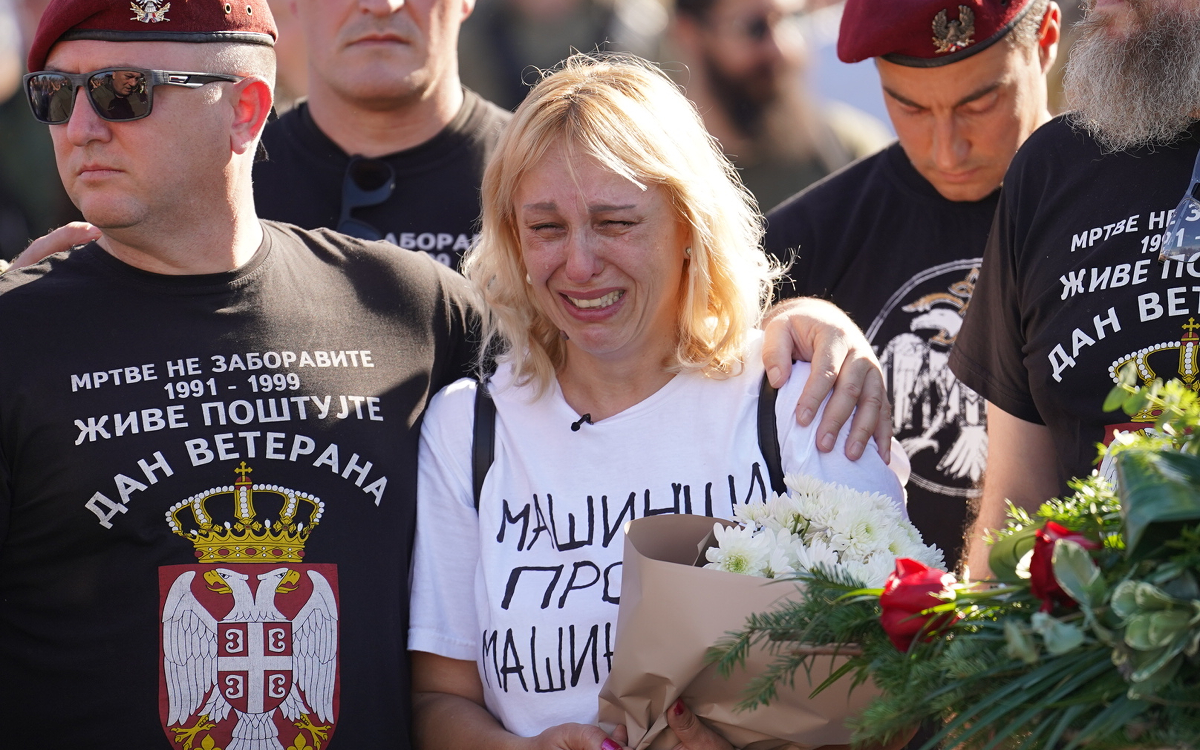
Ahead of the parliamentary elections scheduled for October 25, the British newspaper The Telegraph published an article about Dijana Hrka, the mother of Stefan, 27, one of the 16 victims of the canopy collapse at the railway station in Novi Sad. The newspaper portrayed her fight for justice as a symbol of a movement that could influence the future of Serbia and even the entire region.
A symbol of the movement
Nearly two years have passed since the tragedy of November 1, 2024. The disaster has been attributed to poor construction, government negligence and corruption. The youngest victim, Sara Firić, was six years old. The tragedy triggered mass protests, and Dijana, who tirelessly demands that those responsible be brought to justice, has become their public face. “Corruption killed my son, but they cannot silence me,” she told The Telegraph from her home in Belgrade.
According to the newspaper, work on the railway station was carried out with assistance from China’s Belt and Road Initiative. Former Construction Minister Goran Vesić and 12 other people were formally charged, but the authorities dismissed the charges against Vesić and five others, citing a lack of evidence. The official investigation is still ongoing.
Elections as a referendum
The protests, the largest Serbia has seen in several decades, rallied under the slogan “Corruption Kills” and led to demands for snap elections. Under pressure, President Aleksandar Vučić dissolved Parliament, although elections had initially been scheduled for December 2027. Demonstrators submitted a list of candidates called the “Student List,” which, according to The Telegraph, forms the backbone of the country’s most significant electoral movement in several decades.
Vučić, who is leaving the presidency, plans to become prime minister, using Vladimir Putin’s tactics for retaining power.
Political scientist Florian Bieber argues that sustained civic mobilization is putting unprecedented pressure on the authorities. According to the opinion polls he cites, the Student List enjoys support equal to or greater than that of the ruling authorities, and that support is growing. At the same time, he warns that Vučić will likely use every available means to tilt the election in his favor, pointing to irregularities in previous elections and insufficient oversight of voting by Serbs abroad. In a similar vein, Dijana said that Vučić had “stolen victory” throughout his 12 years in power.
East or West
The Telegraph also describes the election as a decision about Serbia’s geopolitical orientation. According to a CRTA survey, 42 percent of citizens want closer ties with the EU, while 30 percent believe Moscow is the better choice. Serbia, an EU candidate country, is conducting accession negotiations, but, the article notes, Brussels is in a difficult position when it comes to influencing Vučić’s government.
The newspaper recalls that Belgrade has refused to impose sanctions on Russia, that Vučić attended Putin’s Victory Day parade in May, and that the semi-official state funeral of Ratko Mladić further strained relations with the EU. The results of the 2023 agreement on normalizing relations with Kosovo have been modest, while Serbia remains committed to not recognizing Kosovo’s independence. During the UN General Assembly session, Sergey Lavrov said that the West was “forcing” Belgrade to impose sanctions by promising European integration that, in his words, was an illusion.
Bieber points out that the EU is not the main issue for voters, whose primary concerns are healthcare, the cost of living and systemic corruption. The Student List has not taken a position on foreign policy, but he believes it is clear that its supporters are overwhelmingly pro-European.
“We need help from all of Europe”
Dijana calls on the EU to help the citizens of Serbia: “In Serbia, we have no functioning systems. We have no rule of law, no police; every institution is under Vučić’s control.” She adds that the system must be torn down to its foundations and rebuilt, with Vučić removed from power.
The Student List has presented the election as a choice between “Serbia or the mafia.” Bieber believes that a victory for the student movement could inspire change throughout the region because, as he puts it, Serbia under Vučić has played a negative role in the Western Balkans.
For Dijana, however, this is not merely a political issue. Last year, she went on a hunger strike for more than two weeks outside the National Assembly, while the president ignored her appeals. “We must keep fighting so that I will be the last mother in Serbia to weep over the loss of her child,” she said.
The full article can be read on The Telegraph’s website.
MORE TOPICS:
Source: Telegraf Foto: Antonio Ahel/ATAImages
 Add Serbian Times as your Google source