




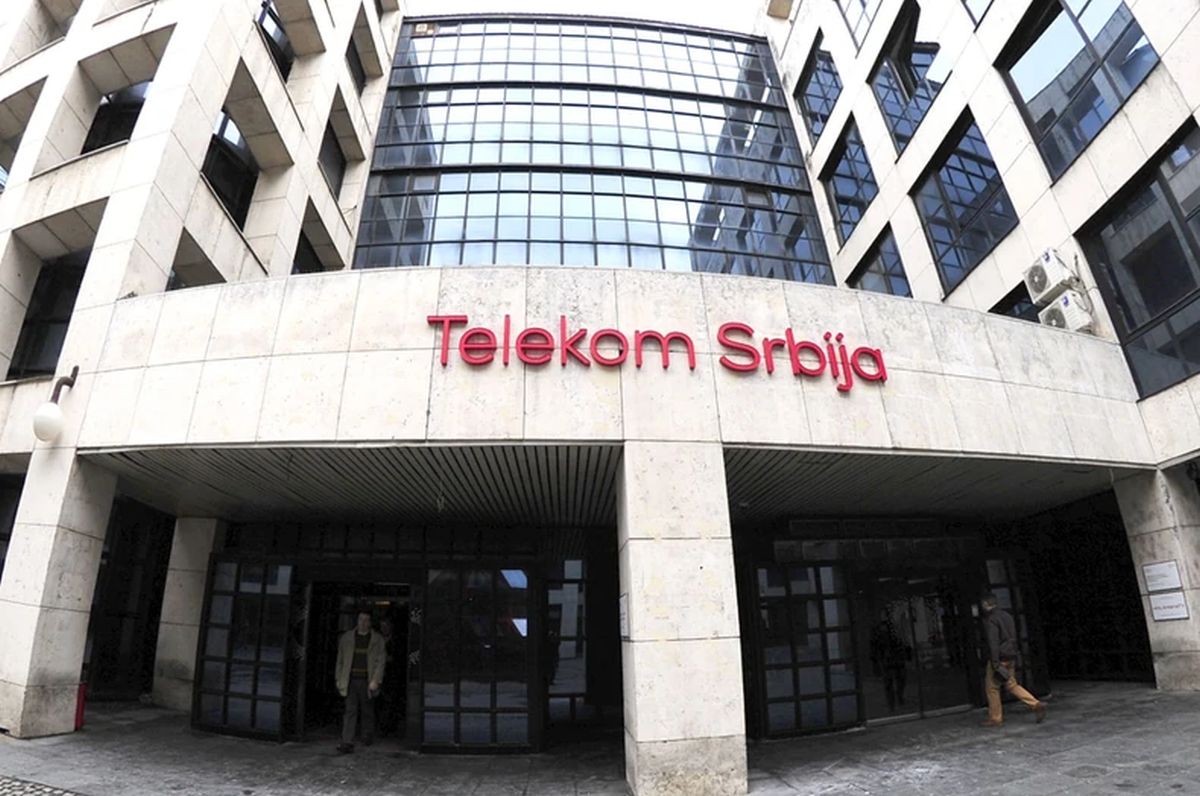
Telekom Srbija has reached nearly 7 billion euros in liabilities. Debt up by 2 billion euros in one year – where is the money going and who pays the price?
The state-owned telecommunications company, which has been aggressively expanding for years by purchasing cable operators and media, at the same time operates with debts exceeding several billion euros. Official financial reports show that Telekom Srbija ended last year with around 211 million euros in net profit and credit liabilities of approximately 4.6 billion euros, while the company itself claims for Nova.rs that their value stands at a record 7.6 billion euros. According to Nova’s interlocutor, 300 million euros was spent on interest alone during 2025. The question arises for how much money this state giant could even be sold today, which ten years ago was worth 1.5 billion euros.
In the expert public, a dispute has been going on for a long time over the methodology by which Telekom should be assessed at all. While management insists on revenue growth and market leadership, economic analysts warn that the income statement cannot be viewed separately from accumulated debt.
A decade ago, when privatization of Telekom was considered, its market value was estimated at 1 to 1.5 billion euros. Today, with official revenues and reported profit, the company at first glance sends a picture of stable business. However, simplified financial math says that a firm’s value is measured by multiplying profit by the number of years needed to return the investment (on average 7 to 8 years). By that model, Telekom still reaches a value of around 1.5 billion euros, but the question arises which investor would pay that price only to immediately have to take over the repayment of a debt that has well exceeded five billion euros.
Between five billion in debt and negative cash flow
Nenad Gujaničić from the brokerage house Momentum Securities emphasizes in a conversation with Nova.rs that in Telekom’s balance sheets for several years now, high financial indebtedness stands out as the primary problem, greatly threatening the very liquidity of business operations.
According to him, although available data relates only to the parent company because consolidated reports with subsidiaries have not yet been published, the overall picture will not change significantly. At the end of December last year, the parent company had a net debt exceeding five billion euros, while as much as 300 million euros was spent on interest alone in that year.
Speaking about the thesis that Telekom’s debts exceed its objective value, Gujaničić explains the methodology by which potential buyers assess the price of a company.
“If someone hypothetically took over Telekom for one euro, they would right from the start owe five billion euros. The picture would be completely different if that debt were moderate, as it was five or six years ago. Then you would value the business based on net profit or operating profit (EBITDA). However, in this case the debt is so overdimensioned that all those profitability indicators have fallen into the background. The fact that the company paid 300 million euros in interest, and that its net profit is around 200 million euros, best illustrates the proportion of that burden. That is at the level of a household budget of a family having monthly earnings of two thousand euros, and on the first of every month having to pay a loan installment of one and a half thousand euros,” Gujaničić explains for our portal.
He warns that such megaproportionate borrowing cannot be justified even by potential future growth, because Telekom operates in a rather conservative branch that is in a stage of saturation and stagnation – fixed telephony is falling, mobile is stagnating, while internet and multimedia do not have growth rates that would remediate expensive past acquisitions. Another key problem is cash flow, which directly shows liquidity.
“For the last four to five years, Telekom’s cash flow has been quite negative, and in the last two years sharply negative. That means the company has not the slightest space to pay a dividend, service current debt, or acquire another firm from its own funds, but must do all that from new loans instead. Despite this, management does not care about such a situation – takeovers continue, and dividends are still paid just to maintain the narrative of Telekom as the strongest company,” Gujaničić states.
An aggressive strategy of overpaying the competition with the goal of creating a monopoly on the market and then raising prices for users, according to his assessment, has serious economic limitations because telecommunications companies are no longer high-growth businesses as they were twenty years ago. In addition to market limits, Gujaničić sees other motives in the background of such business decisions.
“I fear that this strategy is primarily motivated by a kind of ‘blank check’ that the company received in order to discipline the media market. Along the way, a plan was made for a monopoly that would be charged through higher prices, but there are certain limits there. Citizens’ bills for Telekom’s services cannot be higher by two or three times for the simple reason that an alternative always exists. When you lack potential for large growth, financial burden becomes a dramatic problem,” Gujaničić concludes.
Paper stock market and expensive loans
In practice, these data show that Telekom’s true value cannot be measured only by current subscription revenues. The key indicator remains the ratio between equity value and total business value, which directly depends on the level of debt.
Telekom’s entrance into the European financial market was presented to the public by management as an “entry to the stock market,” even though the company is not listed on European stock markets, nor even on the Belgrade Stock Exchange. This was a sale of corporate bonds worth almost two billion euros, which represents classic borrowing.
Moreover, the cost of that borrowing is extremely high. An interest rate close to 7.5 percent, which Telekom will have to pay to financiers, is almost double the interest rate at which the state of Serbia borrows. This shows that foreign investors view Telekom’s business as high risk, and that the company can obtain such loans primarily due to the fact that behind it, as guarantor, stands the state.
This money was used for an investment cycle that was largely politically and media-oriented, rather than technology-oriented. Local cable operators were acquired, Orion WiFi, and at the end of last year Mondo Inc, under which Kurir, Mondo, and Espreso operate. Previously, Euronews Serbia, Bloomberg Adria, and Arena Channels Group were integrated into the same system.
While leadership justifies these acquisitions by expanding market share, international rating agencies view the situation significantly more cautiously. Moody’s assigned Telekom’s new bonds a speculative rating of B1, with the explanation that the company, in addition to high indebtedness and large investment needs, also records a constantly negative free cash flow. To preserve current liquidity, the company in the meantime had to sell part of its own infrastructure, such as cell towers.
Telekom’s response: We are worth 7.6 billion euros, debt is in the golden average
The Nova.rs portal turned to Telekom Srbija with questions about whether the company did an evaluation of its value, how much total debts currently amount to, as well as why it borrowed and in what amounts.
From this state-owned company, they reject claims of threatened business and state that they possess an official assessment by one of the “most renowned financial consultants in the world,” according to which the value of Telekom Srbija amounts to as much as 7.6 billion euros, which is almost seven times more than ten years ago.
“The mentioned evaluation is based on high growth of revenue and users, operating profit, and net profit year after year. Last year Telekom Srbija had a revenue of 2.3 billion euros, operating profit of 1.3 billion, and net profit of over 200 million euros. This year Telekom Srbija will have almost three billion euros in revenue, with operating revenue over 1.6 billion and net profit over 500 million euros. The company’s value is also affected by the assessment of the future, and Telekom Srbija holds a dominant position on the Serbian market where all operators use our optical infrastructure and our media content, and thus an excellent position for profitability growth,” Telekom states for Nova.rs.
In this company they add that in the coming period they expect a reduction in costs of sports rights and financial expenses, as well as positive cash flow, which should lead to a drop in debt to banks and growth in net profit in the coming period.
As confirmation of the success of its business strategy, Telekom cites this year’s issue of corporate bonds on the Dublin Stock Exchange, which they claim attracted interest from foreign investors worth as much as 14 billion dollars.
“Telekom Srbija has invested funds in the last seven years into a powerful optical network and mobile network, we have become the leading media outlet in this part of Europe, and we operate successfully in 15 countries. We have a credit rating from the three largest credit rating agencies, strategic cooperation with the European Investment Bank, American EXIM, Vodafone, and numerous partners across Europe and America. All this time of the investment cycle we kept debt under 4x EBITDA and thus were always in the telecommunications average, and that is one of the reasons we are winners on the commercial market,” Telekom concludes.
Marinika Tepić: How we went from 6 years of warnings to 7 billion euros in debt
Vice President of the Freedom and Justice Party Marinika Tepić in her op-ed recalls that for six years she has been warning “loudly and with documents that Aleksandar Vučić turned Telekom Srbija into his strongest political weapon.”
In her op-ed she further states: “That he turned the state telecommunications giant into a club used to choke free media and into a piggy bank from which his cartel feeds. This mechanism of media monopoly has not been refuted by a single piece of evidence; on the contrary, it has been confirmed by the non-reaction of precisely those who were obliged to react.
Through all these years, some did not believe me, others mocked, others said I was exaggerating and that it couldn’t really be like that. There were also those who asked me why so much persistence over one telecommunications company, as if Telekom were just a firm, and not the last line of defense against media darkness in this country. When in 2020, because of those warnings I presented in front of Telekom’s headquarters, I was physically attacked by former radical Draško Marković, now an SNS official and Telekom’s HR director, many just waved their hand. Someone even managed to see an incident in it, rather than a message that the Vučić brothers’ cartel put into this state giant persons who are ready with physical force to silence anyone who asks what kind of corruption you are carrying out with our money?! Even then I did not give up.
When I was looking for Zagorka Dolovac around Serbia to personally hand her the corrupt Telekom-Žeželj contract worth almost 38 million euros, a contract by which state money was turned into private television Kurir and a tabloid in service of the government, she likewise turned her head. The Supreme Prosecutor in this state refused to take evidence in hand, in public, in front of cameras. And again, many laughed.
Today nobody laughs anymore. Today Telekom is counted to have seven billion euros of debt, and the question is no longer whether I was exaggerating, but why for six years nobody wanted to hear what I presented with documents in hand.
Because I was not presenting impressions, but evidence: contracts, numbers, amounts, names, how state Telekom works exclusively in the interest of political control of media for the party and buddies.
I particularly warned that they would buy up other operators, televisions, and cable systems, and that they would build historical debts just so Vučić could secure media dominance whose expiration date is not tied to his mandate! Telekom funded the regime’s media dominance. Telekom choked competition. Telekom built a system intended to serve Vučić even on the day he loses power!
Well it is no accident that televisions Prva and B92 ended up in the hands of another “SNS brother,” Miodrag Milovanović from Niš, and precisely through financial acrobatics via Telekom. Thus they secured for themselves two televisions with national coverage for the day of losing power and after that as well. Paid, of course, with our money.
For six years I warned and for six years not a single institution reacted, neither the prosecution, nor the Anti-Corruption Council, nor the Supervisory, nor the Executive Board of Telekom. Today, when debt reaches an unprecedented seven billion euros, the question is no longer asked to me. It is asked to Zagorka Dolovac, who took a salary to see what she refused to take into her hands. It is asked to members of supervisory bodies who silently observed state property turning into a private political weapon. And it is asked to Vladimir Lučić and everyone who executed this plunder in the name of one man.
I did my part of the job, on the street, in front of cameras, in Parliament, in the prosecution, with evidence in hand, while they silenced and mocked me. Now it is the institutions’ turn to do theirs. So that darkness doesn’t consume them as well.”
MORE TOPICS:
SEVEN MEDALS FOR SERBIA: Our wrestlers shone at the international tournament in Romania!
Source: Nova.rs, Photo: Printscreen X
 Add Serbian Times as your Google source