



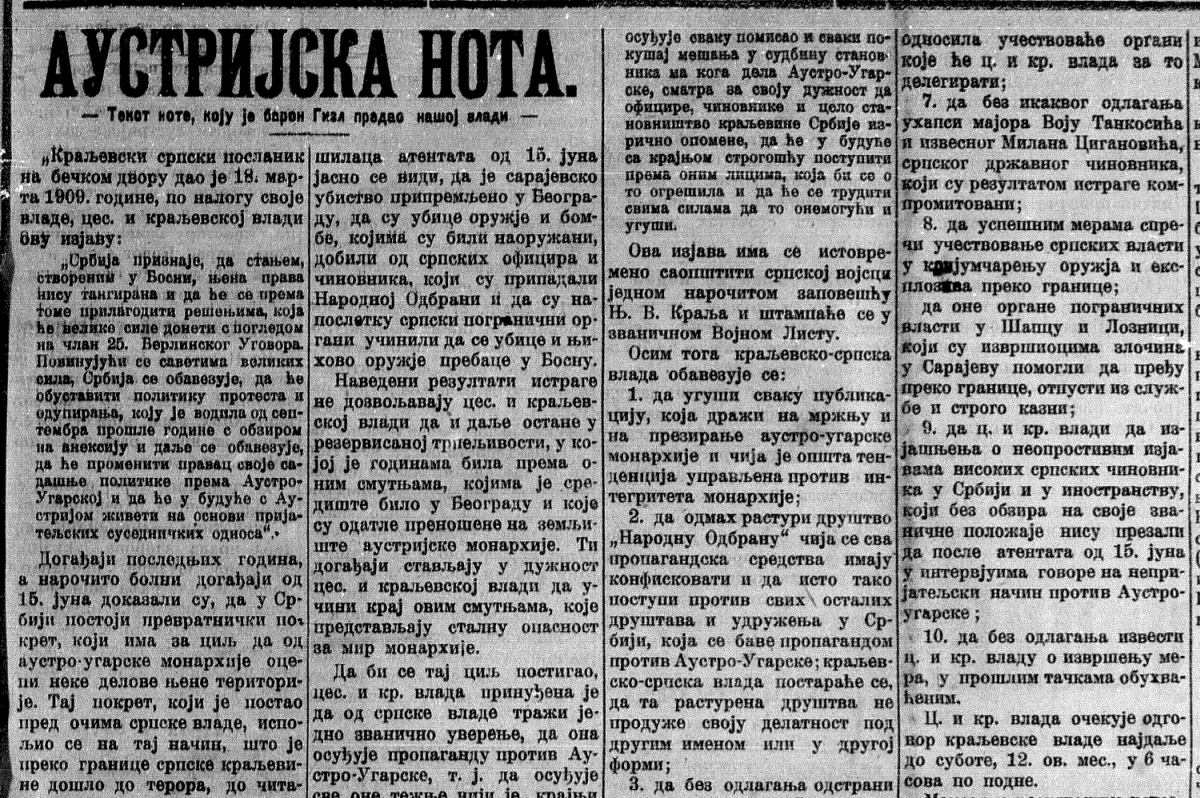
A full month after the Sarajevo assassination, Austria-Hungary threatened and pressured Serbia. During that time, Serbia gathered international support and tried to convince Austria-Hungary that it had nothing to do with the events in Sarajevo. And then arrived this document known as the “July Ultimatum”.
The Austro-Hungarian note to Serbia stating what the state should do in the investigation regarding the assassination in Sarajevo was handed over by Envoy Baron Wladimir von Giesl on July 23, 1914, in the afternoon hours to the representative of the Serbian Prime Minister, Lazar Paču, the Minister of Finance.
A response was requested, as was explicitly stated in the document, within 48 hours.
Today we know that in Vienna and Berlin everything had already been prepared long ago and that the Austro-Hungarian Emperor Franz Joseph had ordered German research submarines at the North Pole to return even before the assassination in Sarajevo because “war is brewing” in Europe.
At that moment, at least in Belgrade, it was probably believed that something could still be done.

“The most terrible document that one state has ever handed to another”
In the document known today as the “July Ultimatum”, Serbia was not directly accused of organizing the assassination in Sarajevo, but it was stated that it had “tolerated the machinations of various societies and associations directed against the Monarchy, the improper language of the press, the glorification of the perpetrators of misdeeds, the participation of soldiers and officials in subversive agitation”.
Here is what was requested from Serbia in the document that was urgently forwarded to the Serbian government for consideration:
- To prevent the publication of publications that incite hatred and hostility towards Austria-Hungary.
- To immediately dissolve the organization “Narodna Odbrana” and to act likewise with other organizations participating in propaganda against Austria-Hungary.
- To eliminate from public education everything that could serve or serves to incite propaganda against Austria-Hungary.
- To remove from the military and administration in general all officers guilty of propaganda against Austria-Hungary, and the names of these officers would be provided by the authorities of Austria-Hungary.
- To accept the participation of Austro-Hungarian authorities in suppressing subversive activities against Austria-Hungary on the territory of Serbia.
- To undertake judicial proceedings against accomplices of the Sarajevo assassination who are on Serbian territory, with the assistance and instructions of Austro-Hungarian authorities.
- To immediately arrest Vojislav Tankosić and Milan Ciganović (persons involved in the assassination according to the preliminary investigation conducted by Austria-Hungary).
- To prevent “assisting the illicit traffic of arms and ammunition across the border” and to “dismiss and severely punish” those border authorities who assisted the three assassins in crossing the border.
- To furnish explanations to Austria-Hungary regarding statements by high-ranking Serbian officials in Serbia and abroad who expressed hostility towards Austria-Hungary.
- To inform Austria-Hungary without delay about the execution of these obligations.
The text of the ultimatum was not immediately disclosed to the European powers. It was not known even to Italy, which was an ally of Austria-Hungary. When the world finally saw this document, weapons were already rattling across the Balkans, and there was no time to react.
British Foreign Secretary Sir Edward Grey, reading the ultimatum, told the Austro-Hungarian ambassador that it was “the most terrible document that one state has ever handed to another state”.

“Nothing remains but to die”
Of the ten demands, Serbia accepted all except one, point 5, which would have meant the arrival of Austro-Hungarian investigating judges and police officers in Serbia to conduct the investigation on its territory.
The government of the kingdom made the greatest possible concessions, but they nevertheless knew at the moment they drafted the response what Austria-Hungary’s reaction would be. Story has it that Nikola Pašić, when he set off to deliver the response, dressed in a black suit as a sign of mourning. Minister of Education Ljuba Jovanović on that occasion stated only that “nothing remains but to die”.
The Serbian dispatch was sent on July 25. The Austro-Hungarian response followed on July 28. In an ordinary telegram came the news that this empire was declaring war on the Kingdom of Serbia.
This conflict grew into the First World War, the largest and bloodiest clash the world had seen until then. Besides the destruction and chaos it brought, the war “cost” Serbia a third of its population, or about 1,247,000 soldiers and civilians. It was the highest price of the Sarajevo assassination.
MORE TOPICS:
SERB BEAT HIS WIFE WHILE ON VACATION IN GREECE: Our people organized to help her return home!
Source: Istorijski Zabavnik, Photo: Printscreen / Narodna Biblioteka Srbije
 Add Serbian Times as your Google source