



I don’t know about all of you, but when traveling the world, I often feel like I come from a country with hundreds of millions of people, not from a tiny place like Serbia. Still, it seems that so much of this particular thing of “ours” is scattered worldwide, even where you least expect it. The latest example comes from Jordan… If someone had told me that I would be drinking Serbian apricot brandy with Arabs in the middle of the desert, eating gibanica (traditional Balkan cheese pie), and singing “Serbian” songs in three different languages, I would probably have waved it off. However…
Upon landing in Jordan, I was greeted by a line of mustachioed taxi drivers who seemed interested in everything except the address of my room. After all, there are no taximeters, so it’s more convenient to divert the potential customer’s attention to anything but the deal that should have been made before entering the vehicle.
Of course, the main question was, “Where are you from?”
“From Serbia,” I replied.
“Ah, Karachi… Karachich,” one of them reacted.
“Karadžić. Oh. This didn’t start well,” I thought. Yet, I was wrong. As we drove from the airport toward the center of Aqaba, I watched the city flicker on the other side of the Red Sea.
“Israel. Eilat. Five minutes,” the taxi driver interrupted me, noticing the fixed gaze that had twisted my neck.
I paid eight dinars, which is about 10 euros, for the ride and continued to the hotel’s fifth floor. Through the wide-open window, I could see a minaret and a massive flag of the Arab Uprising against the Turks, which made eerie sounds as it broke on the refreshing wind. Still, we all know that’s not the sound that woke me up at five o’clock in the morning.

WELCOME TO RAGIB’S WORLD
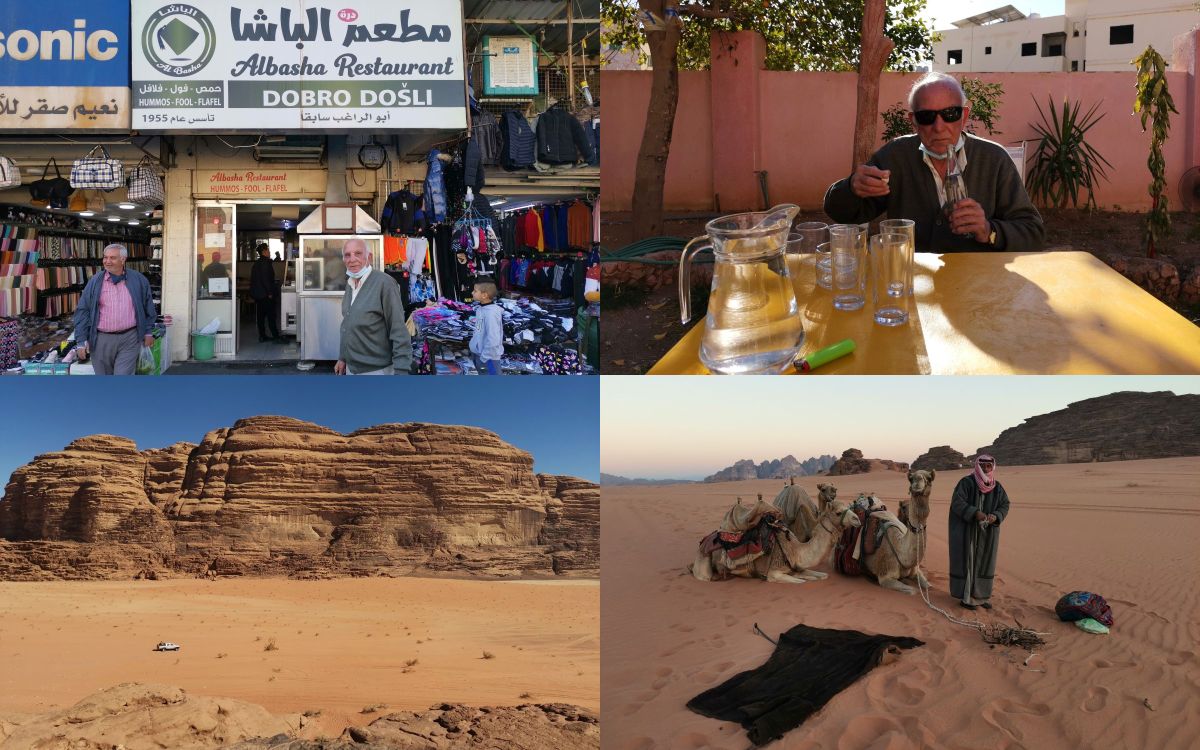
“Speak Serbian so the whole world understands… I’m really starting to believe that,” said my girlfriend, smiling in amazement. A moment earlier, walking through the dusty streets in a sea of Arabic signs, our attention was drawn to a restaurant with a Latin inscription in Serbian characters saying, “Dobro došli.”
As I pulled out my phone and snapped a picture, a smiling uncle appeared at the door, addressing us without hesitation in fluent Serbian: “Come on in. Come on in, the door is here, it’s open.”
He was about seventy, with piercing blue eyes and a firm handshake. He told us his name was Ragib Ibrahim and that he was originally from Palestine but had lived in Jordan for decades. He learned Serbian back in the sixties in Belgrade and hadn’t forgotten it even though almost 45 years had passed since he last walked through our lands.
“I talk a lot. Every day. When I have nothing to do, I talk to myself. My tongue is used to speaking Serbian. I like Serbian much more than English,” he said.
Word by word, I explained to him that I was a journalist and would like to hear his story. Ragib didn’t hesitate: “I have excellent Serbian rakija. Let’s go to my place.”
We jumped into the car and continued the conversation in the pleasant atmosphere of his garden, sipping Arabic coffee with cardamom and Serbian apricot brandy. The bottle was barely opened, and according to Ragib, he received it as a gift two years ago. Obviously, it was a drink he only brought out on special occasions.
“When the company gathers, it should be something like this, from the heart. That’s what I learned from you, Serbs,” he said.
“We just need some folk music,” I said as the muezzin began to sing in the distance.
“This isn’t so far off either,” I replied, more to myself.
Ragib arrived in Yugoslavia by train in 1966. Like many students from the Non-Aligned Movement countries who came to Belgrade for advanced studies in those years, he traveled through Syria, Turkey, and Bulgaria. He didn’t pass the faculty entrance exam very well, but that didn’t stop him from staying for two years and getting to know this new country, which he quickly fell in love with for the rest of his life.
“My first landlords were from Montenegro. Montenegrins were good people. They had three daughters. One was 14, the other 12, and the youngest was only nine. When they wanted to go out, and their mother wouldn’t let them, they would come to me: ‘Please, Ragib, convince mom to let us go to the Danube.’ That was in Zemun. Then, I would convince their mother and take them out until six o’clock when it got dark. I was like a part of the family,” Ragib recalled.
He spent three months in Subotica in addition to Belgrade, but as a man of “southern blood,” he didn’t like the Vojvodina plain.

A SECRET LOVE AFFAIR WITH TITO’S DAUGHTER-IN-LAW
“Belgrade is the most beautiful city for me. I enjoyed my time there,” he said, twisting his lips into a smile. He didn’t hesitate to reveal why he enjoyed it so much.
“Once, I went to play roulette at the Majestic. I was about 22 years old at the time – a young man, a boy. I had some luck and won a lot of chips. Wealthy people were sitting around me, drinking whiskey and smoking cigarettes. I was sipping my red wine when an Iraqi approached me. He asked me to give him some chips to recover what he had lost. At first, I didn’t want to, but after he returned three more times, I finally gave him some. As soon as I gave it, I started losing. Meanwhile, across the table from me was a woman watching everything. I noticed her immediately. The next morning, I came to have coffee, and there she was again. She approached me and said in English, ‘Good morning. Are you with someone?’ I told her, ‘No, please.’ Good American cars with Yugoslav flags were parked in front. We sat for over an hour. She asked me if I would be there tomorrow. I confirmed, and that’s how we started seeing each other. It turned out later that she was the wife of Tito’s son, Žarko Broz. She had one shorter arm. We were together for over a year. I even went to her villa. I wasn’t good… (laughs) She invited me once to his birthday? Imagine!? How could I go? To get killed… We couldn’t appear together anywhere, so I later found another girl – at the Youth Center. I went there to play. Today, my former girlfriends from Serbia are like sisters to me. They sometimes come to visit me. That’s how I got this brandy.”
Ragib continued to tell stories of his youthful escapades—meetings “Kod konja”, city cafes, and the beatings he had received more than once, either for his own or someone else’s recklessness. The last time he was in Belgrade was in 1978 when he was transporting a new car from Germany to Jordan. He says it would hurt to go back again, but life is short, and friends are scattered all over the globe.
Ultimately, we invited one of his ex-lovers for a video call. While I was praising her brandy, Ragib was cracking lewd jokes with his “sister” and grinning merrily.

BEDOUIN NIGHTS AND A GERMAN GIRL WITH A NAME ENDING IN “IĆ”
The next day, we met again, this time at his restaurant, Albasha. We were greeted by the most beautiful Arabic breakfast—falafel, hummus, eggplant paste, and fresh Arabic pita. Full of energy, we said goodbye to our new friend, promising to bring brandy next time, as we headed towards the heart of the Jordanian desert, Wadi Rum, and the ancient city of Petra.
The nights in the desert can be freezing. The Bedouin tents where we spent two days provided only basic protection from the elements. In the morning, everyone would go out into the sun like lizards to warm up their frozen limbs.
As we sat, warming ourselves in wooden chairs, our host, Mohamed – a handsome Bedouin in his early twenties – told us about his girlfriend from Germany, whom he plans to visit this year. Since words seemed insufficient to describe his beloved, Mohamed took out his phone and showed us a picture from Facebook. Above it, it said Lejla with a characteristic surname ending in “ić”.
“Well, your girlfriend is my countrywoman,” I said.
“No, she’s German,” he replied.
“Yes, but from Bosnia. Give me the phone,” I said and found a few songs titled “Lejla” on YouTube. “Here, you have it for when you need to woo her. I don’t know her taste, but maybe you should try White first, then Hari Mata Hari, and finally Divlje Jagode.”
As we climbed into the back of the SUV to set off into the stone canyons of Wadi Rum, Mohamed showed me a series of heart emojis on his phone. They apparently just arrived from Germany. The song went down well.

GIBANICA IN THE DESERT
In the back of the SUV, a Bulgarian couple sat – Ivan and Lora. Ivan was a psychologist and writer, and he had lived in America for years, so we quickly found common ground to chat about in our two languages, helping ourselves with English on rare occasions we got stuck. The trip to Wadi Rum took up the entire afternoon, and even the ten cups of Bedouin tea we had drunk couldn’t quite disguise the increasing hunger.
“Where can we get something to eat now,” I thought, looking around. There was absolutely nothing for miles around, and unfortunately, I didn’t know how to interpret the ancient Google Maps petroglyphs carved into the rock.

“Are you hungry? Do you want a bite?” Ivan said as if he had read our minds.
“What do you have in mind?”
“Wait,” he replied, gesturing as if he already had a surprise ready.
He took a plastic container from his bag, which our grandmothers usually stuff us with when we visit them. Inside, you could see some kind of pie wrapped in napkins.
“Gibnica, from my mother,” Ivan said proudly, unwrapping the homemade pastry.
Delighted like a child, I thought, “Okay, what’s next on the Balkan menu?”

OUR SONG, EVERYONE’S SONG
The plan for the evening was for everyone from the camp to meet in one of the desert ravines, light a fire, and watch the stars. About twenty people gathered, mostly tourists and a couple of local Arabs. With the crackling of dry vegetation, a conversation started about the countries we came from, cultures, and current events.
A Syrian woman suddenly started singing this wonderful song that I immediately recognized, even though she was singing in Arabic.
“Aj, ruse kose curo imaš, žališ li ih tiii…” I continued in Serbian, to which my girlfriend joined in with Greek.

I knew there were several versions of this song in the Balkans. Still, I had yet to learn it extended to the Arabian Levant. Later, I discovered Turkish, Armenian, and Hungarian versions. There is even a documentary about the phenomenon of this song: “Whose song is this?” which was filmed by a Bulgarian woman.
Is it unusual to find a reflection of home in distant lands, or is it just how the human mind is attached to the familiar? The Roman Empire, the Byzantine Empire, the Ottoman Empire… In the last 2,000 years, Serbia and the Middle East have spent more time in a mutual state than separately. Similar music, food, and a multitude of words – it is a testament to our closeness. Whether we want to admit it or not, we are almost the same culture, although a different civilization, however paradoxical that may sound.
As people say, we are all the same… Especially if you speak Serbian, and the whole world understands you, right?
Author: Novak Lukovac
FIND OUT MORE:
 Add Serbian Times as your Google source