




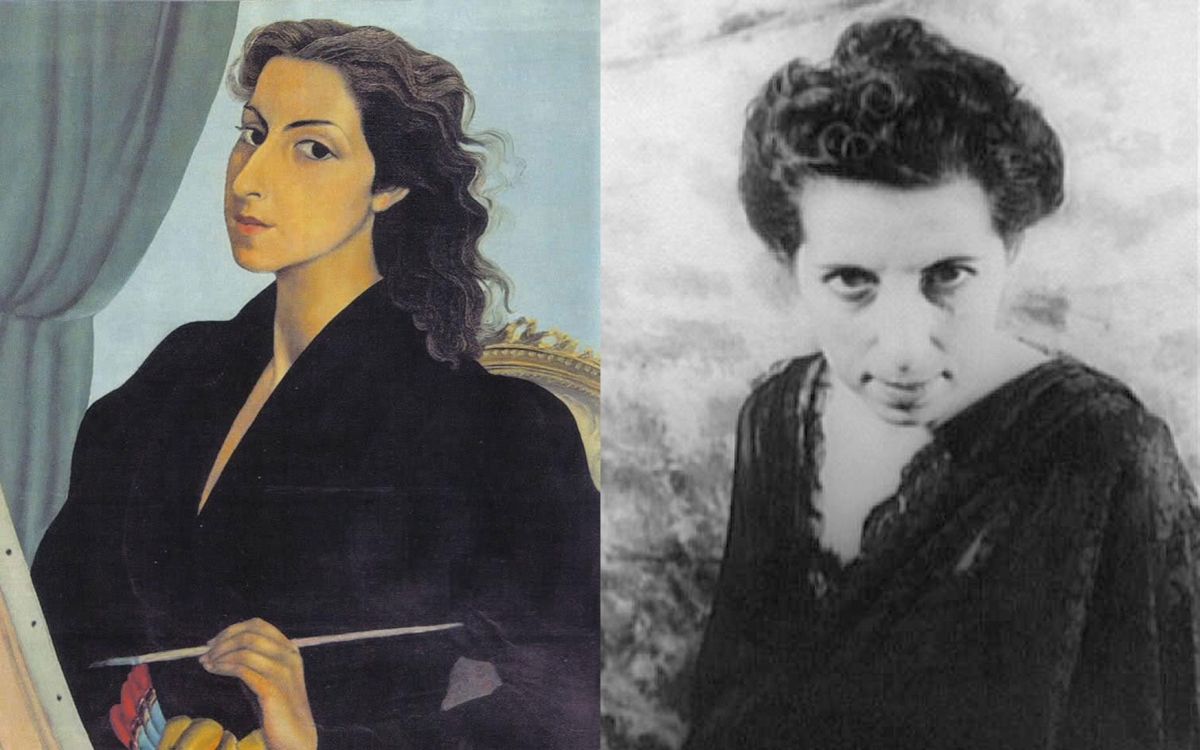
Milena Pavlović-Barili was born in Požarevac on November 5, 1909, as the only child of Danica Pavlović and Bruno Barili, an Italian composer, music critic, and poet. According to some scholars, the image we have of this artist today was largely shaped by her mother, a descendant of Sava Karađorđević, the eldest daughter of Karađorđe.
From early childhood, Milena displayed exceptional artistic talent, excelling with both pencils and words. By the age of five, she was reading newspapers and learning Italian and French. By seven, she was writing poetry about death, and by ten, she had mastered German while studying in Graz.
The monograph Women in Serbian Painting states that Danica Pavlović played a decisive role in Milena’s upbringing and later contributed to the creation of her almost mythical image as a child prodigy, a successful painter who traveled the world, mingled with famous figures, married an American, and died as a result of a fall from a horse.
Milena immersed herself completely in everything she did. Her paintings are filled with unusual events, encounters, departures, wanderings, partings, sorrows, hidden traumas, and nostalgic memories.
She studied painting in Belgrade and Munich, holding her first exhibition in Belgrade before showcasing her work in Požarevac, London, Paris, Rome, and New York. A multitalented artist, she also wrote poetry, which was first published in 1934 in the Italian newspaper Quaderno.
At the time, no town in her kingdom was willing to employ her as an art teacher. Despite being one of Serbia’s most educated and talented female painters, she found no place in her homeland. It was poet Sibe Miličić who bought her painting Angels, providing her with the money needed for a ticket to America.
Milena always hovered between her two homelands—Serbia and Italy, so it was no surprise that she sought refuge in a third—America, where, from 1939, she would find her peace. Letters she wrote reveal that this departure was more than a physical move—it symbolized her coming of age and liberation from her overpowering parents. From New York, she wrote to them less and less, focusing more on herself.
As the years passed, her mother, Danica, increasingly bitter, reconstructed her own and her daughter’s story through memories, preserved and, even more so, destroyed letters. One letter, of an unknown date, testifies to Milena’s strained relationship with her mother:
“If only you knew how much I need you to understand me one day and say: ‘My child, are you tired? Rest a little, for you have done all you could and knew how to do.’ It seems to me that if I heard that from you just once in my life, I would never suffer from insomnia again. Never again would the dawn or the sun find me awake, tormented by thoughts, worries, and fears in my bed. And I wouldn’t always feel crazy and guilty. I do not allow others to tell me I am crazy or that I am wrong because I know and see that none of them could endure my balance. I am completely crushed here. I know how Grandma says: ‘There is no escaping this skin,’ so I struggle, but I don’t know how to change my nature.”
Milena spent the last six years of her life in America, painting, exhibiting, and more importantly during this period, working in illustration, design, costume, and scenography. In a letter written as soon as her ship docked in New York in August 1939, she wrote to her mother:
“I have arrived. It is now two in the morning. My first thoughts and words since the ship docked, I send to you. I watched for a long time all the lights in the distance, like Venice, only much longer on the sides. Moonlight and white clouds, and lanterns moving and gliding over the water, but nothing else is visible. That, my dear, is New York. And I understand nothing. Everything feels eerily strange, like a dream and like something ordinary at the same time…”
Although many theorists believe Milena engaged in applied arts out of financial necessity, she was, in fact, following the path of world-renowned writers, painters, and artists before her, who worked for newspapers. Her fashion illustrations for Vogue in 1940 and 1941 were distinguished by delicate lines and the luminous transparency of watercolors. She depicted women in simple dresses with dropped waists or asymmetrical necklines revealing shoulders or backs, adorned with pearls, flowers, necklaces, earrings, tiaras, brooches, fans, and shawls. In her fashion sketches, Milena portrayed worldly women in her own image.
People said Milena was more graceful and beautiful than her paintings. She saw her own statuesque figure and elevated feminine beauty reflected in her stunning commercial artwork for major fashion magazines, perfumes, and brands: Vogue, Textron Vogue, Harper’s Bazaar, Hearst Magazine, Town & Country. With her charismatic beauty, she easily entered high aristocratic circles. In private, however, she was frail and deeply contemplative about life and death. Many claimed that she was so strikingly beautiful that when she entered a room full of wealthy women, all eyes turned to her. Even in a simple dress, without jewelry, and wearing a small hat she made herself, Milena enchanted everyone.
The paintings and poems she created in America were often interpreted as nostalgic sighs for her homeland. While World War II raged, she sent money and packages through the Red Cross to her parents and friends, dreaming of returning home. She also mourned her love for Cuban pianist Rodrigo González, often remembered as the great but tragic love of her life. Seeking happiness, she married Chicago officer Robert Thomas Gosselin on December 24, 1943.
Despite her lifelong frail health, Milena ignored medical warnings, refusing to give up her beloved coffee and cigarettes. The circumstances of her early death on March 6, 1945, in New York, after falling from a horse, remain unclear. Some believe it was the injuries from the fall, while others suspect a heart attack.
Four years later, her ashes were placed in a foreign cemetery in Rome. Her father Bruno wrote to his former wife Danica, informing her that their daughter rests in a beautiful place, near St. Paul’s Gate, among poets, artists, and people from around the world.
It wasn’t until the 1950s, after an exhibition at the Museum of Contemporary Art in Belgrade, that Serbia began to take greater interest in Milena Pavlović-Barili’s work. In 1962, a memorial gallery was opened in her hometown Požarevac, where around 800 of her works are preserved. Among the exhibits are a bronze cast of her hands, intimate family photographs, her personal wardrobe, dresses, and lace veils. Like her entire life, everything left behind is a metaphysical rhapsody of dreams and reality.
MORE TOPICS:
Source: Stil Kurir, Foto: Milena Pavlović-Barili / Wikimedia Creative Commons
 Add Serbian Times as your Google source