




For anyone who proudly declares themselves Serbian, this song stirs countless emotions. It is a reminder of everything our people endured without ever surrendering.
For many, “March on the Drina” is far more than a musical composition. It is considered the unofficial anthem of the Serbian nation, embodying our fighting spirit, faith, freedom, courage, defiance, and honor. It is both sword and cross, our connection to heaven and to ourselves.
At a time when our national history was suppressed, we desperately clung to it as one of the few remaining links to our glorious heritage. This magnificent work was composed in honor of a brave army that force-marched toward the Drina River, the border of its homeland, which had been attacked by a vastly stronger enemy. It was an army rushing to protect the defenseless people of Mačva, who were being mercilessly massacred by Austro-Hungarian troops, among whom were many of our neighbors, including Josip Broz himself.
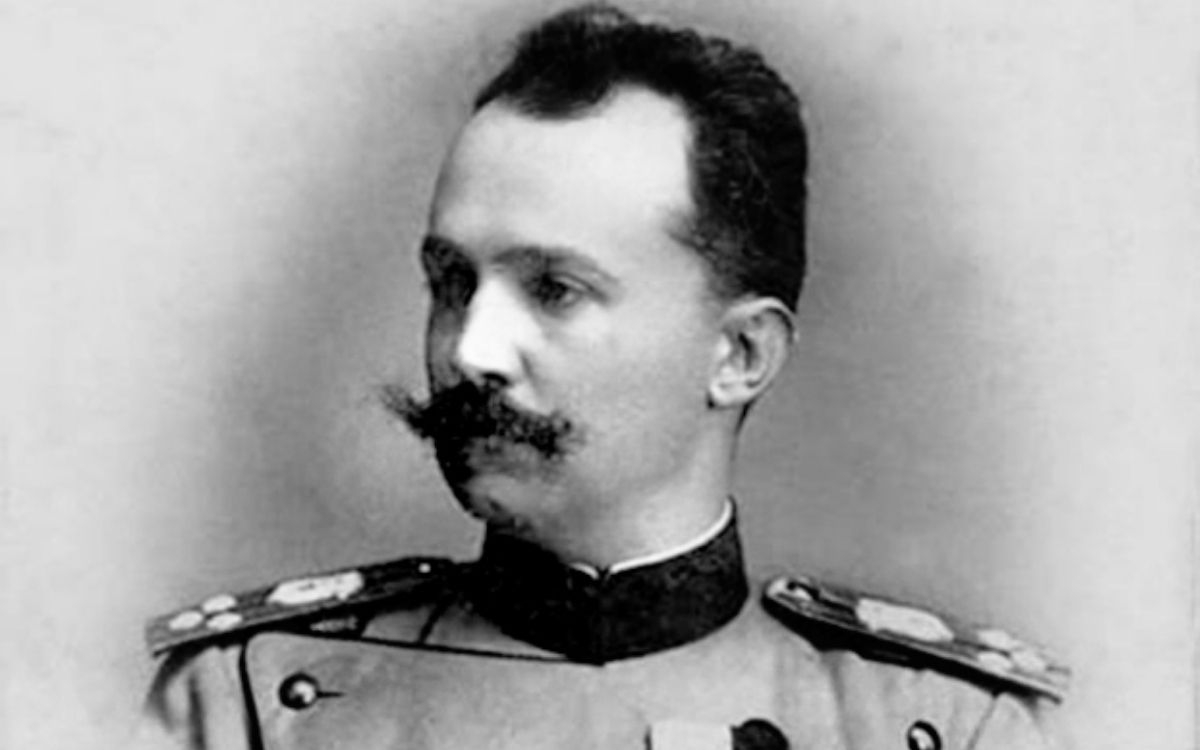
Stanislav Binički composed this powerful “March” inspired by the heroism of Serbian soldiers during the Battle of Cer, where they secured the first Allied victory of the Great War. He dedicated it to the legendary Iron Regiment, one of Serbia’s most celebrated military units, and especially to its fearless commander, Colonel Milivoje Stojanović, known as Brko, who led his men in the decisive charge at Tekeriš that brought victory.
Three months later, he died heroically at the head of his regiment during the Battle of Kolubara, leading the charge with the command: “Follow me!”
In the presence of Field Marshal Radomir Putnik, senior military and state officials, including Archibald Reiss, as well as foreign diplomats, the “March” was publicly performed for the first time in Kragujevac in 1915 and immediately found a permanent place in Serbian hearts. Throughout the war it was frequently played among Serbian troops, inspiring tremendous enthusiasm and fighting spirit. During the breakthrough of the Thessaloniki Front, it was also performed regularly by Allied military orchestras. Naturally, it remained immensely popular during the interwar years, enjoying an almost cult-like status among Serbs.
However, in communist Yugoslavia, the “March” was viewed with deep suspicion, with various ideological commissions branding it as an expression of Greater Serbian nationalism. Forget the Ustaše, the Ballists, or anyone else—the deliberately imposed narrative was that “Serbian nationalism is the greatest threat to the state and its system.”
Even when there was no trace of it, authorities sought to invent it in allegedly suspicious songs such as those about Duke Sinđelić and “March on the Drina,” along with anything else that could be used to, as they saw it, “teach the Serbs a lesson.” Then came what many considered an almost unprecedented incident.
When Ivo Andrić traveled to Stockholm in 1961 to receive the Nobel Prize in Literature and join the ranks of literary immortals, he brought with him a pre-war gramophone record so that “March on the Drina” could be performed during the ceremony. The authentic melodies of the composition deeply impressed the audience at the gala celebrating the Serbian writer.
Several members of the Swedish Academy immediately asked Andrić to give them the record as a gift. He politely declined, promising to send them copies later—which he soon did.
Then, in 1964, marking the 50th anniversary of the Battle of Cer, Žika Mitrović’s film “March on the Drina,” featuring the composition as its main musical theme, premiered at the Pula Film Festival. Although critics attacked the film, supposedly for artistic reasons, it became enormously popular, and many considered it remarkable that it managed to avoid the censorship of the time.
A large portion of the Serbian people, who felt humiliated and deprived of their national dignity—those who did not enthusiastically praise Tito and the Communist Party—experienced the film as a balm for wounded souls. For them, it was extraordinary to watch Serbian soldiers and officers in action through Milorad Marković’s stunning cinematography, accompanied by the sounds of “March on the Drina,” especially the Hollywood-like presence of Captain Kosta, portrayed by Aleksandar Gavrić.
These events proved crucial in gradually restoring the “March” to public life, although the authorities were far from enthusiastic about it. Nevertheless, the composition was increasingly performed in taverns, at weddings, and elsewhere, though rarely at official public events. That same year, in 1964, journalist and publicist Miloje Popović Kavaja also wrote lyrics for the composition.
Those years marked the beginning of a new life for the “March”—actually, two new lives. Unexpectedly, its international success reached global proportions, although this remained largely unknown to the Serbian public. Following Andrić’s gesture in Stockholm, the musical theme became extraordinarily popular throughout Scandinavia.
It was first recorded by a Swedish guitarist, followed by the Swedish Royal Guard, which included it in its regular repertoire. From there, its popularity spread rapidly, and suddenly the “March” became an international hit, spawning numerous adaptations that climbed music charts. More than 25 records were released in styles ranging from rock to twist and hully-gully.
Under the titles “Drina March” or simply “Drina,” the composition was performed by some of the world’s best-known soloists, bands, and orchestras of the era, including the British group The Shadows, predecessors of The Beatles, Belgium’s The Jokers, Sweden’s The Spotnicks, Jørgen Ingmann, and James Last. It was later recorded by megastar Cliff Richard, Chet Atkins, Frank Siciliano, the renowned Mary Laforet, organ virtuoso Cherry Wainer, while American music icon Patti Page also achieved great success with it. More recently, it has been performed by Laibach and Captain Harp.
Naturally, many Serbian musicians also embraced the unforgettable “March,” producing their own interpretations, including R. M. Točak and the band Smak, Johnny Štulić and Azra, Bora Dugić, Moma Stanojević, Dušan Jakšić, Cune, and many others. The most frequently performed version was recorded by the legendary Carevac, himself a veteran of the Great War, accompanied by the powerful baritone of Ljubivoje Vidosavljević.
Many people today call the “March” the most valuable Serbian song. Of course, they are not referring to the joke heard in taverns when someone requests it from a brass band and the frontman with a silver tooth says, “Come on, my friend, why did you have to pick the most expensive one?” Jokes aside, those unmistakable notes have become the holy grail of Serbian patriotic music. They are an inseparable part of our identity, almost something encoded in our very genes.
Attacks and Slander
Unfortunately, like many valuable things in the Balkans, the famous “March” could not escape hatred and envy. For decades, some throughout the region have routinely sought to discredit everything Serbian, and the same happened on January 14, 2013, following the performance of “March on the Drina” at the United Nations General Assembly.
Various individuals and groups launched a media campaign aimed at portraying a freedom-loving composition celebrating the heroic defense of one’s homeland as something it was not. It was yet another propaganda effort intended to turn Western public opinion once again against the supposedly villainous Serbs, relying on the assumption that audiences in the Western Hemisphere would be unfamiliar with the song’s history.
However, not everyone abroad was uninformed. Voices soon emerged describing the campaign as completely unfounded, pointing out that the composition was simply “an old patriotic, libertarian Serbian song from World War I” with no connection whatsoever to the wars of the 1990s. Although such campaigns undoubtedly cause damage and spread further hostility, they ultimately prove unsustainable and often backfire on those who initiate them. Perhaps one day some will realize that such attacks only strengthen Serbian unity and determination to preserve national values and dignity.
Returning to the beginning of this story, we come back to the man responsible for this masterpiece. Stanislav Binički was one of the founders of Serbian classical music and the country’s musical tradition as a whole. Considering his immense contributions and achievements across many fields, it becomes clear what an extraordinary figure he was.
He was born into the family of a Serbian army officer in the village of Jasika near Kruševac on July 27, 1872. From an early age, he played the flute and violin, composed music, and conducted a school choir. While studying at the Grand School in Belgrade, he founded the Academic Music Society. He worked as a teacher, choir conductor, and composer. He graduated from the Faculty of Natural Sciences and Mathematics in Belgrade before completing his studies at the Munich Academy of Music in 1899.
The Ministry of War appointed him military bandmaster and music advisor. He founded the large symphony ensemble known as the Belgrade Military Orchestra, serving as both its director and conductor. That same year, together with Stevan Mokranjac and Cvetko Manojlović, he founded the Serbian Music School. In 1903, he composed “At Dawn,” the first Serbian opera, with a libretto written by Branislav Nušić. The following year, he established the King’s Guard Orchestra, which later evolved into the Belgrade Philharmonic, leading it for the next 16 years.
He Was a Symbol of Honor
At the outbreak of the Great War, Binički served with the Serbian Supreme Command and later endured the harrowing Albanian retreat alongside Serbian troops. On Corfu, he quickly gathered the remaining members of his military orchestra and resumed performances. They frequently held concerts for Serbian and Allied soldiers, most often for the wounded in field hospitals. In 1916, the Supreme Command sent the orchestra on a tour of France, where they gave acclaimed concerts in Paris, Lyon, Bordeaux, Montauban, Orange, Marseille, Toulon, and Nice.
It was a true triumph, with critics and the press full of praise. After the war, Binički continued working tirelessly. In 1920, he fulfilled a lifelong dream by founding the independent Belgrade Opera, becoming its first director. His body of work includes opera, solo and choral compositions, incidental music for theater, numerous marches, and many other musical works.
During the first decades of the 20th century, he was the driving force behind Serbia’s musical life, pioneering countless initiatives as a composer, conductor, performer, educator, and organizer. Binički passed away on February 15, 1942. Amid the turmoil of war, his death went almost unnoticed, but when the news reached Serbian officers and soldiers imprisoned in Nazi POW camps, they honored him not with speeches, but by playing “March on the Drina.”
It often happens that a single masterpiece overshadows an artist’s entire body of work—as Cervantes’ “Don Quixote,” Munch’s “The Scream,” or Bizet’s “Carmen” did for their creators. The same is true of Binički’s “March on the Drina.” It became his calling card: when people mention the “March,” they think of Binički, and vice versa. It remains the most frequently performed Serbian composition both at home and abroad.
Although one glorious army marched into the history of freedom with “March on the Drina,” for Serbs it has become a timeless symbol of honor and chivalry. It seems that only to its stirring melody can we truly march together toward a better future, for it will always strengthen our victorious spirit and unity.
Dr. Lazić
Until the outbreak of World War II, “March on the Drina,” together with “Tamo Daleko” (Far Away), was traditionally performed at the funerals of Serbian veterans of the Thessaloniki Front. As recently as April 18, 2020, citizens of Serbia and Republika Srpska bid farewell to the great Serbian patriot and humanitarian, the legendary Dr. Miodrag Lazić, to the sounds of the “March.” That day, its proud and powerful melodies echoed through East Sarajevo, Niš, Banja Luka, Belgrade, Bijeljina, Prijedor, Zvornik, Trebinje, Kostajnica, and many other towns across Serbian lands.
A Long List of Performers
In addition to those already mentioned, “March on the Drina” has been performed by numerous musicians, including Dekarnis Klatnen, Karel Duba, Roberto Delgado, Walter Scholz, Horst Band und sein Orchester, Leon Young, String Chorale, Homer and Jethro, Boehme Wallhaus Band, Frankie Yankovic, Nashville String Band, Bert Landers and Conrad Gray, Henri Arland and Hans Bertram, Günter Noris and the Bundeswehr Big Band, Rhythmus im Blut, Henri Domnerus Sextet, Kurt Henkels, Hazy Osterwald, Bob Kapers and the Ball Street Jazz Band, Bayernkapelle Minderzdorf, and many others.
MORE TOPICS:
FROM A CAMP IN SERBIA TO VENEZUELAN LEGEND: How Marija from Kruševac became América Alonso!
THE LOST ISLAND ON THE DANUBE: This is the Forgotten History of Ada Kale and Duke Milenko’s Harem!
Source: Dragan Mijović za Glas Srpske, Foto: Wikimedia Creative Commons
 Add Serbian Times as your Google source