




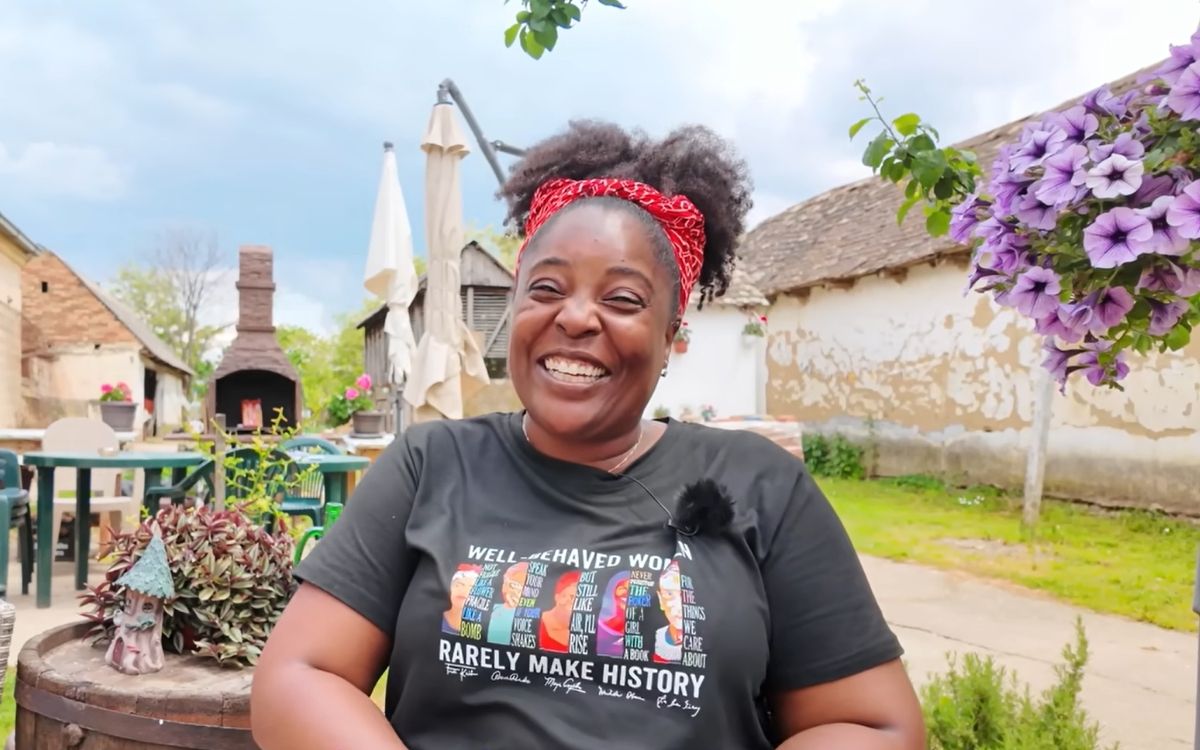
Moving from Los Angeles to a small village in Serbia would represent a radical life change for many. For the American Iris, however, it was not a step backward, but a decision that brought her what she could not find in big American cities – peace, security, closeness among people, and the feeling that she is finally home.
Iris was born in the United States of America, and before coming to Serbia she lived in Los Angeles and Dallas. She was used to the busy rhythm, long distances, crowds, and an environment where the shine of celebrities was a part of everyday life. After meeting her husband from Serbia, her life took a completely different direction.
With him, his son, and her mother, she moved to Serbia. Today, she lives in a village in Srem, in Vojvodina, near Erdevik and Sremska Mitrovica. Instead of city asphalt and a life subordinated to obligations, she is surrounded by a garden, animals, neighbors, and chores that follow the changing of the seasons.
From city shine to working in the garden
Life in the village, as Iris describes it, has little to do with the idealized scenes that can often be seen on social media. Behind the homemade products, green gardens, and animals in the yard, there is a lot of physical labor.
“Fun in the garden” in her new life is not a glamorous gathering, but a joint job with neighbors, over coffee, conversation, and laughter. Tomatoes, onions, watermelons, melons, and sunflowers are planted, the soil is prepared, and animals are taken care of.
The family raises goats and sheep, and they named some of the animals after famous music stars, including Whitney Houston and Marvin Gaye. That detail brings humor into an everyday life that is at the same time beautiful and demanding.
Caring for animals, maintaining the property, and preparing food take time, strength, and discipline. Iris does not try to present the village as a romantic place without problems. She also speaks of jobs that were not easy for her at first, like slaughtering and processing chickens, but she believes that such a life allowed her to understand more clearly where food comes from and how much effort is required to produce it.
For her, the very ability of the family to grow its own vegetables and part of its food became one of the greatest luxuries.
In Los Angeles, she says, food often seemed completely separated from the earth, nature, and the seasons. In the village, its creation is visible from the first seed to the moment it reaches the table.
Neighbors who become part of the family
One of the biggest differences between life in America and Serbia for Iris is the relationship between people.
In a Serbian village, everyone knows each other, and neighbors are not just people who live in houses nearby. They participate in daily life, jump in to help, share experiences, and pass on knowledge. Such connectedness was unusual for her after living in American cities, where people sometimes do not meet even their immediate neighbors for years.
Buying at local green markets is particularly important to her. Instead of large retail chains, she chooses small producers and sellers whom she can get to know personally. In that way, as she says, the money stays in the community, while through conversations with people she learns more about Serbian history, food, and customs.
The market for her is not just a place to shop. It is a space for meeting, exchanging stories, and learning about the country in which she decided to live.
Such a sense of community also changed her understanding of family. While growing up in California, members of her extended family lived relatively close, but real closeness did not always exist among them. In Serbia, she discovered an environment where family and neighborly relationships intertw much more.
Serbian language as an everyday challenge
Adapting to a new country was not simple, and one of the biggest obstacles was the Serbian language.
Grammar seemed almost insurmountable to her at first. Still, she did not give up. She learned the most important words and expressions through everyday situations, conversations with neighbors, going to the market, and doing chores around the village.
The book “Kod nas se kaže” (As We Say Here), a collection of local sayings and expressions, also helps her in learning. Iris realized that a language cannot be learned just by memorizing words, but also by understanding the way people think, joke, and pass on life experience.
Although she still does not speak without mistakes, she gladly talks to the locals. Incorrect cases and a limited vocabulary do not stop her from establishing contact, because, as she noticed, people are mostly patient and ready to help her.
Orthodoxy deepened her sense of belonging
An important part of her coming closer to Serbia was also the Orthodox faith. Iris accepted Orthodoxy, and baptism had a much broader meaning for her than a formal change of religious affiliation.
In church rites, she found seriousness, emotion, and a sense of continuity that she had not experienced in the same way before. Lighting candles, prayer, and attending liturgy connected her with the tradition of her husband’s family, but also with the culture of the country in which she began a new life.
Orthodoxy, as she explains, helped her to no longer view Serbia just as a country she moved to. She began to experience it as her home.
COUNTRY LIFE IS NOT ALWAYS IDYLLIC
Although she speaks with a lot of love about life in Serbia, Iris does not hide its tougher sides.
Winters are particularly exhausting for her. When the greenery disappears, garden work stops, and the days become short, the village can seem deserted and isolated. After the holidays comes a period in which nature is at rest, and everyday life becomes significantly slower.
To stay active, she and her husband walk through the village and try to make about 10,000 steps a day.
Upon arriving in Serbia, she was also faced with weight gain. Homemade bread, jams, meat, and hearty meals were delicious, but also high in calories. She had to find a balance between enjoying home cooking and taking care of her health.
Still, even on days when there is a lot of work or when she misses the city dynamics, Iris says she does not regret her decision.
SHE FEELS SAFE IN SERBIA
As a Black woman from America, before moving she could not know how she would be accepted in a small Serbian town. However, she states that in everyday life she has not experienced racism and that she feels accepted and safe among the people.
Such an experience has a special significance for her. She says that, despite growing up in the US, she would feel greater uncertainty if she and her family chose to live in certain rural parts of America.
In Serbia, she found safety, which she considers today as one of the most important qualities of life. While news of armed violence and insecurity were part of her American experience, in a Serbian village she can focus on her family, daily responsibilities, and relationships with people.
FAMILY LIFE BETWEEN TWO CULTURES
Her home today combines American and Serbian habits. Her mother also lives with them, whose relationship with the Serbian family brings many colorful moments.
Differences in character and customs sometimes cause misunderstandings, but they are part of a family dynamic filled with affection. Sharing coffee, shopping, and conversations have shown that closeness does not depend on whether people speak the same language or grew up in the same culture.
Iris and her husband strive to pass on work habits and financial responsibility to his son. He does not receive an allowance automatically, but earns it by doing household chores and practicing singing. In this, a modern approach to parenting merges with values traditionally associated with country life.
“HERE I CAN BE WHO I AM”
One of the most important changes for Iris is not visible in the garden, house, or yard, but in the way she perceives herself.
In big cities, she felt the pressure to look a certain way and to maintain an image of a successful and orderly life. In the countryside, she does not mind working in old or dirty clothes, because she no longer feels the need to make an impression on people she does not know.
Such simplicity for her is not a sacrifice, but freedom.
Iris does not claim that life in Serbia is perfect. She is aware of cultural differences, language barriers, physical labor, and occasional unpleasant comments on the internet. However, none of that has changed her feeling that she made the right decision.
With a smile, she says of herself that she is “Serbian in life and in death.” Behind that humorous sentence lies a serious sense of belonging to a place that was not given to her by birth, but chosen by her.
From Los Angeles to a village in Srem, her journey was not just a move from one continent to another. It was a transition from a life marked by speed, anonymity, and external glare to an everyday life based on work, faith, family, and interconnectedness.
For Iris, home is no longer just a spot on a map. It is a place where she feels peaceful, accepted, and free enough to live without pretense.
MORE TOPICS:
SERBIAN CITIZEN REPORTED ATTEMPTED RAPE: Man from Kosovo and Metohija arrested in Herceg Novi!
Source: Nova.rs; Photo: Printscreen YouTube
 Add Serbian Times as your Google source