




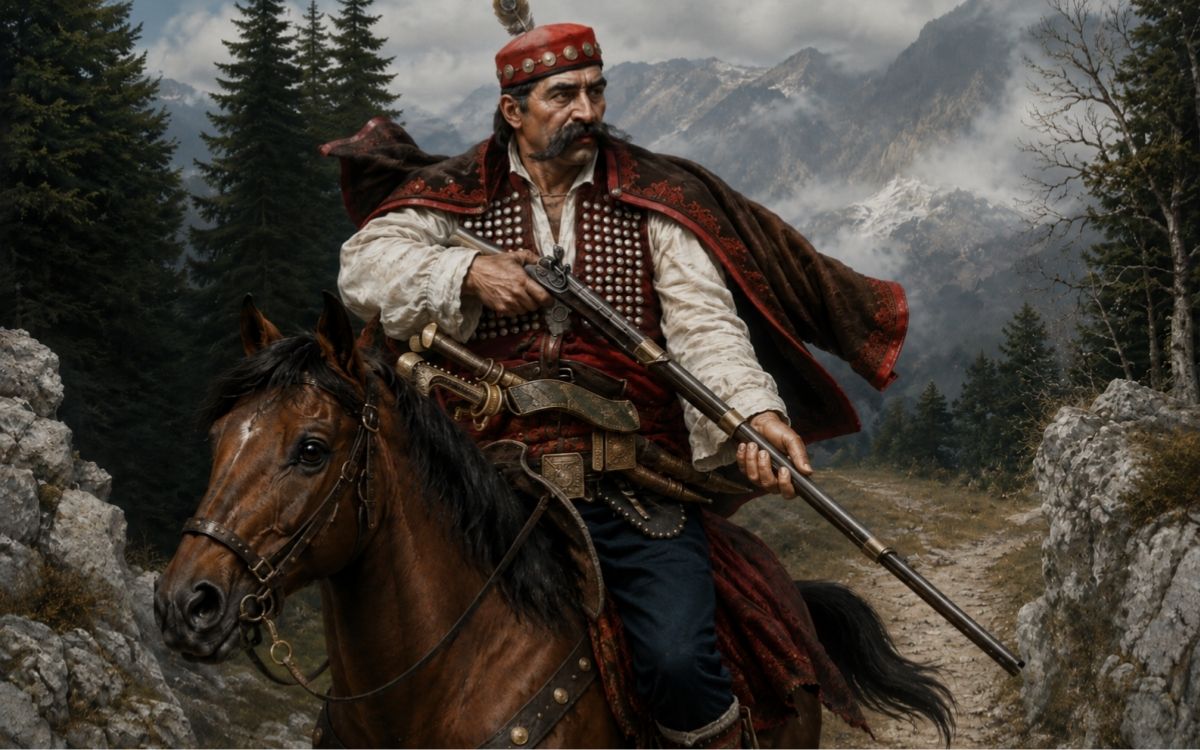
There are heroes whom history remembered by testimonies in historical documents, military reports, and battle dates. There are also those whom the people took over from history, magnified their deeds, enriched them with song, and turned them into symbols. Vuk Mandušić belongs to both: he was a real warrior from the bloody 17th century, but also an epic hero whose name lived for centuries much further than the battlefield on which he died.
The historical Vuk Mandušić is not a personality about whose life we know everything. Rupe near Skradin is cited as his place of origin, while the year of his birth is unknown. In Venetian documents, his surname was recorded in various forms — Mandusich and Mandussich, and he is also mentioned as Vučen. What is reliable is that he died near Zečevo, not far from Kistanje, on July 31, 1648.
In order to understand his fate, it is necessary to understand the time in which he lived. Dalmatia was then one of the most turbulent border areas of Europe, torn between the Ottoman Empire and the Venetian Republic. The Cretan War, fought from 1645 to 1669, formally began due to the struggle for Crete, but its Dalmatian front quickly turned into a series of sieges, raids, migrations, and clashes in which entire villages passed from one state to another.
In that world, the Uskoks emerged, border warriors among whom were natives, volunteers, and Christian refugees from Ottoman territory. They lived off military service, war booty, and dangerous cross-border raids, and their units were led by harambašas and voivodes. They were elusive fighters, useful to great powers in times of war, but often uncomfortable for those same masters when peace set in.
At the end of 1647 or early 1648, Mandušić entered the service of the Venetian Republic and took command over Uskok units composed predominantly of Christian defectors from the Ottoman area. His historically confirmed military career lasted very short, only a few months, but it was so turbulent that his name remained recorded in both Venetian and Ottoman records.
In February 1648, he participated in the Venetian capture of Drniš and Knin. Already the following month, his units prevented Ottoman forces from providing help to the besieged Klis, whereby Mandušić contributed to the capture of this strategically extremely important fortress on March 31. These are not events from a folk song, but data confirmed by contemporary sources and later historiographical research.
His boldest confirmed undertaking followed in the second half of May. With a company of only 175 men, he penetrated deep into Ottoman territory, all the way to Ključ, and then retreated under fight across the area of Glamoč and Grahovo. Despite attacks, he managed to lead the men back, after which on June 2 in Šibenik he personally submitted a report on the raid. It was the kind of action because of which the Uskoks gained fame among the Christian population, and caused fear among the Ottoman garrisons.
Mandušić’s last battle took place at the end of July, when a large Ottoman army penetrated into Ravni kotari, taking captives and carrying war booty. Mandušić and Ilija Smiljanić were given the task to intercept them with significantly smaller forces, free the slaves, and recover the stolen property. Near the Zečevo tower, a disagreement occurred among the commanders regarding the manner of attack, and Mandušić was wounded and killed in battle. His comrades testified about his death as early as August 1 and 2 before Venetian investigative authorities in Zadar and Šibenik.
Ottoman chronicler Ahmed Čelebi also records Mandušić’s death and states that his head was cut off in the battle. The number of soldiers and casualties brought by the Ottoman record is probably exaggerated, as was often the case in war chronicles of both sides, but the very fact that an enemy source single him out by name is proof of his significance. Mandušić was not just one of many border fighters, he was a commander known enough that his death was recorded and celebrated in the opposing camp.
Particularly important for the picture of his character are the assessments of the Venetian General Provveditore Leonardo Foscolo. He described Mandušić as an experienced, brave, and sensible warrior, respected among his own people, but also among enemies. After his death, the Venetian authorities decorated his family and relocated them to Istria, which shows how much the Republic valued his service.
That is where what can with reasonable certainty be called a historical biography ends, and a much broader life of Vuk Mandušić in folk memory begins. His raids became the basis of numerous stories and songs, among which are “Vino piju dvije harambaše”, “San Mandušića Vuka”, and “Smiljanić na Zečevu”.
In the epic poem “Vuk Mandušić izbavlja ropstva Senjanin Ivana”, preserved in the Erlangen Manuscript, Mandušić and Sandić Jovan suddenly attack an enemy camp, free the captive Senjanin Ivan, and reverse the outcome of the conflict. That poem is not a military report and cannot be read as a literal description of an actual event. However, it shows how the people remembered him: as a faithful friend who does not abandon a comrade and as a harambaša who appears when it seems that all is lost.
The greatest literary immortality was bestowed upon him by Petar II Petrović Njegoš in “The Mountain Wreath”. Njegoš’s Mandušić is at the same time a fearless warrior and an emotional man, capable of suffering over unattainable beauty and weeping over a broken džeferdar (a type of long flintlock rifle, i.e. musket). The famous line “A u ruke Mandušića Vuka biće svaka puška ubojita” turned his name into a proverb about a man whose skill is worth more than the weapon itself. Still, “The Mountain Wreath” is not Mandušić’s biography. Njegoš introduced the historical name into his own literary world and built a complex epic hero from him.
Mandušić’s name appears today in various national historiographies, which interpret him through later identity divisions. Venetian sources, however, speak primarily of Uskoks, Morlachs, refugees, and military subjects of the Republic, categories from the 17th century that cannot be fully converted into contemporary national designations.
For Serbian culture, the fact is that Mandušić has been present for centuries as one of the great heroes of Serbian Uskok epic poetry and that through Njegoš’s work he took a permanent place in Serbian literary and historical memory.
History, therefore, does not confirm every feat that the song attributed to Vuk Mandušić. We do not know what he looked like, what he said before the battle, nor whether his džeferdar really had a special place in his heart. But we know something more important: with small bands he went deep behind enemy lines, fought bravely, stayed with his people before a many times stronger army, and died on the battlefield. Folk poetry may have exaggerated his deeds, but it did not invent his heroism, which was great enough to be recorded even by his enemies.
MORE TOPICS:
SERBIAN CITIZEN REPORTED ATTEMPTED RAPE: Man from Kosovo and Metohija arrested in Herceg Novi!
Source: Serbian Times; Photo: ChatGPT prompt by Serbian Times
 Add Serbian Times as your Google source