




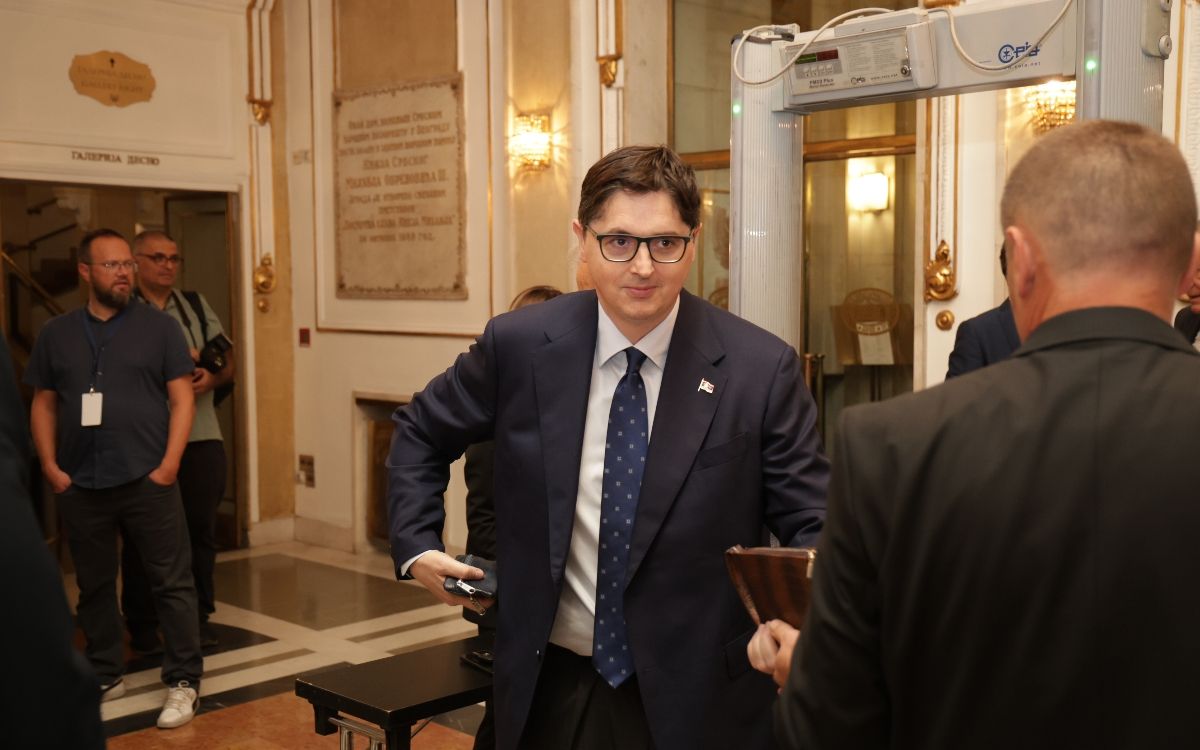
Uglješa Mrdić, a Serbian Progressive Party (SNS) official known for going on a hunger strike in a tent outside the National Assembly, has significantly increased his assets this year, KRIK reveals. Mrdić, who is 30th on the SNS electoral list, bought two apartments in Belgrade within just a month and a half, with an estimated combined value of around €170,000, according to a real estate agency hired by KRIK.
Documents collected by KRIK show that he bought the first apartment on July 15 and the second on September 1 this year. According to the real estate agency hired by KRIK, the two apartments are worth around €170,000 combined.
One apartment is in Kaluđerica, a suburban neighborhood of Belgrade. It measures 34 square meters and is worth around €70,000. The other is in a better and more expensive location, Zvezdara. It measures 26 square meters and is worth €100,000.
It is not known how Uglješa Mrdić financed the purchases.
Neither apartment has a registered mortgage, suggesting that he did not take out a loan to buy them, but paid for them in cash.
Before purchasing the apartments, data from the Anti-Corruption Agency show, he did not own any real estate that he could have sold to finance the purchases. He declared that he had savings, but their amount is unknown.
He could not have afforded the apartments on his salary alone, either.
He bought them while serving as a member of parliament, earning a monthly salary of 220,000 dinars (around €1,900). He would have needed 90 monthly salaries to buy the apartments, meaning he would have had to save his entire salary every month for more than seven years.
Nevertheless, he purchased the apartments during a period when he went from being an obscure SNS official to a well-known public figure.
To find out where the money for the apartments came from and whether the purchases were connected to his increased activity within the party, KRIK journalists called Mrdić.
During the phone conversation, he said he was entering an event and asked them to send their questions by message. After that, he stopped answering calls and did not respond to the questions sent to his phone number or the email addresses available to the journalists.
“A Serbian family can afford to buy a couple of properties”
Last week, Finance Minister Siniša Mali sparked widespread public outrage when he stated that a Serbian family could afford to buy a couple of properties.
“If you have worked hard and bought two or three apartments for your children, to leave them something for the future,” Mali said, provoking public anger because his remarks seemed to suggest that he was either out of touch with reality or deliberately mocking Serbian citizens.
For Mali, who has been at the top of the political scene for years, owning two or three apartments is no big deal. KRIK previously revealed that he had purchased as many as 24 apartments in a luxury Bulgarian seaside resort. He is not an isolated case: other members of Aleksandar Vučić’s inner circle also own valuable real estate.
When he made that statement, Mali certainly was not thinking of Serbian citizens earning an average salary of around €1,000, who can hardly afford even one property. So whom could Mali have had in mind?
Uglješa Mrdić, a lower-ranking official in Mali’s party, fits the profile of the person Mali described.
Who is Uglješa Mrdić?
In the very year before treating himself to new properties, Mrdić did the party a considerable favor. On the last day of October last year, he set up a tent on the steps of the National Assembly building and began a hunger strike because the prosecution was investigating his party colleagues.
Afterward, he proposed a package of amendments to Serbia’s judicial laws, dubbed the “Mrdić laws,” which would effectively place the work of the prosecution under the government’s full control.
He has been an SNS member of parliament since 2020 but became widely known to the public in November last year, when he spent 11 days on a hunger strike in a tent on the steps of the National Assembly building.
As he explained at the time, he had taken this step because he was dissatisfied with the work of the prosecution. He demanded the arrest of Nebojša Bojović, former president of the Shareholders’ Assembly of Serbian Railways Infrastructure, and Milutin Milošević, the company’s former executive director, over what he claimed was their responsibility for the collapse of the canopy at the railway station in Novi Sad on November 1, 2024, which killed 16 people and seriously injured one person.
During Mrdić’s hunger strike, numerous SNS officials visited him in his tent, as did convicted criminals. A photograph obtained by KRIK shows that he was also visited by Milan Ostojić Sandokan, publicly known as the leader of the Šabac criminal gang, who was sentenced to 10 years in prison for ordering a murder.
Mrdić remained in the public spotlight even after ending his hunger strike. He proposed a package of judicial law amendments in the Serbian Parliament known as the “Mrdić laws,” which would effectively place the work of the prosecution under the government’s full control.
Mrdić practically admitted that this was their goal himself in an interview with K1 television. He said the laws had been introduced because part of the prosecution service and the system had broken away from Serbia and attempted to stage a color revolution.
“They attacked the state because they started arresting ministers from the SNS. Because, in the end, they wanted to arrest President Vučić, let’s be frank. They started arresting people, wanted to carry out the color revolution to the very end, and bring down the state,” Mrdić said at the time.
The laws were adopted but later amended following criticism from legal experts and the European Union, which described them as an attack on judicial independence.
A PhD with a grade average of 6.63
Mrdić presents himself as a doctor of economics, but his official biography does not state when or where he completed his undergraduate studies or earned his doctorate.
The media previously revealed that he studied for 13 years and that his average grade upon completing his undergraduate studies was 6.63, KRIK reports.
The Faculty of Law in Belgrade told KRIK that Mrdić was a self-financing student from 1998 to 2002, when he lost his student status because he failed to enroll in the third year within the prescribed period. He subsequently transferred to the private Faculty of Law, Commerce and Judiciary in Novi Sad, where he passed his final exam in 2011, the faculty told KRIK.
Mrdić has been with the SNS since its founding. Before that, he worked as a journalist for several media outlets, including the pro-government weekly Pečat.
“When I joined the SNS, I sat with Aleksandar Vučić in his office. I told him I needed one big favor: to give me an application form, because I wanted to join him in building and strengthening the then newly formed Serbian Progressive Party,” Mrdić told the pro-government tabloid Alo in 2021.
Mrdić receives more than 220,000 dinars per month from various sources. Among other things, he earns 95,000 dinars a month for providing legal advice at the Institute of Roads and 43,500 dinars as a lecturer at the Belgrade Academy of Business and Art Applied Studies.
Since 2018, he has been chairman of the board of directors of the joint-stock company “Putnik,” which was seized from drug lord Darko Šarić over suspicions that it had been purchased with money earned from cocaine smuggling. It is not known how much Mrdić receives for this position.
MORE TOPICS:
Source: KRIK, Foto: Aleksandar Jovanovic Cile / ATAImages
 Add Serbian Times as your Google source