




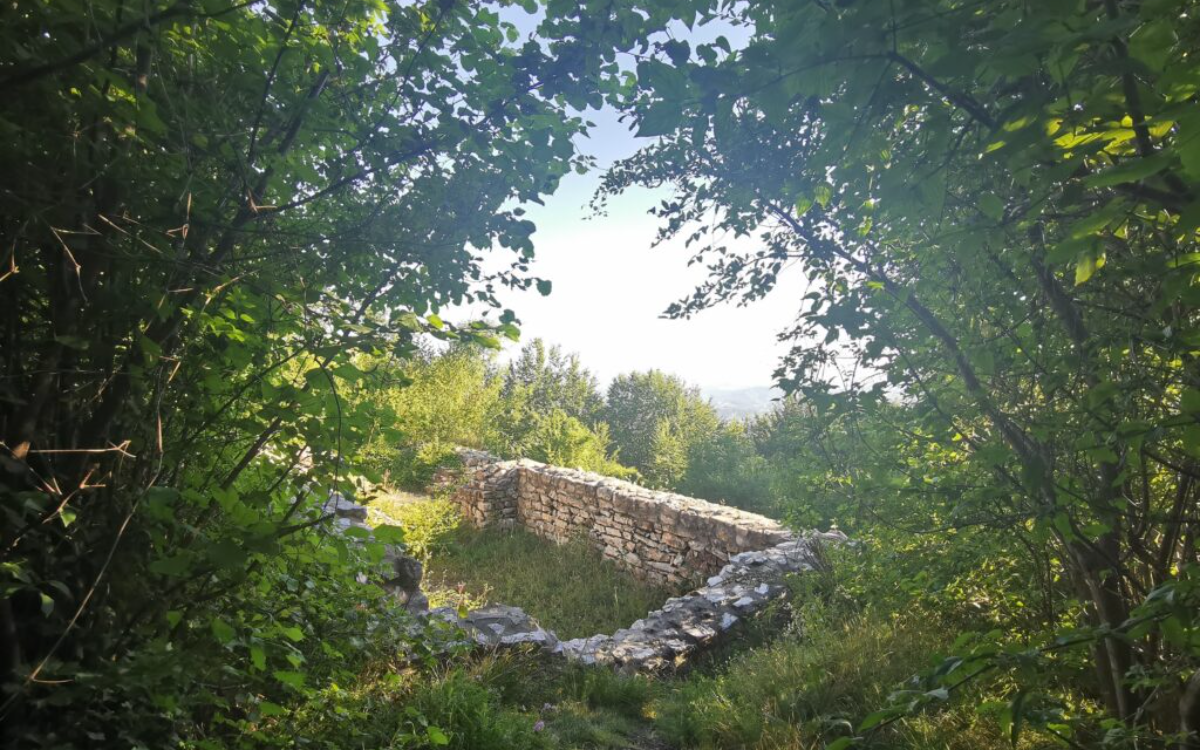
Less than twenty kilometers from the center of Čačak, on the slopes of Mount Jelica, the Gradina fortress has withstood the centuries. It was built by the last Roman and first Byzantine emperor, Justinian I—the same man who left the legendary Hagia Sophia in Istanbul as a legacy to the world.
Rising on a mountain peak of the already forgotten settlement of Jeljen in the area of the Dragačevo village of Grab, this legend-shrouded fortress still preserves numerous traditions today; it was the center of the region at the time, and later became fertile ground for archaeological research.
“At the site, which spans 22 hectares, remains of churches, tombs, individual graves, and remnants of military and folk architecture can still be seen today. An inscription in Latin indicates that one basilica dates from the end of the 4th or the first half of the 5th century, and it is also necessary to highlight the existence of a baptistery in the basilica,” Delfina Rajić, director of the National Museum in Čačak, told RINA.

At Gradina, the coexistence of a mixed population was established, whose uniqueness was determined by characteristic traces of their clothing items and dishes. Experts from the Faculty of Philosophy in Belgrade have been conducting research for decades at this archaeological site of first-class importance, especially after the discovery of a silver reliquary in the shape of a sarcophagus.
“The National Museum in Čačak reconnoitred Gradina in 1969 and 1972. At that time, researchers found well-preserved remains of ramparts on the surface of the terrain, in some places even over two meters high. Three years after the first archaeological excavations of the fortress, the Lučani Municipal Assembly declared Gradina on Jelica a cultural monument in 1987,” Rajić stated.

This archaeological site is located at 846 meters above sea level and offers a magnificent view of the entire city of Čačak. In a monumental sense, the richest remains are the discovered ramparts, churches, and houses from the early Byzantine period.
“The daily life of the inhabitants of this urban settlement is documented by numerous finds of ceramic and glass vessels, some of which represent imports of eastern origin. In addition, a large number of iron and bone tools were found, some of which were certainly produced at Gradina itself. During research so far, this fortification has proven to be special compared to other archaeological sites of that type, primarily due to the rusticity of the architecture, but also because it was resettled after being destroyed,” the director of the National Museum pointed out.

Portable finds from Gradina are kept in the National Museum in Čačak, and Rajić reminded that the first known interest in the remains on the Čačak – Dragačevo road dates back to 1843. At that time, Sreten Protić, a clerk of the Dragačevo district, reported to the Ministry of Internal Affairs that an inscription dedicated to the goddess Diana had been found, “carved in stone on some ruins, on Mount Jelica above Čačak.”
“What is amazing in this whole story is the untouched nature and the preservation of those basilicas with ramparts. It is a site that truly has great tourist potential and, with a little effort, could become a unique archaeological park. I believe that in the coming period, all the wealth of this part of Serbia will be recognized,” said Gvozden Otašević, a journalist and chronicler of the Dragačevo region.

Thanks to the publications of Professor Mihailo Milinković from the Faculty of Philosophy, Gradina on Jelica has become very well known and well-positioned in Germany and Austria, as well as at professional gatherings in Croatia. Archaeologists still face the difficult task of deciphering who all came and stayed there, because all the inscriptions from the slabs were erased and ended up as crushed stone on the road to the village of Goračići in the 1950s.
Sites like Gradina represent the key to further archaeological studies of late antiquity and the early Middle Ages, and not only in our region. Gradina on Jelica is an important key to understanding the processes that dominated the Balkans during the early Byzantine period, the time of the Migration of Nations, and the early Middle Ages. It was precisely in that period, on the ruins of the Roman Empire, that the basic formation of Europe as we know it today took place.
MORE TOPICS:
SERBIAN CHEF SHONE ON THE BIG STAGE: Miloš won a silver medal at an international competition!
Source: RINA; Photo: RINA
 Add Serbian Times as your Google source