



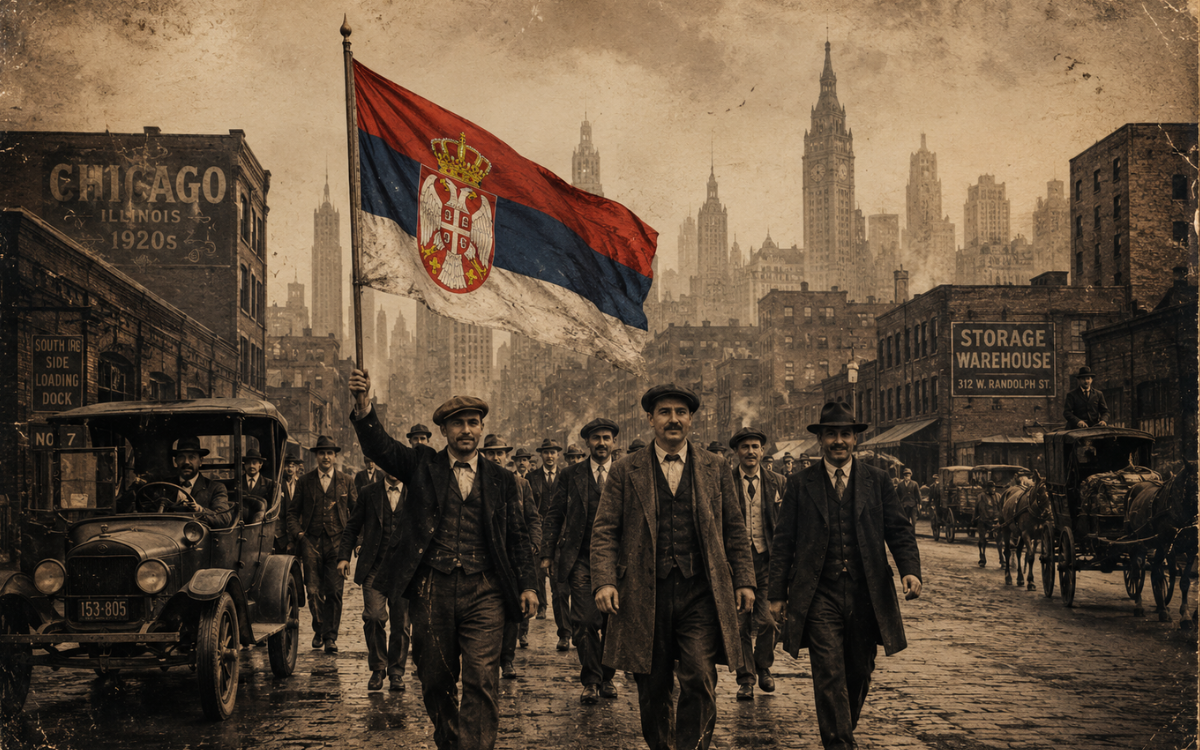
While the city was ruled by gangsters, prohibition, and the grayness of heavy industry, thousands of Serbian emigrants in the suburbs of Illinois, through bloody work and sacrifice, created the “second largest Serbian city in the world.” This is the story of them.
In a time when the smell of gunpowder from submachine guns spread through Chicago in the 1930s, and the street gangs of Al Capone and the Irish boss Dion O’Banion divided up the neighborhoods, on the south side of the city, in the Calumet district, a different, quiet history was being forged. There, where the sky merged with the black smoke of gigantic steel mills, thousands of kilometers away from their native soil, Serbian emigrants were building a city that decades later would become known as the “largest Serbian city after Belgrade.”
But, the path to the Chicago asphalt was not paved with Hollywood dreams. It was a path across the ocean, paid for with blood, sweat, and unprecedented hardship.
From Lika karst to glowing furnaces
Most of the Serbs who settled in Illinois at the end of the 19th and beginning of the 20th century did not come from the plains of Šumadija, but from poor, rocky areas under Austro-Hungarian rule; Lika, Kordun, Banija, and Dalmatia. Fleeing from hunger and conscription, they arrived at the port in New York with wooden suitcases and barely a few dollars in their pockets. They were immediately sent to where the American industrial machinery needed cheap and strong labor: to Chicago and neighboring Gary.
There, they were welcomed by steel mills, a modern hell on earth. The workday lasted 12 hours, seven days a week. At temperatures that exceeded a thousand degrees, our people, without any protective equipment, poured the steel from which the skyscrapers of Manhattan and the railroads that connected America were later made. They called it “bloody bread.” People died daily, and the survivors aged overnight.

Life in “boardings” and the kafana as an institution
Since mostly men came alone in the first waves, without families, they organized their lives in so-called boardings – shared houses where as many as thirty workers shared a few beds. They slept in shifts: while one group was at the factory, the other slept in the still-warm beds.
In that grayness of soot and hard work, the only oasis was the kafana. But the Chicago Serbian kafana of that era was not just a place for drinking; it was a courtroom, a bank, a consulate, and a church. There, rare newspapers that arrived from the Balkans were read, there, money was collected to be sent to families in the old country, and there, to the sounds of the tamburica and a glass of homemade rakija, tearing nostalgia was healed.
Surviving in Capone’s backyard
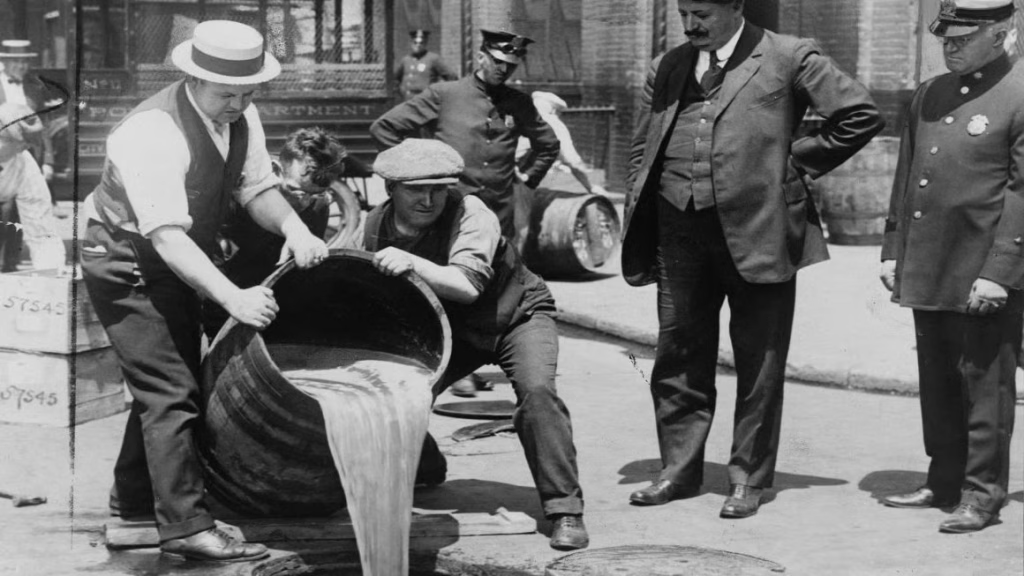
When prohibition came into force in America in 1920, Chicago became the capital of the underworld overnight. The southern and western parts of the city, where most of our workers lived, were controlled by Al Capone personally.
Serbs, used to distilling rakija in their villages, quickly understood the rules of the game. In the basements of workers’ houses, secret stills began to pop up. Illegal alcohol, known in America as moonshine, became a ticket for survival during the Great Depression. Nevertheless, our people managed to stay aside from major mafia clashes, they minded their own business, worked in factories, and preserved the community.
While bullets flew through the city, in 1929 Serbs founded the Serb National Federation, organized the first folklore sections, raised temples like the Holy Resurrection Church, and built institutions that stand even today.
From a steel mill to a Hollywood Oscar
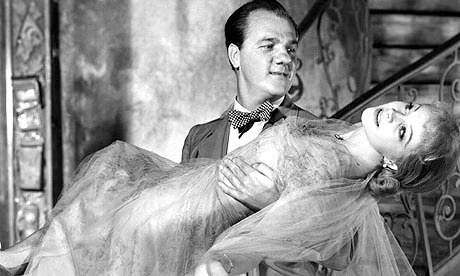
That this community was capable of great achievements is best shown by the story of Mladen Sekulović, the son of a steel mill worker from Gary. Mladen’s father, Petar, came from the vicinity of Podgorica and spent his whole life next to glowing furnaces. Mladen himself worked hard physical jobs in the factory as a young man, but on weekends he acted in the theater troupe of the local Serbian church.
That boy from a working-class suburb of Chicago would later change his name to Karl Malden and become one of the greatest actors in the history of Hollywood, winning an Oscar for the cult film “A Streetcar Named Desire.” Until the end of his life, Malden proudly pointed out his origin and spoke fluent Serbian with his colleagues in Hollywood, reminding everyone where he came from.
A legacy that lives on
Today, a century later, Chicago is no longer a city of steel mills and steam locomotives. The descendants of those workers who arrived at Union Station in wooden opanci are today successful doctors, lawyers, professors, and businessmen.
New waves of emigration brought new energy, but the spirit of those old, tough people who managed to preserve their name, slava, and language in the whirlwind of history and among Chicago gangsters, still hovers over the Windy City. They did not just build buildings out of steel, they built an indestructible bridge between the Balkans and America.
MORE TOPICS:
I EXPECT THE ARRIVAL OF PUTIN IN BANJA LUKA: Dodik on the agreement with the Russian president!
Source: Serbian Times Photo: Chatgpt, Ilustracija
 Add Serbian Times as your Google source