




“It was a pleasure to plant the Serbian flag at the very top of the world. I proudly unfurled it in the Arctic, at 90 degrees north latitude. It is an absolutely incredible feeling to realize that I am the first student from Serbia to have reached the North Pole. When I held the Serbian flag at the Pole, I felt enormous pride and responsibility. I still cannot believe that I have become part of this unique Rosatom expedition.”
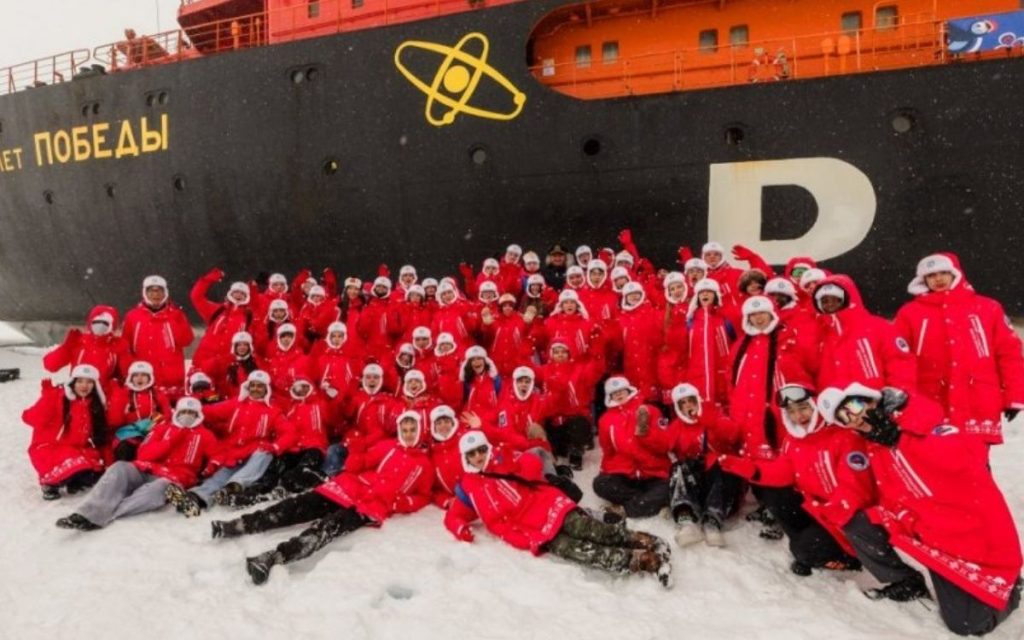
This is how Viktor Franolić, an IT student at the Sixth Belgrade Gymnasium, who will begin his second year at the educational institution in a few days, speaks to “Novosti.” Still under the impression of his unforgettable journey to the North Pole as part of the seventh international scientific and educational expedition “Icebreaker of Knowledge,” which brought together talented schoolchildren from all over the world on the deck of the nuclear-powered icebreaker “50 Years of Victory”: from 22 countries and Russia. Among them was our Viktor, apparently officially the first citizen of Serbia at the North Pole.
From Murmansk, where they arrived with one parent each, the young researchers embarked on a unique journey under the auspices of the state corporation “Rosatom.” When the captain of the nuclear-powered icebreaker issued the official order to begin the voyage, the bow was directed toward the Arctic, and the route was Murmansk – North Pole – Franz Josef Land archipelago – Murmansk.
“The entire journey lasted 15 days, while the voyage on the icebreaker lasted a total of 10 days,” Viktor tells us.
“From Murmansk, we went directly toward the North Pole, and on the return journey we spent one day near one of the 191 islands in the Franz Josef Land archipelago.”
This trip to the Arctic will certainly be a journey he remembers for the rest of his life, but we asked him what left the biggest impression on him of everything they saw and visited.
“At the North Pole, I remember the polar bear and the strong wind the most. Near Franz Josef Land, we saw many birds and an abandoned polar station. But the entire expedition was truly an unforgettable experience, and it is very difficult to choose one favorite moment. Throughout the expedition, temperatures ranged from one to 10 degrees, while at the North Pole itself it was minus five, accompanied by very strong winds.”
It is not easy to reach the North Pole, but those who have the privilege of reaching it across the Arctic Ocean carry unforgettable images with them forever.
“At 90 degrees north latitude, we were surrounded by beautiful landscapes of the Arctic Ocean and very strong winds, but for me it was a wonderful achievement. And I will remember the Arctic Ocean for the breathtaking views into the distance across pieces of ice known as ‘pancakes,’ larger ice floes broken up by the icebreaker, and the calm, glass-like water flowing into the cracks,” Viktor tells us, sharing fragments of his experience from this extraordinary journey.
He returned to Serbia from the trip richer for having made new friends from Russia, Armenia, Bangladesh, Belarus, Bolivia, Brazil, Hungary, Vietnam, Egypt, India, Indonesia, Kazakhstan, China, Kyrgyzstan, Mongolia, Myanmar, Namibia, Rwanda, Tanzania, Turkey, Uzbekistan and the Republic of South Africa.
“We were lucky enough to see as many as two polar bears, one while heading out at five in the morning, and the other just a few hundred meters from the top of the world, the Arctic. Near the Franz Josef Land archipelago, we watched a large flock of Arctic birds, while our parents enjoyed watching beluga whales near the shore of Teriberka during their excursion,” Viktor says.
“The 22 of us from abroad became friends very quickly and spent the entire expedition together. We are still in daily contact,” Viktor says.
From the very first moment after leaving the port in Murmansk, intensive work began aboard the ship. The program included theoretical lectures, workshops, interactive discussions, scientific experiments, as well as specialized consultations on career guidance. Eminent experts from various scientific fields worked with the young researchers.
“The lectures were diverse, about polar bears, the marine world of the Arctic, the operation of a nuclear reactor, national dances… Most of all, we talked about the development of nuclear technology,” Viktor reveals.
MORE TOPICS:
Source: Novosti, Foto: Rosatom
 Add Serbian Times as your Google source