




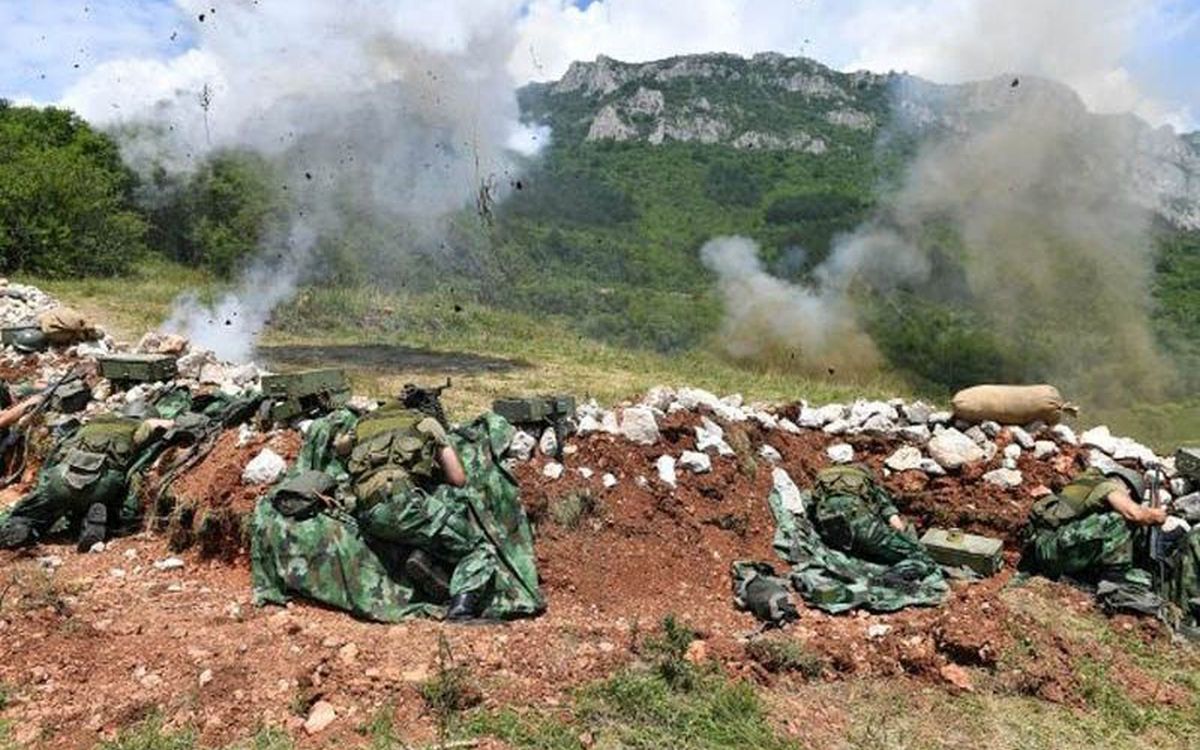
For Mount Paštrik on the Yugoslav-Albanian border, until 1999, apart from the residents of Prizren and their neighbors, only rare geographers, mountaineers, and former border guards who stayed at the watchtowers knew. The battle fought on its slopes 26 years ago, the heroic resistance of the Army of Yugoslavia, and the scale of the force they faced, bravely and decisively, made this mountain an almost mythical place of defense for Kosovo and Metohija.
Along with the Battle of Košare, Paštrik is considered the place of the most agonizing battles that the defenders fought with Albanian terrorists. As opponents, they had the joint forces of NATO, foreign mercenaries, KLA terrorists, and the regular army of Albania, which is still rarely talked about today. All of them, gathered around the same task – the conquest of Kosovo and Metohija – launched a major military operation “Arrow” on May 26, 1999, the goal of which was a ground incursion into the FRY, cutting off the Prizren – Đakovica communication, and passage into the depth of the province.
Mount Paštrik is the place where the command was issued that became the common oath of all defenders of Kosovo and Metohija in 1999 – “There is no going back, Serbia is behind us.” Believing in the strength of this motto, the Army fought heroically. This is also evidenced by the casualties – in operation “Arrow”, the 549th Motorized Brigade, which held the position on this part of the border, had 25 killed and about 200 wounded fighters. In the brigade’s zone, a total of 87 officers, non-commissioned officers, and soldiers were killed, and 300 were wounded and injured. The ferocity of the battles, especially during the NATO air strikes, is also evidenced by the fact that dozens of fighters were injured, even though they were not exposed to direct missile hits at all.
Operation “Arrow” began in the early morning of May 26 with an attack on the front between the Ćafa Prušit and Liken watchtowers. That is when Albanian tanks appeared, and Serbian positions were pelted with mortar and howitzer fire. With this offensive, the enemy tried to mask the main direction of the offensive across the Gorožup watchtower. In the direction of the main attack, the VJ had only 400 people, of which half were on the front line. They were stretched along a six-kilometer-long line. The situation was further aggravated by the fact that around 5,000 terrorists were staying near the border at that moment.
The commander of the 549th Motorized Brigade, decorated with the ribbon of the Order of the People’s Hero, retired General Božidar Delić, emphasizes that the defenders quickly consolidated in protecting their positions.
“As there was not enough manpower, I ordered every unit to form one company of 150 to 200 people. The armored battalion did this as well, tank crewmen became infantrymen. The artillerymen too. A company was formed even by the Rear Battalion, composed of cooks and technicians. They all took rifles in their hands and headed to Paštrik into battle. Already by the evening, there were about 1,000 of us there,” recalls the first days of the offensive General Delić, who was a colonel at the time.
In the midst of the attack, the Gorožup watchtower found itself surrounded, and an order was issued to abandon it. Just a few hours later, the defenders consolidated and, virtually without orders from higher command, retook the watchtower, which was even recorded by television cameras.
The main support for the terrorists came from the American military. The north of Albania was the base of NATO forces in those days. At the “Rinas” airport was the center of air support for the offensive. During the battles on Paštrik, evacuations were carried out by “Chinook” helicopters, and American instructors and strategists were also in the chain of command. The Americans would take over the main role a few days later.
FIND OUT MORE
By order of General Wesley Clark, the strategic aviation of the US Armed Forces was raised against the defenders of Paštrik. Those were the hardest days for the Serbian soldiers in this battle. A-10 “Thunderbolt” airplanes – sowers of death – were joined by F-16 fighters, “Tornado” aircraft, and even giant B-52 and B-1 bombers. They took off from England and released their deadly cargo on positions in the vicinity of Prizren.
“The brigade zone, primarily on Paštrik, from the Gorožup watchtower to Planeja, was bombed 24 times from May 31 to June 10. They didn’t always hit, most often they struck empty space. But when two planes unload 100 tons of bombs, everything vanishes. Stone fences, electric poles, vegetation become nothing. Only stumps remain. Houses as well. Multi-story buildings in contact with aviation become just slightly larger piles of rubble, roof tiles, and rebar,” svedoči General Delić.
One of the most important roles during the defense of the border during those difficult days of 1999 was held by Lieutenant Colonel Stojan Konjikovac, who performed the duty of Chief of the Operational Organ of the command in the 549th Motorized Brigade. The hardest day in the battle on Paštrik, as he says, was May 31, when an unprecedented force from the air poured down on the defenders.
“They used all forces to make a breakthrough. In the sky above us, at least a dozen NATO planes circled continuously. They operated over the area of Šeh Mahala, a hamlet of Planeja where every house was targeted. In just one run of carpet bombing, in the basement shelter where we took refuge, seven fighters were killed and ten were wounded. Lieutenant Colonel Boško Lemić also died in that run,” recalls General Konjikovac.
The runs of NATO aviation are remembered by all participants of the battle on Paštrik. Especially ferocious were the strikes of the bombers, whose combat load consists of as much as 55 tons of missiles. They operated in pairs, and one “carpet” covered an area of approximately 16 hectares. In that space, everything becomes leveled with the ground. The sound effect, as well as the visual one, as emphasized by the fighters whom wartime luck served to survive it, is terrifying.
Despite the incomparably stronger enemy, the most modern military equipment that NATO raised, as well as day-and-night exposure to enemy fire, the defenders did not retreat even a single step. The enemy could not cross over them into Serbian land. Although a battle without a direct winner was fought on Paštrik, these facts give the defenders of Kosovo and Metohija the right to speak of a triumph. The task they received, regardless of the heavy casualties, they fulfilled.
MAJOR VLATKO VUKOVIĆ: STRENGTH
“My 2nd Motorized Battalion of the 549th Brigade, of which I was the commander, was daily exposed to simultaneous runs of NATO aviation from the air and attacks by terrorists and the army of Albania. Those were the hardest moments. People were dying, but they did not give in. And we were pelted with all the weaponry the enemy had.”
CAPTAIN GORAN MIŠIĆ: HEROIC
“At moments it was terrible. Everything is burning, exploding, radiating. But we held on heroically. Every soldier of my company, of the 55th Border Battalion, of which I was the commander, had one to two shelters. Every group had a well-dug and camouflaged shelter. There was no moving of the defense line.”
LIEUTENANT DRAGAN MARKOVIĆ: INVINCIBLE
“I will never forget the bombing of the village of Planeja and the hamlet of Šeh Mahala. A dull explosion was heard, followed by a series of detonations of carpet bombs. Above Planeja, where the mortar platoon I commanded was located, a huge black mushroom appeared. We felt anger because of the helplessness to counter such a force from the sky. On land, we were invincible.”
SOLDIER DEJAN LAZIĆ: HONOR
“It was a real war. We had two goals – to stay alive and not to let the enemy breach the defense. I saw how quickly and easily one loses their head. But also what a wartime comrade, fellow fighter, brother-in-arms means. We never left wounded and dead comrades behind. Honor and camaraderie forged in the hardest times did not allow us to leave.”
THE NIGHT WHEN GENERAL VLADIMIR LAZAREVIĆ TURNED GREY
In 1999, General Vladimir Lazarević commanded the Pristina Corps. During those dramatic days, he met with countless challenges, temptations, and problems. The hardest moment, however, is related to the battle on Paštrik.
“At the end of May, around two-three o’clock after midnight, they informed me from Pristina that Bill Clinton was holding a press conference, where he stated that NATO had killed 700 soldiers of the Pristina Corps on Mount Paštrik that day. Communications with the defenders were cut off. Just a day earlier I was in that direction and saw the effect of the aviation. I assessed that the defense was stable. When I heard the information from Washington, I wanted to set off immediately. I looked at myself in the mirror and saw that I was completely grey. The real truth was – on that day, two of our soldiers died.”
MORE TOPICS:
BRAVO, GIRLS!: Serbian female rowers won the silver medal at the European Junior Championship!
Source: Novosti, Photo: IstorijaSrbijes.blogspot.com
 Add Serbian Times as your Google source