




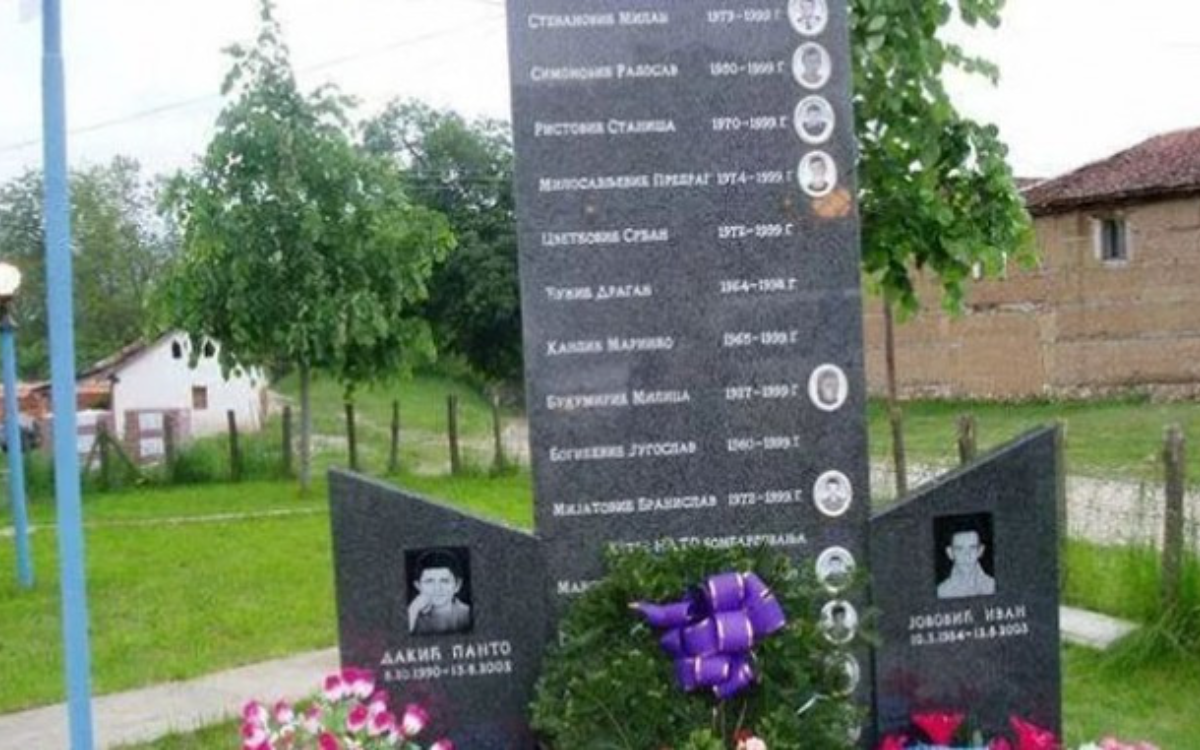
In [Goraždevac], near Peć, on August 13, 2003, one of the most heinous crimes against Serbs since the arrival of international forces in [Kosovo and Metohija]*** took place, in which two children were killed and four were wounded.***
Automatic weapons were fired in bursts at [Serbian children] who were at an improvised beach on the Bistrica River, and no one has been held accountable for the killings and injuries, nor is there any indication that this will happen.
According to the UNMIK investigation, 87 bullets were fired at the group of Serbian children and young people.
Ivan Jovović (18) and Pantelija Dakić (12) were killed. Jovović was killed during the attack and shooting, while Dakić died later in hospital.
Đorđe Ugrenović (20), Bogdan Bukumirić (14), Marko Bogićević (12), and Dragana Srbljak (13) were wounded.
Marko Bogićević and Bogdan Bukumirić suffered more serious injuries, while Dragana Srbljak and Đorđe Ugrenović sustained somewhat lighter wounds.
A large group of Serbian children from the Goraždevac enclave, 28 of them, were at the improvised beach on the Bistrica River or in the river itself on August 13, 2003, due to the summer heat.
The gunfire is believed to have come from the Albanian village of Zahač.
Following the attack, UNMIK investigators said that an unknown number of individuals opened automatic fire from “Kalashnikovs” at a group of Serbian children and young people from Goraždevac, firing 87 bullets, Tanjug reported.
Subsequent interpretations led to the assumption that the attack, and the killings, were connected to the announced return of around 200 previously displaced Serbs to the Peć area.
After the terrorist attack occurred, UNMIK police representatives emphasized their commitment to the investigation. They even said they would “turn over every stone” to find the killer or killers.
The crime in Goraždevac was officially condemned by the then leaders of UNMIK and KFOR, as well as representatives of the EU, the United States, France, Russia, and the leaders of the provisional authorities in Pristina.
Official Belgrade requested a session of the UN Security Council.
After the terrorist attack, UNMIK and the Kosovo Police questioned around 70 witnesses, with some reports putting the number at 75. Approximately 100 houses were searched.
A reward of one million euros was also offered for information about the crime, but there were no results and, officially, no new information was obtained.
Since there were no potential suspects, EULEX formally suspended the further investigation in 2010.
The authorities in Pristina did the same in 2015.
EULEX representatives emphasized that the investigation could be reopened, as they said, at any time if new information emerged.
Goraždevac is generally described as the most populous Serbian village in Metohija. This is probably true for that part of Metohija, the area around Peć. However, the situation has been changing in recent decades.
According to the 1981 census, 1,440 people lived in Goraždevac. Among them, 72 percent were Serbs.
According to the results of the 2011 census, 570 people lived in the village, of whom 255 were Serbs, or 44 percent.
The situation is made tense and painful by the fact that no one has been held accountable for the murder and wounding of Serbian children in Goraždevac, nor is there any indication that this will happen.
Moreover, the attack on Goraždevac in August 2003 was not the only one. The Serbian enclave was attacked on several occasions. Even the monument to the victims of the terrorist attack in August 2003 was targeted by vandals.
MORE TOPICS:
Source: Politika Foto: Tanjug Video
 Add Serbian Times as your Google source