




As the extraordinary parliamentary elections in Serbia approach, questions are reopening regarding the conditions under which citizens go to the polls and the possibility of expressing their electoral will freely and without pressure. The upcoming elections arrive at a time of deep political polarization and societal tensions, almost three years after the parliamentary elections of December 2023, which were accompanied by numerous allegations of electoral irregularities.
International observers from the OSCE/ODIHR mission then pointed to pressures on voters, pressure on public sector employees, misuse of public resources, and unequal conditions for election participants. Similar issues were documented by CRTA, which spoke about various forms of political pressure on citizens and concluded that the elections were not free and fair.
The common denominator in this story is the Serbian Progressive Party. SNS is accused by citizens, media, monitoring missions, as well as important international actors and institutions. The main accusations were related to blackmailed and bought voters. Employees in state-owned companies are particularly highlighted, but also individuals from the private sector connected to the ruling structure. Employees were threatened that if they did not vote for SNS and provide proof that they voted for that party, they would lose their jobs.
What is a valid ballot?
Voting in Serbia is free and secret, and the voter expresses their will independently, behind a screen. At the polling station, no one is allowed to suggest to you who to vote for, nor to control how you filled out the ballot.
It is particularly important to know what is considered a valid ballot.
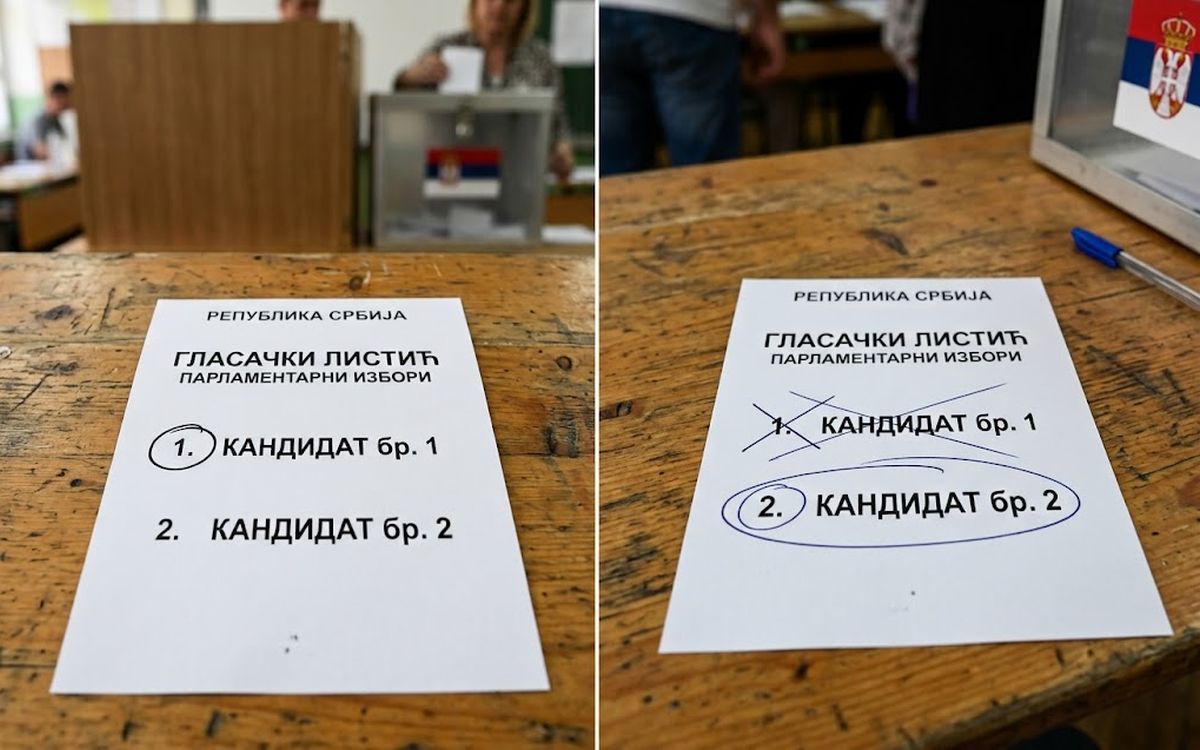
According to the Law on Election of MPs, a ballot is valid when the sequence number in front of one electoral list is circled, but also when the ballot is filled out in another way from which it can be concluded with certainty for whom the voter voted.
This means that additional markings by themselves do not necessarily invalidate the vote. CRTA stated in its explanations that the ballot can remain valid even when messages are written or drawn on it or when other electoral lists are crossed out, provided that it is clear which list the voter voted for.
The same rule has been explained by the media for years. Radio Free Europe reported in 2017 an explanation from the RIK that a ballot remains valid if other candidates or their lists are crossed out, provided it can be determined for whom the voter voted. Istinomer published the same interpretation in 2018, citing the then Rulebook on the Work of the Polling Board.
But there is an important difference: if two or more electoral lists are circled, or the voter’s choice cannot be reliably determined from the ballot, the ballot is invalid.
Therefore, if someone makes a mistake while filling it out, the most important thing is that in the end it is unequivocally clear which electoral list they gave their vote to. Precisely because of this, CRTA previously advised voters that, if they make a mistake, they should clearly mark the option they want to vote for and cross out unwanted options.
And what if someone asks you to take a photo of the ballot?
Photographing a ballot is not allowed. The official portal for voters explicitly states that photographing ballots and unauthorized recording, as well as using mobile phones and other means of communication, is forbidden at the polling station.
However, if you are blackmailed into taking a photo of the ballot, you can circle the number they demanded from you, take a picture, and then cross it out and circle the one you actually wish to vote for.
If, on the other hand, they give you ballots that are already filled out outside the polling station and ask you to bring out the ballot you receive at the polling station, try to point this out, even subtly, to one of the observers or controllers. Keep in mind that among them are those who will surely react and stop the voting process.
If someone attempts to influence your vote or check how you voted, you can contact the polling board. CRTA also states that a voter can point out a violation of the secrecy of voting to the polling board.
The most important thing to know is: your vote is yours and voting is secret.
MORE TOPICS:
Source: Serbian Times / CRTA Foto: Nano Banana
 Add Serbian Times as your Google source