




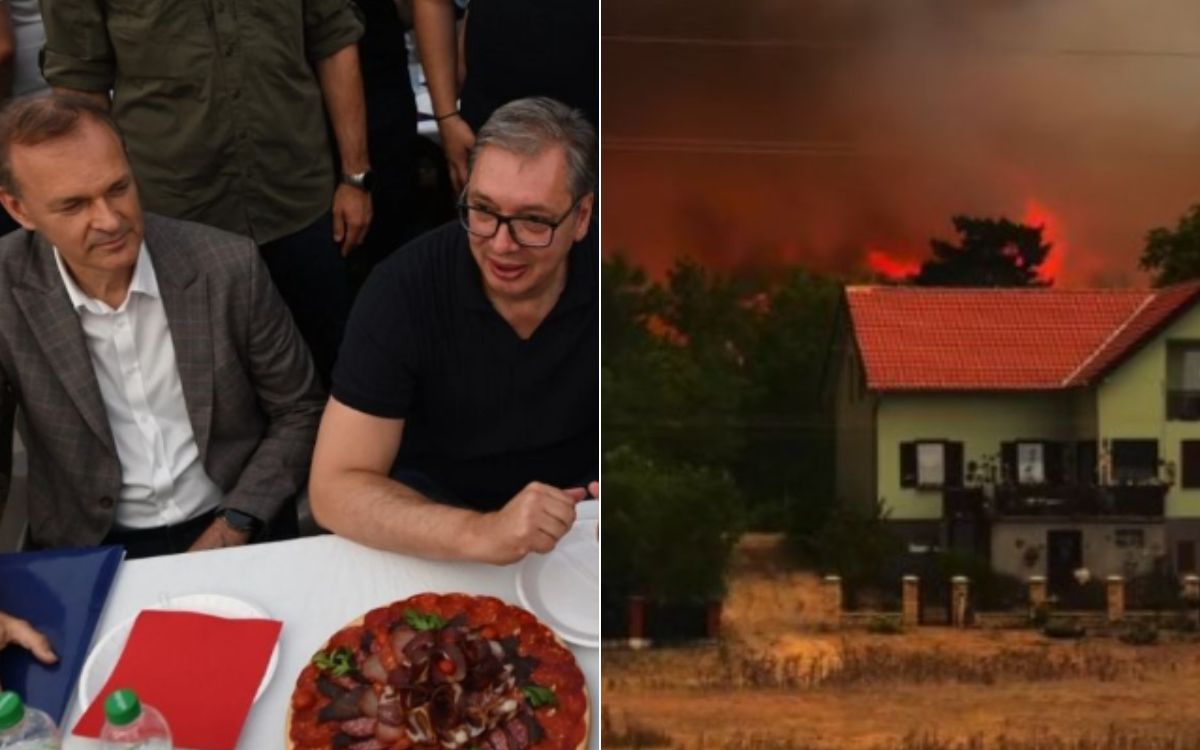
As Europe faces one of the worst wildfire seasons in recent years, the responses of government officials have differed from country to country.
In Serbia, the problem with wildfires in the Deliblato Sands has been ongoing for more than a month.
The fires in the Deliblato Sands began as early as July 21, while the major fire that has been ravaging the reserve for weeks has been burning continuously since August 5.
In the meantime, several thousand hectares of forest have burned, wildlife has also died, and the full extent of the damage is still unknown.
However, Serbia’s highest government officials visited the Deliblato Sands only weeks later, first Prime Minister Đuro Macut and Interior Minister Ivica Dačić, while President Aleksandar Vučić did not visit the site until August 23.
They also only recently requested assistance from Russia and then from the European Union to help extinguish the fire.
On the other hand, EU countries have also been battling wildfires this summer, but the response of their officials to these natural disasters was much faster.
In Croatia, the prime minister and president arrived in the affected area in less than 24 hours, Spanish Prime Minister Pedro Sánchez went to the affected areas several days after major fires broke out, while French President Emmanuel Macron arrived in Gironde on the fifth day of the battle against the flames.
Croatia: Plenković and Milanović Arrived in Less Than 24 Hours
One of the most striking examples of a swift response from the country’s leadership was recorded in Croatia, following the devastating wildfire that hit the area around Lokva Rogoznica and Omiš.
The fire broke out on the evening of August 13, and during the night, fueled by strong winds, it approached residential areas and tourist facilities. Thousands of people were evacuated, while dozens were injured. Euronews reported on August 14 that the fire had affected the area around Omiš and that a large number of people had ended up in hospital.
The following morning, August 14, Croatian Prime Minister Andrej Plenković arrived in Omiš.
At the Plaža Hotel, Plenković held a meeting with chief fire commander Slavko Tucaković, Split-Dalmatia County Prefect Blaženko Boban, Omiš Mayor Zvonko Močić, as well as representatives of firefighters, civil protection, police and healthcare institutions.
According to the Croatian government, the prime minister particularly thanked the firefighters who had spent the previous night defending homes and settlements.
“What they managed to defend is truly a miracle,” Plenković said, announcing state financial assistance for residents and the local community to repair the damage caused by the fire.
This means that the Croatian prime minister arrived in the affected area less than 24 hours after the fire broke out.
Croatian President Zoran Milanović also arrived in Omiš that same day.
“A horrible event, a natural one, although perhaps it isn’t only natural — we don’t know that. I express my respect and gratitude to everyone who fought the fire. Those are primarily the firefighters, but it’s not only them — it’s everyone who was there yesterday and today, and who will be securing the area in the coming days and hours. And thank you to them. We will now tour the area. Property has been damaged, but that is secondary compared to the people who, unfortunately, were caught off guard,” Milanović told reporters.
Milanović said he had come to Omiš from Hvar and that the entire area was covered in smoke.
“This is unprecedented, and there is no real prevention against something like this,” Milanović briefly said.
Spain: Sánchez on the Ground on the Third Day of the Major Fire
A similar situation occurred several weeks earlier in Spain, which was hit by massive wildfires in the second half of July.
The situation was particularly dramatic in the province of Ávila and the western part of the Madrid region. One of the largest fires began on July 22 near Burgohondo in Ávila, and the fires soon spread across tens of thousands of hectares.
The French newspaper Le Monde reported that the fire near Burgohondo began on July 22 and later became the largest fire ever recorded in Spain, while huge fires were simultaneously spreading across the Madrid region.
By July 25, the fires in Madrid and Ávila had affected around 45,000 hectares, while tens of thousands of people had been evacuated or confined to their communities because of the danger posed by the fire and smoke. Spain’s Military Emergency Unit (UME) had established a unified command for the two major fires.
That same day, July 25, Prime Minister Pedro Sánchez arrived in the affected area.
According to an official statement from the Spanish prime minister’s office, Sánchez went to an emergency command center in the town of Cenicientos in the Madrid region, where he attended a meeting of the state emergency coordination committee and was briefed on the development of the fires. He was accompanied by Madrid regional president Isabel Díaz Ayuso and Interior Minister Fernando Grande-Marlaska.
Sánchez warned at the time that “complicated hours” lay ahead for firefighters and residents, particularly because of the uncertain direction and intensity of the winds.
If July 22 is taken as the starting point of the major fire in Ávila, Sánchez arrived in the affected area three days later, while the fires were still active and out of control. El País reported on July 25 that firefighters had already been battling the blaze for the “third consecutive day.”
France: Macron Arrived on the Fifth Day of the Fire
France was almost simultaneously confronted with a massive wildfire in Gironde, in the southwest of the country.
The fire broke out at 12:02 p.m. on July 22, and over the following days turned into a disaster of enormous proportions. According to data published by Le Monde, around 42,000 hectares had burned within ten days, while nearly 200 homes were destroyed in the Le Porge area alone.
The fire was so intense and unpredictable that French officials described it as a “megafire” and an unprecedented situation. By July 27, the fire had already consumed tens of thousands of hectares, while thousands of firefighters, soldiers and other emergency personnel were involved in efforts to contain it.
French President Emmanuel Macron traveled to Gironde on July 27, the fifth day of the battle against the flames.
The Élysée Palace officially announced that Macron arrived in Bordeaux that day, where he received a briefing on the situation at the fire and rescue services’ operational center and then spoke with personnel involved in fighting the fires.
However, it should be noted that Macron did not go directly to the fire line itself. According to Le Monde, due to weather conditions and the possibility of the fire flaring up again, he did not visit the main fire zone but instead spoke with people working between the Arcachon Basin and the wider Bordeaux area.
MORE TOPICS:
Source: Nova, Foto:R.Z. / ATA Images; Printscreen Instagram
 Add Serbian Times as your Google source