




If you love archaeology, Roman heritage, ancient sites, Byzantine churches, and forgotten cities – Serbia is the right place for you. Believe it or not, 17 Roman emperors were born in the territory of present-day Serbia. A third of all Roman emperors were born in places such as Sirmium (today’s Sremska Mitrovica), Viminacium, or Felix Romuliana near Zaječar.
International tourists are becoming increasingly aware of the significance of this part of Europe for ancient history, particularly the Roman era. But did you know that Serbia hides an “ideal city,” as described by the emperors of the early Byzantine period? That city is Justiniana Prima – a Roman ancient city in southeastern Serbia. It is a unique location that tourists have been discovering in recent years, and many of them have already given it a nickname – the Serbian Pompeii.

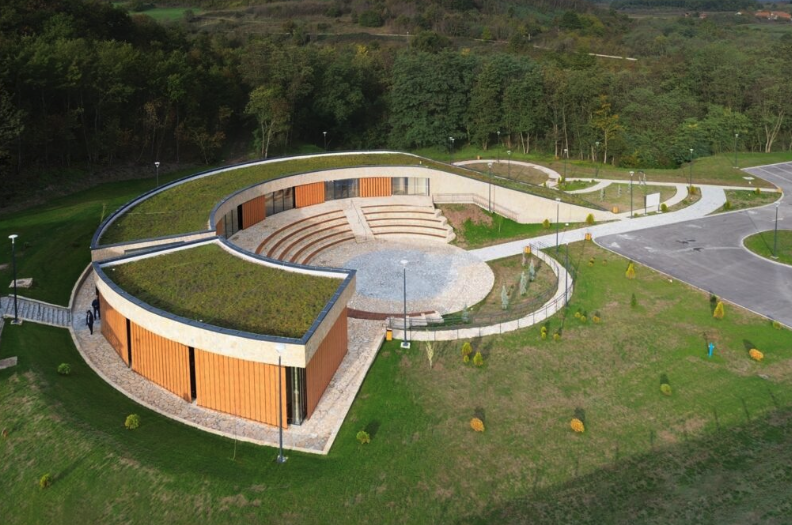
During 2024, a team of expert archaeologists worked on the conservation of the baths, or Roman thermae, in the eastern part of the site. Conservation efforts also included the floor and wall heating systems of the Roman baths. After these works, the western part of the thermae will undergo restoration, including mosaic remains and stone columns from the 6th century, dating back to the time of Emperor Justinian. The Republic of Serbia is investing significant funds to restore this cultural monument, which had been somewhat forgotten in recent years, and to place it prominently on Serbia’s tourist map. The “Caričin Grad” Visitor Center was opened on June 17, 2024, to present the archaeological site “Caričin Grad,” the “Radan Mountain” Nature Park, as well as the cultural and historical heritage of the municipality of Lebane.

It is located at the foot of the archaeological site itself, which is highly convenient for professionals in the fields of archaeology, Byzantine studies, history, architecture, art history, Christian religion, military strategy, educational institutions, and others who benefit from the proximity of the site for meetings and gatherings.

The center’s building has two physically separate sections, one of which includes a conference hall and a presentation room with a souvenir shop. The conference hall, with 50 seats, hosts scientific gatherings, conferences, meetings, and presentations. The presentation hall, with guided tours, features interpretation panels depicting the reconstruction of how the city looked in the 6th century. Through an exhibition of replica artifacts found at the site, displayed in four separate showcases, visitors can see the objects used by the inhabitants of Caričin Grad.

The content displayed on interactive totems presents the current tourist offerings of the municipality of Lebane and Radan Mountain Nature Park. Another service is a virtual reality (VR) view of Caričin Grad using VR glasses. The souvenir shop offers representative souvenirs themed around Caričin Grad.

In front of these two halls is an amphitheater space with 360 seats, ideal for open-air theatrical performances, which is complemented by a parking area for buses and cars, with a capacity of about 100 parking spaces.
The entire space is designed in the style of a classical Greek amphitheater with excellent acoustics and blends perfectly into the natural surroundings. The Caričin Grad Visitor Center is one of the most modern facilities of its kind in Europe.

The Caričin Grad Visitor Center also includes the “Teodora” building, which offers visitors dining and accommodation services. This space is built in the style of an ancient Roman house with an atrium around which nine rooms and a conference hall are arranged. In two triple rooms and six double rooms, up to 18 guests can be accommodated at once. The spacious atrium connects the rooms to the conference hall and is covered with a glass roof that allows plenty of light to pass through.

On the lower floor, there is a restaurant with a capacity of 40 seats inside and 60 seats on the terrace. Traditional Serbian cuisine and Leskovac-style barbecue are served here. The menu features dishes characteristic of southern and eastern Serbia. Many guests come specifically for homemade “propeć” pie, meat dishes such as “Sprža,” spicy paprika spreads like “Ajvar” and “Ljutenica,” Leskovac barbecue, and cooked meals. A specialty that can only be ordered at this venue is “Justinian’s schnitzel” and “Teodora’s schnitzel.”

The “Caričin Grad” visitor center was built to bring tourists closer to the significance and potential of the 6th-century archaeological site. This site of exceptional importance represents the remains of the early Byzantine church center “Justiniana Prima,” founded by Emperor Justinian I. The core urban area, surrounded by walls, covered about 10 hectares and was not subjected to later additions. The broader area extended over 40 hectares, featuring two additional rings of fortifications, the banks of two rivers – the Svinjarička and Caričinska – along with a dam and a lake. The fortification is notable for its authentic urban planning, characteristic of Roman cities at the beginning of the Byzantine era, with four main gates, forums, thermae, and other public buildings. Floor mosaics are a particular treasure, having adorned the floors of basilicas and public baths.

This site is also linked to legends still told among the locals today, such as the story of an emperor who publicly promised his daughter’s hand in marriage to anyone who could bring water to the city – and how the lucky man was none other than a young swineherd from a nearby village.
The visitor center is named after the site Caričin Grad, and Empress Theodora was – according to many – the most powerful woman in Byzantine history, a civilization that lasted for 1,000 years. Empress Theodora was the wife of Emperor Justinian and one of the most influential women of all time. In the book “Secret History,” written by the emperor’s historian Procopius, her strong character and unwavering will are vividly described, showing that she ruled alongside Emperor Justinian as an equal.

Empress Theodora has been an inspiration for many artistic works for centuries. She has been depicted in novels, films, and paintings. Even today, her fascinating personality seems extravagant. She is a muse immortalized by artists in the art colony “Caričin Grad,” which takes place in July at the site. The colony gathers artists from Serbia, former Yugoslav countries, Europe, and occasionally even distant overseas nations.

The Caričin Grad Visitor Center stands at the foot of the archaeological site, providing an ideal location for professionals in archaeology, Byzantine studies, history, architecture, art history, Christian religion, military strategy, and educational institutions who benefit from the proximity of the site for meetings and events.
The visitor center also includes the “Teodora” building, which offers dining and accommodation services to visitors. This space is built in the style of an ancient Roman house with an atrium around which nine rooms and a conference hall are arranged.

MORE TOPICS:
TODAY WE CELEBRATE MLADENCI: Many beliefs are associated with the day of the Holy Forty Martyrs!
Source, Foto: Centar za kulturni turizam
 Add Serbian Times as your Google source