



The war in the Pacific during the Second World War began with Japan’s attack on Pearl Harbor on this day, December 7, 1941. This became the reason for the United States to enter the war against the Axis powers — Japan, Germany, and Italy.
Pearl Harbor is a port on the southern side of the island of Oahu, in Hawaii, west of the administrative center of Honolulu. The natural lagoon was used to build a large naval base, which became the main stronghold of the U.S. Pacific Fleet.
History of the Pearl Harbor naval base
Although the United States had representatives in Hawaii as early as 1820, serving as official agents for trade and sailors, military presence came decades later. In the beginning, whalers made up most of the American presence.
The U.S. received exclusive rights to use the lagoon known today as Pearl Harbor in 1887, following the Reciprocity Treaty of 1875 and the Convention of December 6, 1884, signed with the Government of Hawaii, which was then an independent kingdom. The U.S. took possession of the lagoon on November 9, 1887.
However, the natural state of the lagoon did not allow access to deep-draft vessels, so extensive construction work was undertaken.
The Spanish–American War of 1898 significantly increased the importance of this naval port. After their victory, the U.S. took control of the Spanish-held Philippines. The United States had already had a Pacific Squadron since the 1860s. Formally, in 1899, the U.S. Navy established the Pearl Harbor Naval Base, after Hawaii fell under Washington’s authority.
Japan’s expansion in the Pacific
Japan’s expansion in the Pacific continued throughout the interwar period. The aggression against China occurred in July 1937, and a puppet administration was set up in Nanking.
Earlier, Japan had created the puppet state of Manchuria (Manchukuo) in 1932, installing Pu Yi (1906–1967), the last emperor of China, as its nominal monarch. Before that, Japan had taken Taiwan and Korea. After the First World War, Japan occupied most of Germany’s former Micronesian territories.
When Japan occupied French Indochina (modern-day Vietnam, Cambodia, Laos) in September 1940, and later in July 1941 (the southern part), Washington imposed an oil embargo. The blockade, joined by the British and Dutch, included other strategic materials. The condition for lifting the embargo was Japan’s withdrawal from China.
Washington had long anticipated a war with Japan, but the expected point of attack was the Philippines, not Pearl Harbor. It is believed this expectation contributed to — or at least hastened — the Japanese decision to attack the U.S.
Emperor Hirohito approved preparations for the attack on July 2, 1941. At the same time, Japan attempted to ease the blockade through diplomatic means, without success. Analysts estimated that Japan had at most an 18-month fuel reserve.
The plan was designed by Admiral Isoroku Yamamoto. The idea itself was his. Six aircraft carriers with around 450 aircraft, two battleships, three cruisers, nine destroyers, and 25 submarines were selected for the attack. Training exercises were conducted in the Kuril Islands.
The Japanese attack on Pearl Harbor began on December 7, 1941. The intention was clearly to deliver a decisive blow to U.S. forces in the Pacific, hoping that a rapid recovery would be impossible.
Surprise failed — but the attack succeeded
Shortly after midnight before the attack, the Japanese released mini-submarines toward the base, intending to sink U.S. ships with torpedoes. However, the Americans detected them and opened fire.
Thus, the element of surprise was lost — but necessary defensive measures in Pearl Harbor still did not follow.
The Japanese fleet had approached Hawaii by an unusual route. Admiral Chūichi Nagumo commanded the carriers.
The airstrike began at 7:40 a.m. local time. Interestingly, no alarm was raised at the American base before the attack, even though radar operators had detected incoming aircraft.
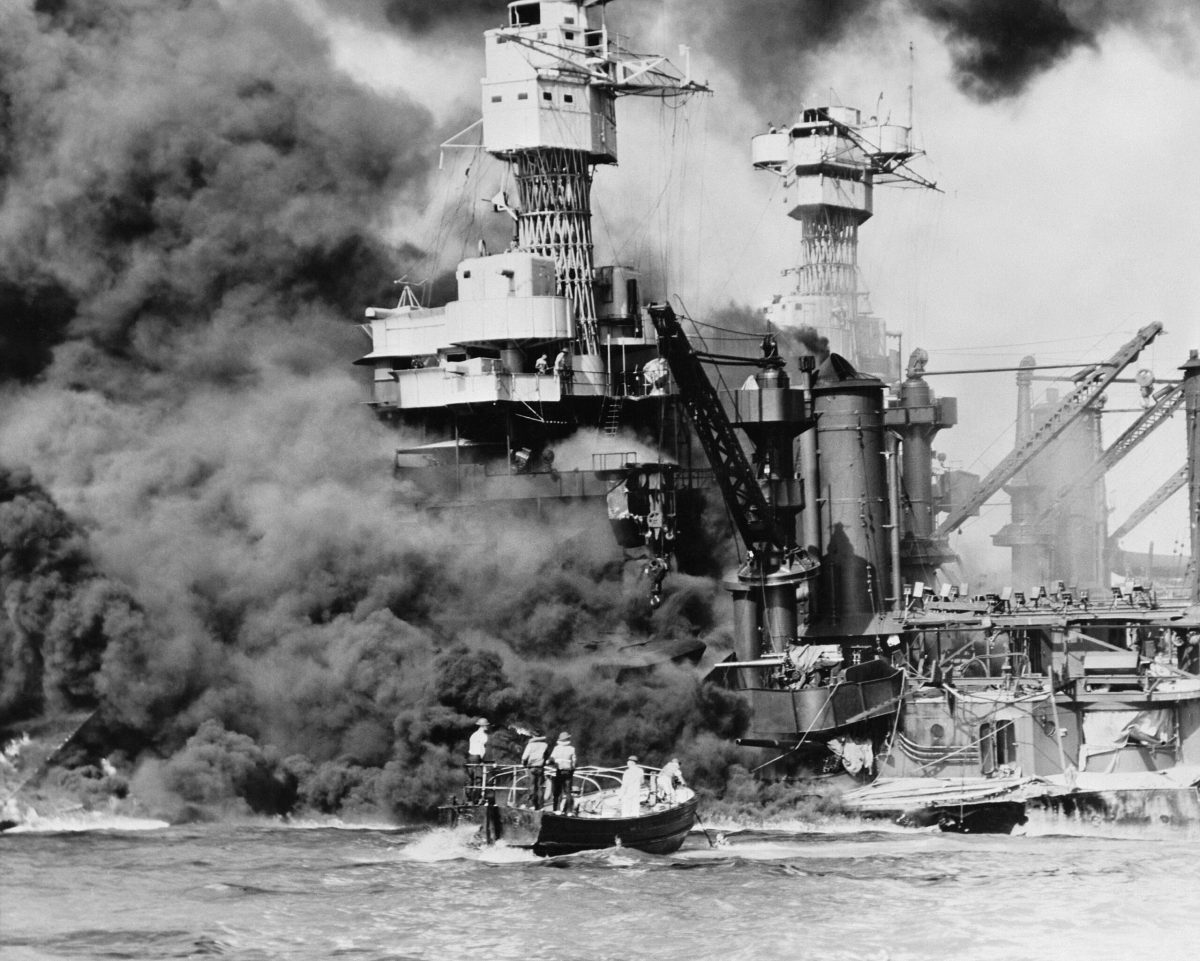
The attackers quickly destroyed the American aircraft stationed at the base. Around 180 Japanese planes took part in the first wave. They then targeted the ships, which were positioned under peacetime conditions. An hour later, about 170 Japanese aircraft arrived in a second wave, continuing the destruction.
From a military standpoint, the attack was highly successful. A total of 2,403 Americans were killed, including 68 civilians. The U.S. lost 188 aircraft, while 159 were damaged. Nineteen American warships were hit, heavily damaged, or destroyed. The battleships Utah, Oklahoma, and the destroyer Arizona were rendered unusable. Other vessels were later repaired and returned to service.
The Japanese lost 64 men, 29 aircraft, and had 74 damaged. Five mini-submarines were destroyed during the night attack. The immediate consequence was the full entry of the United States into the Second World War.
However, the Japanese failed to inflict significant damage on the naval base’s infrastructure, except for destroying Hickam Airfield. The American aircraft carriers were also preserved, as they were away from the base at the time. Admiral Yamamoto believed the success was therefore incomplete.
Nonetheless, in the next phase of the war, Japan continued expanding with little resistance. By January 1942, they captured Manila. In addition to the Philippines, they seized Hong Kong (British Victoria), British Burma, Malaya, Singapore, Sabah and Sarawak, and most of Indonesia (then the Dutch East Indies), including New Guinea.
First defeats and the end of World War II
At least until the spring of 1942, Japan’s advance in the Pacific seemed unstoppable. Their first defeats came at the Battle of the Coral Sea, east of Australia, in May 1942. Then they were decisively beaten at Midway in June.
The war in the Pacific continued with varying fortunes until 1945. Early that year, U.S. forces captured Iwo Jima and Okinawa.
After the U.S. dropped atomic bombs on Hiroshima and Nagasaki on August 6 and 9, 1945, Japan signed an unconditional surrender on August 15. This brought an end to the Second World War, as the conflict in Europe had already ended months earlier with Germany’s surrender on May 8–9.
Interestingly, Duško Popov — believed to be the inspiration for Ian Fleming’s James Bond — later wrote in his memoirs that he tried to warn J. Edgar Hoover, the head of the FBI, that an attack on Pearl Harbor was imminent.
Popov reached this conclusion after observing Japanese agents in Taranto, following the British air raid on that Italian port on November 12, 1941, which sank several Italian warships. Hoover, however, refused to discuss the matter.
MORE TOPICS:
Source: Euronews, Foto: Wikipedia
 Add Serbian Times as your Google source