




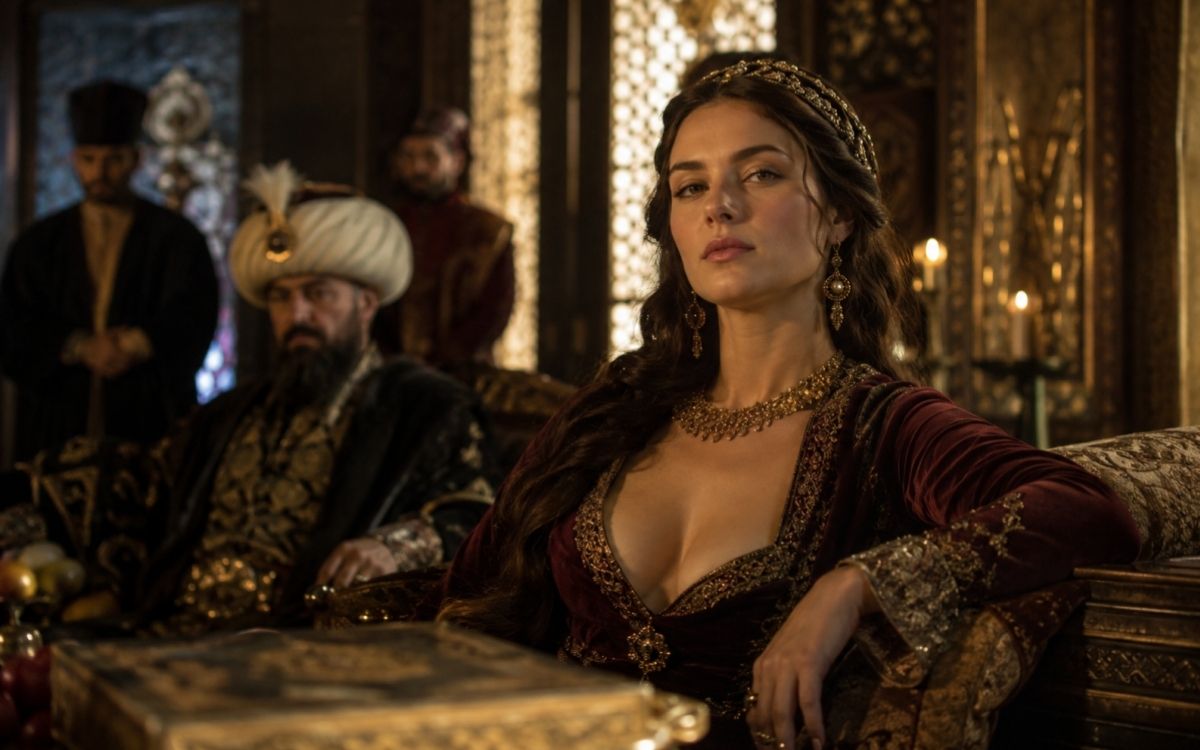
Mara Branković, the beautiful daughter of Despot Đurađ was, after Olivera, the second Serbian princess to be married to a Turkish sultan. Unlike Olivera, Mara did not have an excessive influence on her husband, partly because Murad II preferred men, but her biography is certainly worthy of a film series…
Mara, daughter of Despot Đurađ Branković and granddaughter of Vuk Branković, was born in 1418 in Vučitrn, and while still a girl she ended up at the Ottoman court, in the harem of Murad II, as the second wife of the Turkish sultan.
Folk song records that in her childhood she suffered from a severe illness, and that her father, out of gratitude to God and the elder Joanikije for the miraculous healing, built a monastery, named Devičin or Devič after the healed virgin.
The folk poet also records that Mara was very beautiful, that “there is none more beautiful in all the seven Vlach kingdoms and the entire Turkish empire.”
Despot Đurađ, upon coming to the throne of Serbia, agreed with his wife Jerina to marry Mara to the Turkish sultan Murad II in order to protect the interests of the country.
Mara would thus become the second Serbian princess to go into a harem. The first was her great-aunt, Princess Olivera Lazarević, daughter of Prince Lazar and Princess Milica, wife of Sultan Bayezid I.
Following Đurađ’s takeover of power, Ottoman troops ravaged the south and east of the Serbian Despotate. The Turks occupied large territories, even in the interior of the country, as well as the cities of Niš and Kruševac.
The peace concluded with Murad II had harsher terms than the one concluded after the Battle of Kosovo. The tribute to the Ottomans was much higher, and the state much smaller. Nevertheless, Murad, considering that with the new peace he had regained mastery over Serbia, allowed Đurađ to build a new capital, as he had lost both the old and new ones, Kruševac and Belgrade. Thus, Branković began the construction of Smederevo, a new capital on the banks of the Danube, on the border with Hungary.
Dowry as a ten-year tribute
One of the conditions for concluding the new peace with the Ottomans was the marriage of Đurađ’s daughter Mara to Sultan Murad II and her departure for the harem.
Đurađ and Jerina had to collect a huge dowry – 600,000 ducats, which was more than the ten-year tribute that Đurađ had been paying to the Turks since 1428. They married in 1436 and Mara was the second and last wedded wife of Murad the second, who had previously married Halima.
The sultan was, according to estimates, 13 to 16 years older than Mara. When they married he was 32, and Mara was between 16 and 19 years old. Sources describe him as an inconspicuous man who did not suffer from the external manifestation of his authority. However, unlike Olivera, Mara was not lucky in her marriage to the Ottoman master, primarily because he preferred men to women.
“There is little doubt that Murad II was, at the very least, bisexual, if not a homosexual who had sexual contact with women only as much as was necessary to leave offspring,” says historian Nikola Giljen, author of the book “Two Serbian Sultanas: Olivera Lazarević (1373-1444) and Mara Branković (1418-1487) – Two biographies as a contribution to the history of Serbian-Ottoman relations 1389-1487”, which is soon to be published by the Graphic Atelier Dereta from Belgrade.
Giljen says that Mara did not manage to win the love and affection of her husband, regardless of her beauty, and points to historical notes by the French travel writer Bertrandon de la Broquière about Murad II:
“After drinking, he finds the greatest pleasure in women and small sodomite boys, and he has 300 or more women and 25 or 30 boys who are constantly with him, more often than his wives.”
Stojan Novaković (1893) recorded how Murad had “a leaning toward the sodomite error, and he kept, for that purpose, 25-30 boys.”
Murad blinded her brothers
Mara, thus, could not do much for Serbia like Olivera could, because she did not have the same status at the Ottoman court as her older relative. For a long time, she was completely passive, until 1441 when Sultan Murad issued the order to blind her brothers Grgur and Stefan, who were in Ottoman captivity.
Mara, unfortunately, did not manage to save them from their terrible fate. Namely, Sultan Murad wanted to grant her request; however, the punishment was carried out instantly, so the messenger with the order not to carry out the punishment arrived too late.
“The fact that Mara knew about Murad’s most likely verbal order for the blinding of Grgur and Stefan, and that she had the opportunity to go before the sultan to plead for her brothers, shows that already at that moment her position in the harem and at the Ottoman court was much better than a few years earlier,” says Nikola Giljen.
Mara, like her great-aunt Olivera, remained consistent in her Christian faith and had no children with Murad II. Whether a surgical procedure intended to prevent pregnancy was performed on her, as it was on Olivera, is not known for certain. The fact that she did not become a mother was compensated, however, through the great esteem and respect of Murad’s successor, Mehmed II the Conqueror.
Perhaps this was influenced by the closeness between Mehmed’s mother and Princess Mara, who lived together in Bursa for a time.
“Mara could have also been a kind of nanny or teacher to Prince Mehmed, because her education was far greater than the education of his mother – a slave. Therefore, it is not surprising that the Karlovac Genealogy writes that ‘Emperor Mehmed loved and respected Mara as his own mother,'” states Giljen.
Mehmed II the Conqueror respected his stepmother
The closeness and mutual respect between Mehmed and Mara would come to the fore from the time of Mara’s return to Serbia after Murad’s death, until her own death in 1487. In that period, many historians consider Mara to have been among the most influential women in Europe.
Sultan Mehmed “respected Empress Mara as his very own mother, catering to her wishes,” writes Count Branković in his Chronicles. After Murad’s death, in 1451, Mehmed allowed his stepmother to return to Serbia, gifting her with her dowry, the regions of Toplica and Dubočica.
Mara could have become the Byzantine empress, but she refused the marriage proposal of Constantine XI Palaeologus, who was a widower without children. She rejected the suitors saying that she had sworn never to marry again.
And so it was. She turned to the church. She was a great benefactor, but she did not become a nun. She even stayed on Mount Athos, where she helped the monasteries of Hilandar, Saint Paul, and Vatopedi.
“That Empress Mara stayed on Mount Athos, despite the well-known ban, is evidenced by the chapel built at the meeting place of Mara and the monks. That chapel, whose frescoes depicted the meeting itself, existed until the beginning of the 20th century, when it was destroyed by a torrent from a nearby mountain stream. The Athonites built a new chapel on that spot in 1928, which still exists today,” says Giljen.
After returning to Serbia, Mara lived in Smederevo, deeply respected by her father, mother, and the Serbian people for her sacrifice, until, as a supporter of the more realistic Turcophile current in Serbian politics, she had to flee to Turkish territory, escaping the wrath and revenge of her brother Despot Lazar and his wife Jelena. She settled in Ježevo near Serres, on estates granted to her by Sultan Mehmed II. It was a good choice, given that this land was on the road between Western Europe and Serbia toward Mount Athos and the Ottoman Empire.
After the fall of Serbia under Ottoman rule in 1459, Mara represented the most important and most realistic political factor in the life of the Serbian people. Pious travelers stopped by her home on their journey to Mount Athos, and Mara helped them and provided a resting place. She helped her brother Grgur, her uncle Toma Kantakuzin, Despotess Jelena, the widow of her brother Lazar, and in Ježevo, the daughter of Despot Lazar, Bosnian Queen Mara-Jelena, also found refuge.
This wise woman had comfort and refuge for everyone, even for her sister-in-law Jelena, from whom she had once fled Serbia.
How great her influence was in church circles can be seen from the fact that her wish was decisive during the election of several Ecumenical Patriarchs. She died in Ježevo near Drama in 1487 and was buried in the nearby Kosinica monastery.
Women on Mount Athos
The ban on women’s access to Mount Athos has been violated equally in the Middle Ages and in modern times, says Nikola Giljen.
It is known that Tsar Dušan stayed on Mount Athos from September 1, 1347, to June 1348, when he took refuge there with his wife Empress Jelena and son, Prince Uroš, from the plague epidemic. A cross was erected at the place where the monks of the Hilandar brotherhood welcomed Dušan with his entourage and family, and not far from there, the Tsar also planted an olive tree.
Otherwise, the ban on women’s access to Mount Athos has been violated several times throughout history. During the Greek Civil War of 1946–1949, Athonite monks received refugees on the coast, among whom were a large number of women and children fleeing from the communist pogrom, reminds Nikola Giljen.
MORE TOPICS:
Source: Ekspres; Photo: ChatGPT prompt by Serbian Times
 Add Serbian Times as your Google source