




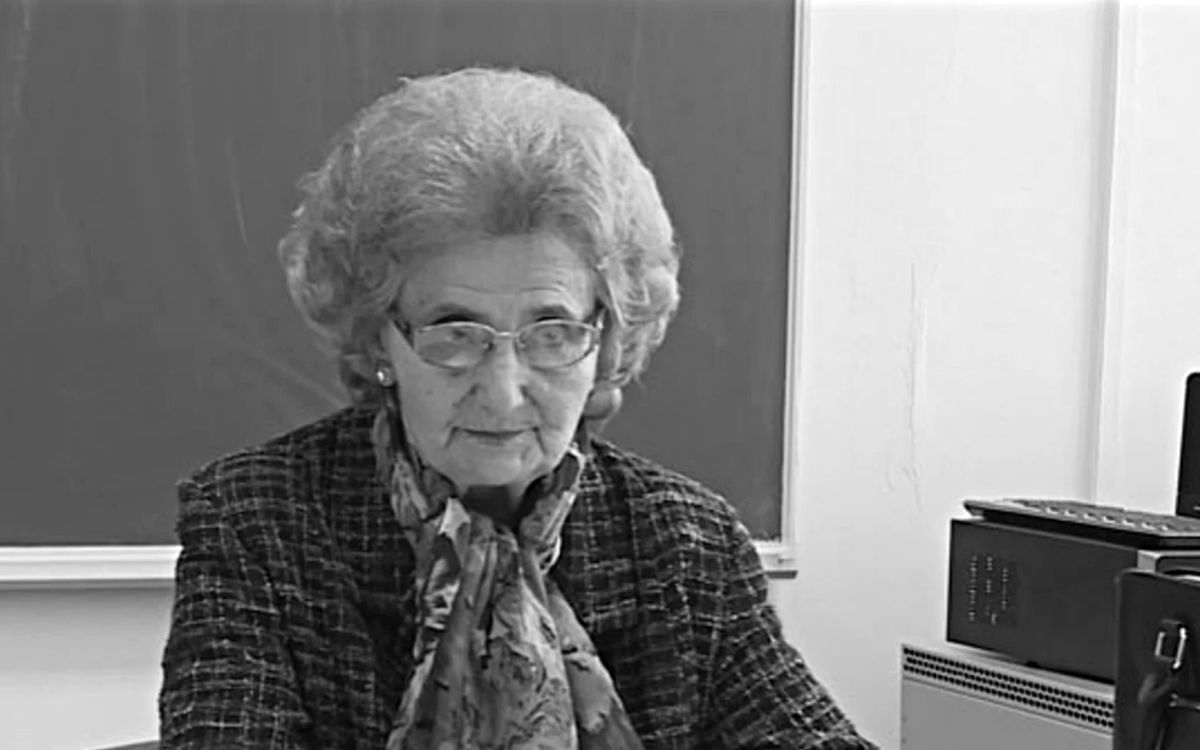
Dobrila Kukolj has passed away at the age of 94, extinguishing one of the last living voices that testified to the horrors of the Ustashe concentration camp Jasenovac.
As the long-time president of the Banja Luka Association of World War II Camp Inmates, Dobrila Kukolj dedicated her life to preserving the memory of the suffering of the Serbian people, speaking in schools, at forums, commemorations, and public gatherings about the crimes she survived as a child. She was born in 1932 in the village of Međeđa near Kozarska Dubica, and was taken to the Jasenovac camp at just ten years old, where she spent three months and lost part of her family, carrying traumas that followed her entire life. Despite the difficult experience, she remained committed to testifying to the truth, regularly visiting the Jasenovac Monastery and the Donja Gradina Memorial Area, leaving behind a precious testimony about one of the most tragic periods of Serbian history.
In the remainder of the text, we convey the testimony of Dobrila Kukolj from the book “The Book of Memories” by author Tanja Tuleković, in which she describes the horrors she experienced as a child in the Ustashe and Nazi camps:
“I was born in 1930 in the village of Međeđa, near Bosanska Dubica, in the former Yugoslavia. We were a fine, wealthy family, we had a shop in the village. My grandfather had a mill, storehouses. In the house, we lived together with my uncle and aunt and their family. In total, there were 12 of us. My wonderful childhood was interrupted by shelling from across the Sava River because I lived right along the Sava. I watched those shells going across the Sava River onto our meadows and I did not know what that meant. In the summer of 1941, their first entries into our village occurred: companies with Home Guards. Back then they stayed briefly, 2–3 days. They entered the registry offices and gathered the books of births, deaths, marriages and burned everything. We fled to Prosara. When we returned home, that was the first time in my life I saw a murdered man. That was my neighbor, Marko Milanović, known as the American. The Ustashe slaughtered him. They flayed his skin. I was taking it terribly… why that, how that? The Ustashe also slaughtered a young man, Sreto Šolaja was his name. He was 20 years old. They slaughtered him, but did not finish him off. His mother Ana begged for someone to finish him off. Those were terrible stories. One grandmother of mine, Petra Batajić was her name, they caught her and raped her in the hedge and slaughtered her. That was just the beginning.
On November twenty-first, 1941, the Ustashe entered my house for the first time. That was the day of the Slava of my father Rade and grandfather, Saint Archangel. The Ustashe said to extinguish the candle. They asked why everyone had gathered there when gathering was forbidden. My father extinguished the candle, and grandfather told the newcomers that his sons were celebrating his name day. Grandfather invited them to come in, and he treated them. The Ustashe did not attack anyone, but they threatened that without their knowledge people must not gather. That was our last dinner together. This grandfather was beaten alive with rifle butts and bayonets in 1940 at Jasenovac and beaten all over until he breathed his last. In December, the Ustashe began catching whomever they reached in the village again, so we had to flee to Prosara again. In Pućari we stayed until spring and returned to our village. The people started to sow gardens. The Ustashe would pass through the village and take whatever they wanted from our houses. My grandfather used to say: ‘There will be war, children, it will be bad!’ That remained so in my memory.
One morning in the yard, swearing, banging, shouting was heard. They drove all of us out of the house, as well as all the inhabitants of the village. They corralled us into the yard of the church and school. They said we had to gather there, to make some kind of roll call. Then they drove us in a column to Dubica. Then a Muslim, Pezić, came out in front of my family and begged for us to stay, saying that he would protect us. He was good with my family before the war. My mother Savka thanked him and said: ‘Where my people go, there we will go too!’ We continued to Cerovljani. The Ustashe are escorting us. No one could escape. They drove us forward. The column is large, I cannot say how many people were there. I remember that in that column was a certain Milka Ružičić. She was a very beautiful girl. An Ustashe approached to take her for himself, and her mother began to cry, to defend her. He took that woman and roughly beat her up and said he would kill her if she spoke one more word. From that Ružičić family, no one remained alive.
In Cerovljani we were there for seven days, we ate what we had. They separated the men more mature than us. That was the last time I saw my father and my brother, who was 16 years old. I can never stop mourning that brother of mine! Adults were not allowed to approach them, only children. Me and my younger sister, she is five years younger than me, we went over there and saw father and brother and uncle. One day trucks came and they packed all those men in. We never saw them again. We stayed for another day or two and then continued to Uštica, then to Jasenovac.
While we were passing through Košutarica, the adults and children from that village were banging on tin cans and shouting: ‘The Serbs should be killed! Go there – that is where you belong!’ I cannot erase that from my head. When we came to the Sava, my aunt says to my mother that we should jump into the Sava, and my mother says:
‘Don’t, maybe someone will stay alive!’ At the very entrance to the camp it was written USTAŠE SUPERVISORY SERVICE NDH. In the column on both sides stood Blackshirts. In front of my went my cousin Rajko and the Ustashe removed him. Screaming broke out. My grandfather went to defend him and could not defend him. The Ustashe caught my grandfather and killed him with bayonets and rifle butts right there in front of us.
That was terrible! From a woman behind us they snatched a child from her hands, tore it away, she cried and cried, wailed like every mother. An Ustashe took that child and impaled it on a sword. She screamed and fell unconscious. To make matters worse, they threw that child to the dogs. The dogs tore it apart. They packed us onto a meadow right next to the Sava. Crying broke out… we have no one, we have nothing… we don’t know what will happen to us. We are hungry and thirsty.
The Ustashe gave us only corn flour in lukewarm water, so in the morning the stomach was huge… diarrhea, dysentery. Whichever child did not survive, some nurse would collect the children in the morning and throw them into the Sava. Women capable of work were led by the Ustashe during the day to work. In the evening they brought them back. I remember well one woman when she returned in the evening, she wailed that she was in pain. My mother comforted her because she said she would judge herself. The Ustashe came for her, led her to the bank of the Sava, hit her in the head with a mallet, and threw her into the Sava.
One morning when they were giving us food, they gave us a small piece of bread, black bread. My brother Gojko stood behind me, he got bread but he asked for more. The Ustashe cut off that arm of his up to the elbow. He screamed, cried. We got scared and fled.
One day the Ustashe began to separate girls of 10–11 years old. I started running around the camp to save myself and in that running of mine I came across a mother who gave birth to a child right there on the ground and I stepped on that baby. I didn’t even dare to look back. I can never forget that. That was the hardest for me.
Later I heard that those girls were found at the brickworks. In the camp we stayed until the beginning of October. They packed us into stable wagons and took us toward Sisak. They kept us at the station for three days. Small little windows on that wagon. In the morning they open the doors a little for us and take out the dead children. Like little birds we gasped, we have no water…
And I had a head of onion, so I sucked on that a little bit, and gave a little to that younger sister of mine. One morning at that station they opened the wagon for us and ask if we are thirsty. And they are bathing and give us that soapy water with which they were bathing to drink. And we drink… thirsty.
Then they drove us toward Lipik and Pakrac. Then they took us to Poljana near Novska and there two horse-drawn carts were waiting for us. They packed us in and took us to Gaj and distributed who would go where. I went to the village of Toranj. I was assigned to one family: Franjo and Elza had four children.
They were fine to me, I cannot complain. My mother and sister were with another family. In the beginning I ate a little bit, they bathed me and changed my clothes. During the day I was with them, tending the livestock and such, and at night I went to sleep with mother.
With those bosses I found a young man, he was 23 years old, Dragan was his name. He was a Partisan but he changed into women’s clothes when the separation of men occurred and so ended up here. One day he disappeared. He caught a connection and went back to Bosnia. Me and my cousin met that Dragan in 1944. He was the commissar of a battalion. Unfortunately, at the very end of the war, they killed him from an ambush.
In Toranj we stayed until September 1943. At that time, the NDH authorities allowed women and children to return home. Passes were received by Jovanka Čekić, she is from Ševarlije or from Slabinja, and so our turn came too. We were returning via Bosanska Kostajnica. There on the bridge the Ustashe and Home Guards met us, she showed the pass and they let us through. When we moved away down the road to Dubica, they began to shoot at us. Half of that column remained on the road. We fled into the village of Petrinja and stayed that night in that forest, spent the night in some abandoned house. The second day we started toward the village of Jasenje, so we stayed there for a few days too.
Finally after that we came to our house. Back then our place was not yet burned down. The Ustashe were in the village. Ustashe patrols constantly controlled the village. They knew to come at night and bang on the door just to mistreat us. Then they began to lead the women to work in the fields. Once the women got wise when they banged on the door and tell them that they cannot enter. They ask why, and the women say: ‘Typhus!’ So we were at peace for a bit.
There we stayed until Christmas 1944, when they began to slaughter again. Whomever they caught, that person they also killed. On Christmas itself we had to flee to Prosara. Then the Cherkessians came along. We fled in front of them. We fled to the village of Vojskova. There we stayed until the very liberation, my mother and I. My sister Jagoda passed away. Due to the experienced stresses and fears, she fell ill from some disease, we did not know what disease that was. She just shook. In such torments she died.
When we returned home, everything there was burned down, nothing was left for us. Galonja Mihajlo was in the Sajmište camp in Zemun. They tortured them, tortured them… They did not want to keep them in enclosed spaces, but outside. The summer of 1942. The sun scorched so much that the skin cracked. And my brother Boško, all his skin was burned, and other camp inmates peeled that skin of his and ate it. My brother Boško ended up that way too.
Interview recorded on July 2, 2011. Video collection of JUSP Donja Gradina, JUSP-VS-46.
MORE TOPICS:
Source: Knjiga sećanja, Tanja Tuleković, Donja Gradina 2019 Photo: RTRS
 Add Serbian Times as your Google source