




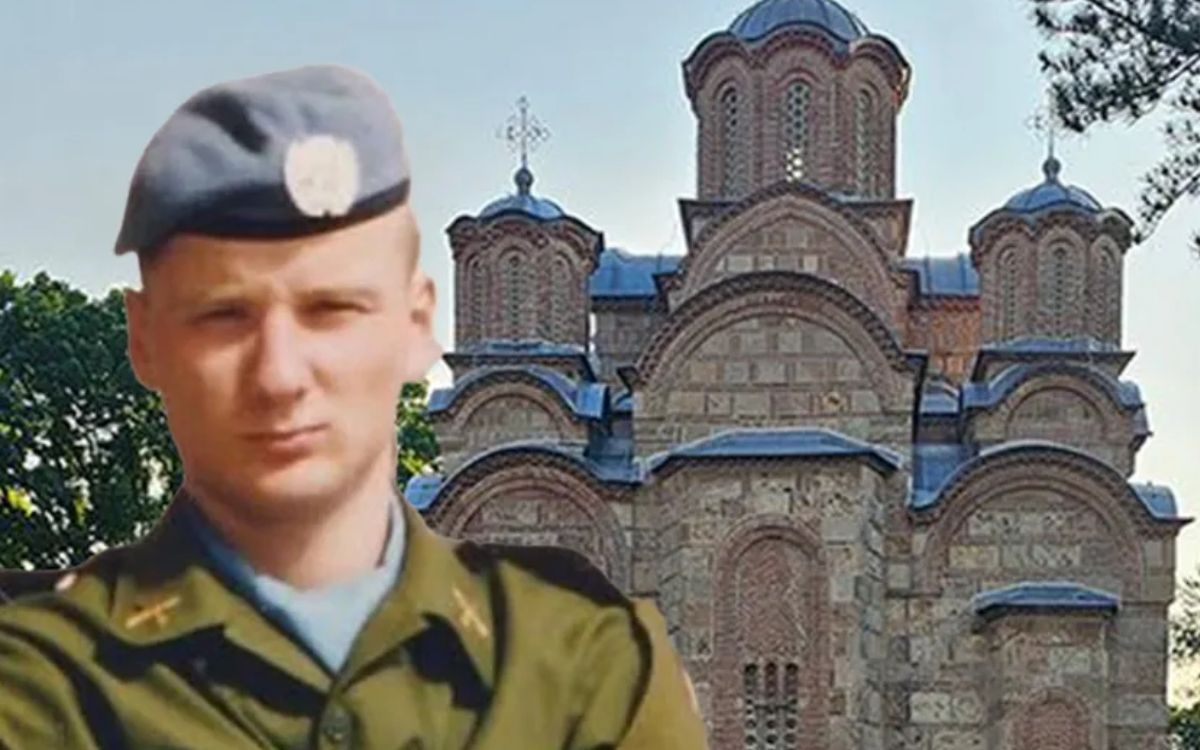
Knut Flovik Toresen once spoke about Gračanica and the pride he felt at being able to light candles again in this holy monastery in an interview for the website Serbian History.
“My name is Knut Flovik Toresen. I was born in Norway, into a Norwegian family near the small town of Narvik in the north of the country in 1971. During World War II, fierce battles were fought in this region. In Beisfjord, not far from where I was born, there was also a camp for Serbian prisoners. As a child, I listened to stories about the suffering of Serbian prisoners, and that left an indelible mark on me,” he said.
He became an officer in the Norwegian Army, where he has served since 1990.
“That I would end up as a Norwegian officer in the Balkans was completely unimaginable when I chose my career. In 2002, I was baptized in a Serbian church in Skugrić near Modriča in Republika Srpska, the same year I got married and took a Serbian wife. Together we have two children, both Norwegian-Serbian, who were also baptized in Skugrić,” he explained, adding:
“For me, it was the right thing to do to be baptized and become Orthodox. I also see how important it is to preserve traditions in Norway, such as celebrating our family patron saint day. Our family celebrates St. Stephen on January 9.”
He first arrived in Kosovo and Metohija with the Norwegian military in 2001, when, as he says, he quickly realized that Serbs were being persecuted by the Albanian majority.
“In the summer of 2003, I was again assigned to Kosovo and Metohija, this time with the Norwegian battalion serving as KFOR’s rapid reaction force. I served there as the duty officer at the battalion command post,” he recalled.
In the spring of 2004, signs began to emerge that the situation was about to escalate.
“Several smaller incidents were reported, including information that certain Albanian leaders were planning unrest in order to drive the Serbian population out of Kosovo and Metohija. It was also reported that Albanians had organized and rented buses to transport large crowds. Then, in early March, a false story spread among the Albanian population claiming that Serbs had chased Albanian children into a river near Mitrovica, causing three of them to drown. On March 15 and 16, we received several reports of attacks on Serbs, but it appeared that the KFOR leadership chose not to see the connection between these events,” he said.
Serbian churches and villages across Kosovo and Metohija came under attack, and the violence appeared highly organized.
“I was working the night shift in the operations center, and all night long we received reports of houses being set on fire and groups carrying gasoline and incendiary bombs. I informed KFOR headquarters about what our personnel on the ground had observed. In the morning, I finished my shift and went to bed. Shortly afterward, a soldier woke me up and told me I had to come immediately — the Albanians were attacking. I returned to the operations center. We were ordered to move to an intersection south of Priština to stop the Albanians from destroying what remained of Čaglavica and then proceed toward Gračanica to protect the people,” Knut recounted.
“As the operations officer, I was on the ground alongside the commander. One company was first sent to Gračanica and another to Čaglavica. On the way, we were attacked by a crowd. Our first Norwegian soldier was injured, and four vehicles were damaged. By the time the first Norwegian company arrived in Čaglavica, several houses had already been burned. The company commander ordered his soldiers to form a shield line to stop the Albanians. There were just over 100 soldiers facing several thousand Albanians.”
READ MORE:
As the situation in Gračanica somewhat stabilized, more and more attackers gathered around Čaglavica.
“The soldiers stationed in Gračanica were therefore ordered to move to Čaglavica and stop the Albanians there. The attackers threw stones, Molotov cocktails, and in some cases even used firearms against the Norwegian soldiers.”
He contacted a German general and demanded clear orders.
“I wanted to know whether we were allowed to use all available means to stop the attackers, but it seemed difficult to get an answer. I contacted them again and insisted on a clear order. After some time, the attackers were finally stopped in Čaglavica. I remember being very pleased that we were able to do something and that it was the Norwegians who stopped them there. We had already received reports that several of our holy churches had been attacked without intervention from either the UN or KFOR,” he recalled.
“As an Orthodox Christian, I made a choice. I could not accept this and decided to do everything I could to defend Gračanica. I even wanted to get to Čaglavica as quickly as possible so I could be closer to where it was happening. As a believer of the Serbian Orthodox Church, I had visited the Gračanica Monastery for services, prayer, and candle lighting. For me, the monastery is the holiest place I have ever been. I did not share these thoughts with my colleagues, but for me the feeling was clear: as a Norwegian officer, I could help defend something I valued most deeply, and if necessary, die for it. Many of my colleagues were exhausted, but I remember feeling calm and focused. I decided that I would stay in Čaglavica and defend Gračanica, doing at least what little was within my power.”
They eventually reached Čaglavica in command vehicles.
“Everything was chaotic — smoke from burning houses, tear gas everywhere. I had to put on a gas mask, and I remember sweat running down my throat. We positioned ourselves just behind the front line. The commander believed it was important to stay close to the action. We had many wounded. I remember seeing them brought back, some with bleeding head injuries. I think we had around 20 to 25 wounded soldiers but very limited medical resources, and only one doctor who had already been sent away with injured personnel. There were wounded members of several national contingents. One of my friends and fellow officers was shot in the knee. The attackers pushed children in front of them to prevent Norwegian soldiers from firing. Stones and weapons were transported in ambulances from Priština Hospital. During the night of March 18, things finally calmed down. Around 400 Norwegian soldiers held back 10,000 Albanians for nearly ten hours. Gračanica was saved. After almost 50 hours without sleep, I finally felt exhausted.”
He recorded a status report:
“The attackers fired at us, threw iron bars, stones, and grenades. In one case, a hand grenade landed right behind an armored personnel carrier. Fortunately, no one was injured. Another grenade rolled between the legs of several Norwegian soldiers without exploding. They tried to set our soldiers on fire with gasoline and fired shots at them. Two Norwegian vehicles were hit by explosives. One armored vehicle burned down. Forty KFOR and UN personnel were injured, including 20 Norwegians.”
On the morning of March 18, they returned to Lebane.
“Shortly afterward, I went out with several officers to assess the situation on the ground. Together, we toured Serbian villages. Some houses had been abandoned and burned. Some Albanians seemed to take pleasure in killing domestic animals such as dogs and pigs. We passed one of our camps where several Serbs had sought refuge. I particularly remember that several children were traumatized.”
He says he was extremely tired, but also grateful.
“I thanked God that Gračanica had been saved and I was proud to be a Norwegian officer. In the weeks that followed, I was once again able to light candles in the holy monastery that meant so much to me.”
MORE TOPICS:
HORROR IN ZAGREB: Man (65) shot at three children with an air rifle after an argument, one wounded!
RED METEO ALARM PARALYZED EUROPE: Heatwave ravages the Old Continent, temperatures over 40 degrees!
Source: Telegraf; Foto: SPC, Printscreen Facebook