




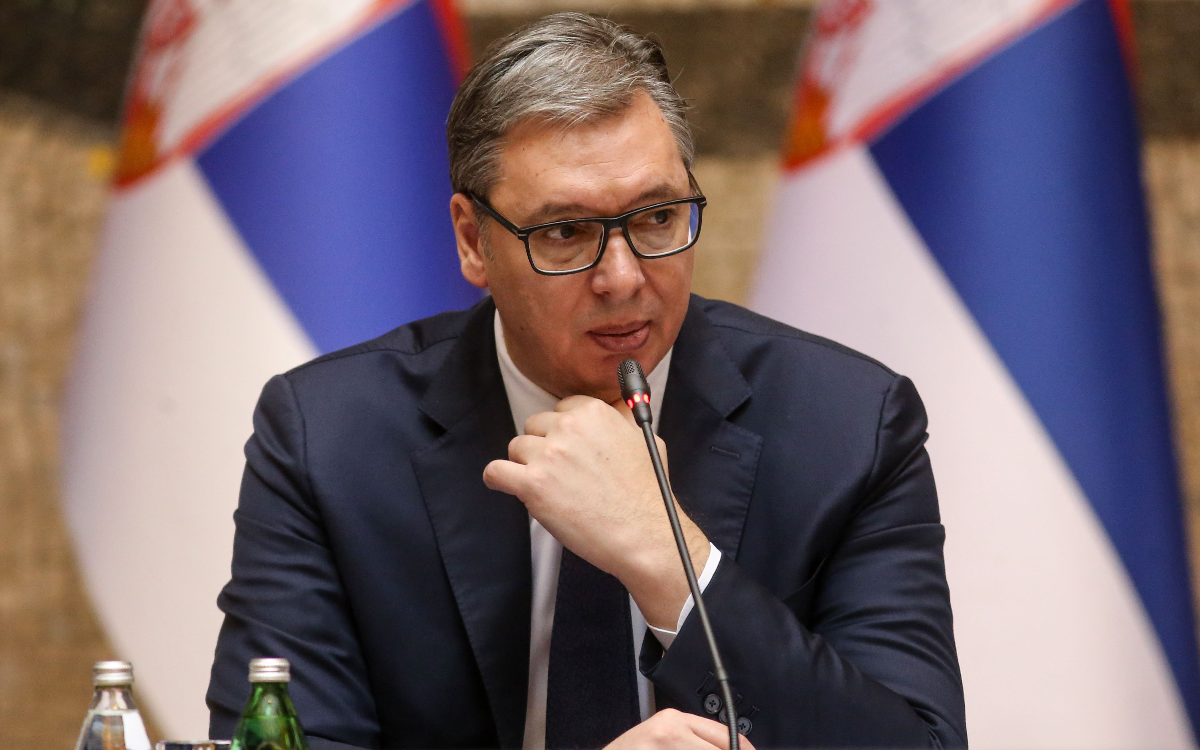
The Metropolitanate of Montenegro and the Littoral of the Serbian Orthodox Church (SOC) issued a statement regarding remarks made by Serbian President Aleksandar Vučić in recent days, in which, as it said, he repeatedly mentioned the Serbian Orthodox Church in Montenegro, “the 2020 litije (religious processions), and similar matters.”
The Metropolitanate said Vučić’s statements “are full of ambiguities” and that it considers it unacceptable for “confused, yet loud accusations about ‘malicious and dangerous ideas within the Church’ to be repeated continuously.”
“While understanding his criticism of the disturbing and shameful lack of compassion shown by the Ministry of Foreign Affairs of Montenegro toward the suffering of the Serbian people during Operation ‘Storm’ by sending representatives of our country to the ‘celebration’ marking the anniversary of that ethnic cleansing, we feel a pastoral obligation to respond to certain political interpretations of Church-related matters, leaving political and ideological issues to politicians and ideologues,” the statement reads.
The Metropolitanate said it is greatly damaging to “church and national unity” for the President of Serbia to make highly vague criticisms of the Church while, “in the same breath and almost in the same sentence, saying that ‘we had malicious and dangerous ideas in the Church,’ and then adding that ‘some people’ tried ‘to create an Orthodox Church in Montenegro,’ but that those people were thwarted because ‘Patriarch Irinej and the bishops recognized in time what was happening.'”
“If we add to this Vučić’s statement that ‘the litije in Montenegro began when they wanted an Orthodox Church in Montenegro, just to erase the word – Serbian,’ then it seems to us that we are entering a zone of useless and harmful ambiguities, which might be tolerated from someone with less responsibility and public significance, but not from the President of Serbia,” the Metropolitanate stated.
“With our best wishes and prayers to God that Serbia’s political leaders perform their duties for the progress of that country and its citizens, and that, to the extent possible, they provide help and support to all Serbs wherever they may live and work, we must point out that we have no positive experience with political guidance and interpretations of Church activities. Neither is that the role of politicians, nor does their unsolicited interference in Church matters bring good to either the state or the Church. In that regard, we consider it unacceptable that these confused, yet loud accusations of ‘malicious and dangerous ideas within the Church’ continue to be repeated, and it is particularly unhealthy that they are, as a rule, linked to the time of the 2020 litije in Montenegro, while being vaguely, incompletely, and inaccurately directed toward ‘some people’ who ‘tried’ to create ‘something’ involving the Church in Montenegro,” the statement continues.
“For the sake of truth, we remind Mr. Vučić and the broader public that it was precisely the faithful of the Serbian Orthodox Church in Montenegro, namely its four dioceses, bishops, clergy, monastics, and faithful people (all of them as citizens of Montenegro or as their representatives and prayerful servants before God), with the moral and spiritual support of priests and believers of our local Church throughout the world, who defended the Church from the attack by the then Montenegrin political leadership on Church property and the Church’s integrity. By defending the Church’s name, identity, and property, they also defended the unity of the Serbian Orthodox Church. They did so in exactly the right way: responding to attacks on the civil and religious rights of the people and clergy both as citizens and through spiritual means. We did not allow politicians to take the leading role even then, and the faithful among politicians understood this correctly, although there were those who did not welcome it. We believe that, had the wishes and intentions of the latter prevailed, the Church’s resistance to the anti-Church policies of Milo Đukanović would not have been as strong as it was, with God’s help, nor would it have possessed the spirit of a genuine Church movement that the people recognized and supported in such large numbers,” the Metropolitanate noted.
The statement says that the “people” who worked against the unity of the Church in Montenegro, “or rather, those who had such intentions and ideas,” were solely representatives of the then political leadership of Montenegro, who adopted “that inappropriate and anti-civilizational law” at the end of 2019.
“It is difficult to recognize them in Vučić’s latest statements, and the faithful, together with the clergy, are at the very least confused by these retrospective interpretations of the reasons behind the start of the 2020 litije. Those ‘people’ cannot, even through the most awkward verbal allusions, be connected with the leadership of the Serbian Orthodox Church in Montenegro, as certain Belgrade tabloids once claimed about the late Metropolitan Amfilohije, and we hope that this was not President Vučić’s intended meaning. However, we are reacting precisely because Mr. Vučić’s statements are clearly full of ambiguities. And if the respected President of Serbia has, by any chance, confused the coordinated actions of the bishops, clergy, and faithful in Montenegro at that time with a non-existent church separatism, we remind him that it was precisely this activity, in both organizational and practical terms, that made the successful conduct and conclusion of the prayerful and protest litije movement possible. This very achievement contributed to the amendment of the flawed Law on Freedom of Religion or Belief and the Legal Status of Religious Communities, as well as to the signing of the Fundamental Agreement between the State of Montenegro and the Serbian Orthodox Church,” the Metropolitanate added.
The Metropolitanate stressed that none of this was written in order “to make President Vučić’s political work more difficult, much less to justify ourselves before him.”
“For neither would be consistent with the dignity of the Serbian Orthodox Church, for whose unity and glory the clergy and faithful people of Montenegro have wholeheartedly sacrificed throughout history, especially during the past several decades,” the statement concludes.
Belgrade media previously reported that Vučić, while in Mrkonjić Grad in Bosnia and Herzegovina’s Republika Srpska entity, said, among other things, that “we also had malicious and dangerous ideas within the Church.”
“I am referring to the so-called polycentric ideas, the federalization and confederalization of our Church, and recently you hear, ‘what a surprise,’ from prominent Serbian nationalists, ideas about polycentric Serbianhood. That is the death of the Serbian people; that is the death of the Serbian Church. When they tried to create an Orthodox Church in Montenegro, our bishops recognized in time, and I know both our Patriarch and Patriarch Irinej recognized in time what was happening. Had they succeeded, our Serbian Church would never again have been what it is today and what it always will be. The Serbian Church is the same here in Mrkonjić Grad, the same in Pirot, the same in Sydney, the same in Skopje, the same in Frankfurt, in Melbourne, and everywhere else in the world. Likewise, we must know what our vital national interests are.”
During his visit to Republika Srpska, according to media reports, Vučić also said that “Montenegro has accused us of genocide four times.”
“It has reached the point where people identify as Orthodox Christians, but nationally they are not Serbs. And we must be grateful to Republika Srpska. There are fewer Serbs in Bosnia and Herzegovina than in Montenegro, yet Montenegro has accused us of genocide four times, they recognized the so-called Kosovo, while Republika Srpska has never done so. There is a great difference between those pursuing a united policy and those who want to break apart the integrative core of the Serbian people. Do not forget that the litije began in Montenegro when some people wanted to create an Orthodox Church in Montenegro simply by removing the word ‘Serbian.’ And believe me, such ideas still exist today.”
MORE TOPICS:
FROM AMMUNITION TO DRONES: How Serbia became one of Israel’s most important partners in Europe!
Source: Vijesti; Foto: ATA Images
 Add Serbian Times as your Google source