




With the development of social media, digital technologies and artificial intelligence, an endless field has emerged that is extremely fertile ground for various types of pre-election manipulation. Professional portals dedicated to exposing fake news — such as Raskrikavanje, Istinomer and Fake News Tragač — have already pointed to examples of a negative campaign whose main target is Ilija Srdanović, the top candidate on the Student List.
The campaign to discredit the Student List in pro-government media is strongly focused on the narrative that the top candidate on this electoral list — Dr. Ilija Srdanović — is allegedly a close associate of former Montenegrin President Milo Đukanović, as well as a vocal advocate of Montenegrin independence.
After months of escalating rhetoric toward this neighboring country in media close to the authorities, this story received an additional layer with the calling of snap parliamentary elections in Serbia. The timeline is actually quite simple: first, Montenegro was portrayed as a country harboring hostile intentions toward Serbia, which was ironically “apologizing for loving it more than it loved us”; in parallel, the student movement was branded as terrorist and an outpost of foreign agencies; then these two propaganda lines converged in one man — Ilija Srdanović.
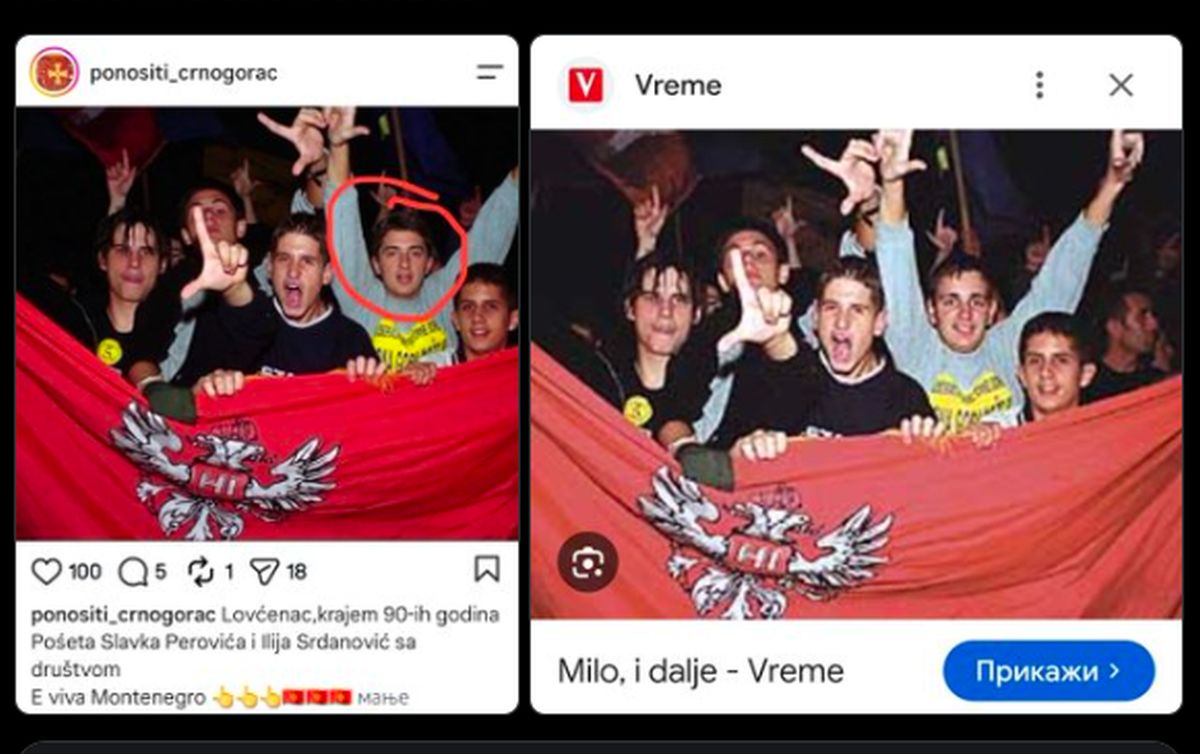
“GOSI bomb! Srdanović has hated Serbia since childhood — This photograph reveals everything” was one of the lead stories on Friday on the website of the pro-government tabloid Informer. In the article, the top candidate on the Student List is described as “a blockade protester from the bottom of the barrel, who has hated Serbia since childhood!” and as someone who “supported the worst Ustaše in the 1990s, even the worst Ustaša, Slavko Perović in Lovćenac!”
As “evidence,” a photograph from Instagram was attached, allegedly showing a young Ilija Srdanović taking part in a reception for Slavko Perović in the Vojvodina village of Lovćenac in the 1990s. Perović was the founder of the Liberal Alliance of Montenegro, the first party to publicly advocate Montenegro’s separation from the Federal Republic of Yugoslavia.
However, just as the digital age enables the manipulation of photographs and video content, it also provides us with opportunities to expose those same abuses. With a little searching on the internet, we can find the original photograph.
On the website of the weekly magazine “Vreme,” an article titled “Milo, Still” about the campaign for the presidential elections in Montenegro was published on October 24, 2002. Below the fourth paragraph is a photograph by photojournalist Stevo Vasiljević showing supporters of the Liberal Alliance.
The same photograph can also be found in a 2022 article on the website of the Podgorica newspaper “Pobjeda,” suggesting that it was taken in Montenegro.
Two clicks away from UDBA. pic.twitter.com/mlXJXIEHc1
— FTN SE BUDI (@ftn_se_budi) September 18, 2026
A significant difference can also be seen in the original photograph compared with the one that appeared in the tabloids — the man in the gray sweatshirt is not young Ilija Srdanović. The photograph was therefore digitally altered in order to discredit the top candidate on the Student List.
Srdanović in Novi Sad did not show a “Montenegrin L”
And that is not the end of the digital manipulation. A photograph is also circulating on social media allegedly showing Srdanović making the shape of the letter L with the thumb and index finger of his right hand. The caption of one of the posts claims that Srdanović is showing a “Montenegrin L,” the symbol of supporters of the Liberal Alliance.
The Raskrikavanje portal, however, points out that the photograph was digitally altered. The portal’s editorial team used a reverse image search to find the original photograph, initially published by Nova.rs, which shows that Srdanović is not making an “L” with his raised right hand, but a clenched fist.
The original photograph was taken when Srdanović addressed citizens at the students’ first pre-election rally in Novi Sad on September 10, 2026.
Wait, slowly… is it really true that this Ilija SRDANOVIĆ, who is leading the Student List, was a young Montenegrin liberal in Vojvodina in the early 1990s? A supporter of Slavko Perović.
But please… only if anyone knows for sure.
This is not naive at all.— Ratko Dmitrović (@RatkoDmitrovic) September 18, 2026
The Istinomer portal also wrote about this manipulation, likewise stating that a digital analysis of the viral photograph confirms that the disputed part of the image was altered afterward.
Fake photograph of an alleged SNS membership application belonging to Ilija Srdanović
A photograph of a form bearing the Serbian Progressive Party letterhead has also spread on social media, accompanied by the claim that it is a membership application filled out by Ilija Srdanović.
Istinomer determined, however, that the disputed photograph does not constitute authentic evidence that Srdanović was or is a member of the SNS.
On the contrary, the way the first name, parent’s name, surname and digits are written on the alleged membership application shows a pronounced uniformity in the style, shape and size of the letters, contrary to handwritten script and characteristic of digitally inserted content.
Good evening to the top candidate on the Student List pic.twitter.com/x25HpURZCm
— Olgica Rajković (@OlgicaRajkovic) September 16, 2026
In addition, the disputed photograph displays the first seven visible digits of Srdanović’s alleged national identification number — 0709970. However, since the first seven digits of a national identification number indicate the date of birth in the day-month-year format, that sequence of digits would correspond to September 7, 1970. Ilija Srdanović, according to publicly available biographical data, was born on August 7, 1970, which would be represented in the identification number by the sequence 0708970, Istinomer points out.
Ilija Srdanović’s photograph from the Epiphany Cross swimming event is not AI-generated
However, the opposite trend has also emerged on social media — claims that some photographs of Ilija Srdanović that may be perceived by the public as favorable were generated using artificial intelligence.
Thus, several profiles on X and Facebook claim that Srdanović’s photograph from the Epiphany Cross swimming event was created using AI. Some profiles have circulated a screenshot resembling online AI-image detection tools as evidence. However, those screenshots do not show which tool was used, Fake News Tragač reports.
The Fake News Tragač editorial team found several different photographs from the Epiphany Cross swimming event on Ilija Srdanović’s Facebook profile, published on Epiphany or shortly afterward in 2025 and 2023. In addition, they used three AI-image detection tools — Sightengine, ZeroGPT and SMOGY, published in the online AI community Hugging Face — to check whether the photograph might have been created using artificial intelligence. All three tools showed that the photograph was almost certainly not AI-generated.
There was no “Students Are Winning” banner at the protest in Pristina
A video from a protest in Pristina allegedly showing a group of people carrying a “Students Are Winning” banner is circulating on social media, Raskrikavanje reports, specifying that the video’s caption reads: “Scandal in Pristina. Albanians carry ‘Students Are Winning’ at a protest in support of Thaçi.”
However, numerous anomalies characteristic of AI-generated videos and digital manipulation can be seen in the footage, Raskrikavanje points out.
@orlovognezdo Albanians have risen up in Pristina! At a protest in support of Hashim Thaçi and the other UÇK villains, a banner reading STUDENTS ARE WINNING appeared. #studentipobedjuju #srbija🇷🇸 #kosovskamitrovica #kosovo🇽🇰 ♬ original sound – orlovognezdo
For example, at one point, a man walking behind the banner passes through it and stops in front of it, after which the banner comes together again.
Immediately afterward, the banner extends on the other side, and new people carrying it appear out of nowhere.
It is also noticeable that certain details in the footage are unclear, such as the hands of those carrying the alleged banner. Some people in the footage also appear and then suddenly disappear.
Istinomer simultaneously points to numerous digital artifacts characteristic of content generated by artificial intelligence. Some people’s hands do not have properly formed fingers, arms merge with scarves, banners and parts of clothing in certain places, while bodies and objects overlap unnaturally. In one part of the footage, a person can also be seen whose body visually merges with another person and the banner. Such changes in anatomy and boundaries between different objects are not characteristic of authentic footage, but rather of generated video.
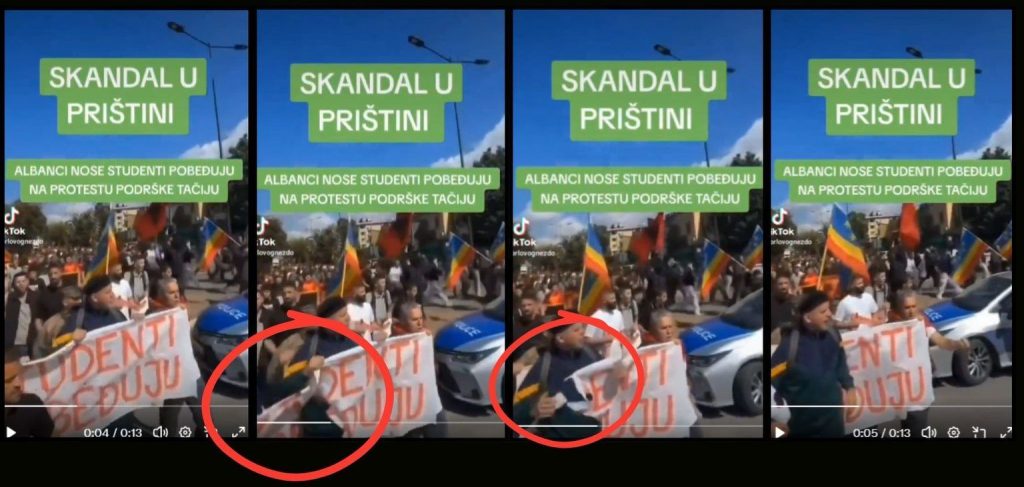
This video was originally shared yesterday by the “Orlovo gnezdo” TikTok account, which, judging by its posts, openly promotes the SNS and Aleksandar Vučić. The video has garnered more than 260,000 views on TikTok alone so far, and today it is also being shared on X and Instagram.
Many X users had already suggested in the comments that the video was AI-generated.
The same TikTok account — “Orlovo gnezdo” — also published the false claim that student Emina Spahić from Novi Pazar was “the only one (…) who asked for the inscription on the shirt to be in Latin script” at a gathering ahead of the submission of signatures to the Republic Electoral Commission.
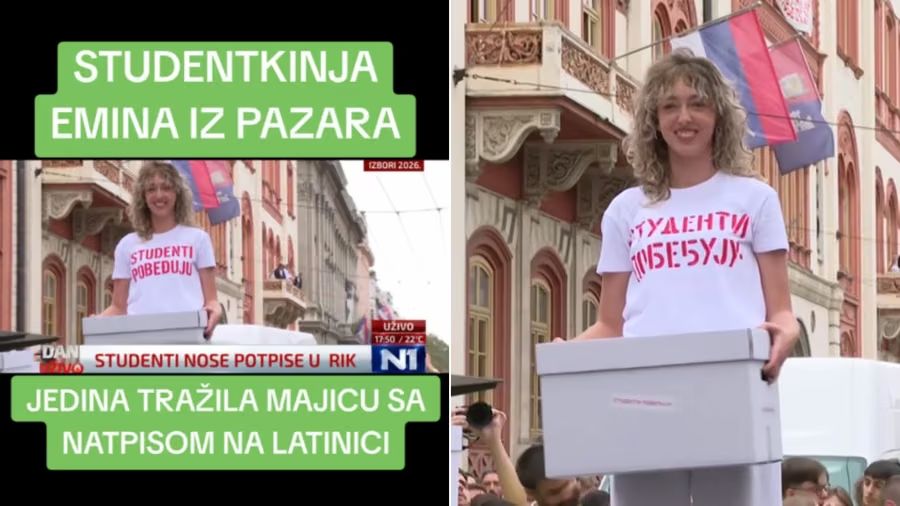
As evidence, an alleged screenshot from the N1 program “Dan uživo” was also provided. By reviewing the program footage, it can be seen that Emina Spahić was wearing a shirt with a Cyrillic inscription throughout, including at the “screenshot” moment when she lifted the box, Istinomer reports.
MORE TOPICS:
Source: N1 Foto: Printscreen X
 Add Serbian Times as your Google source