




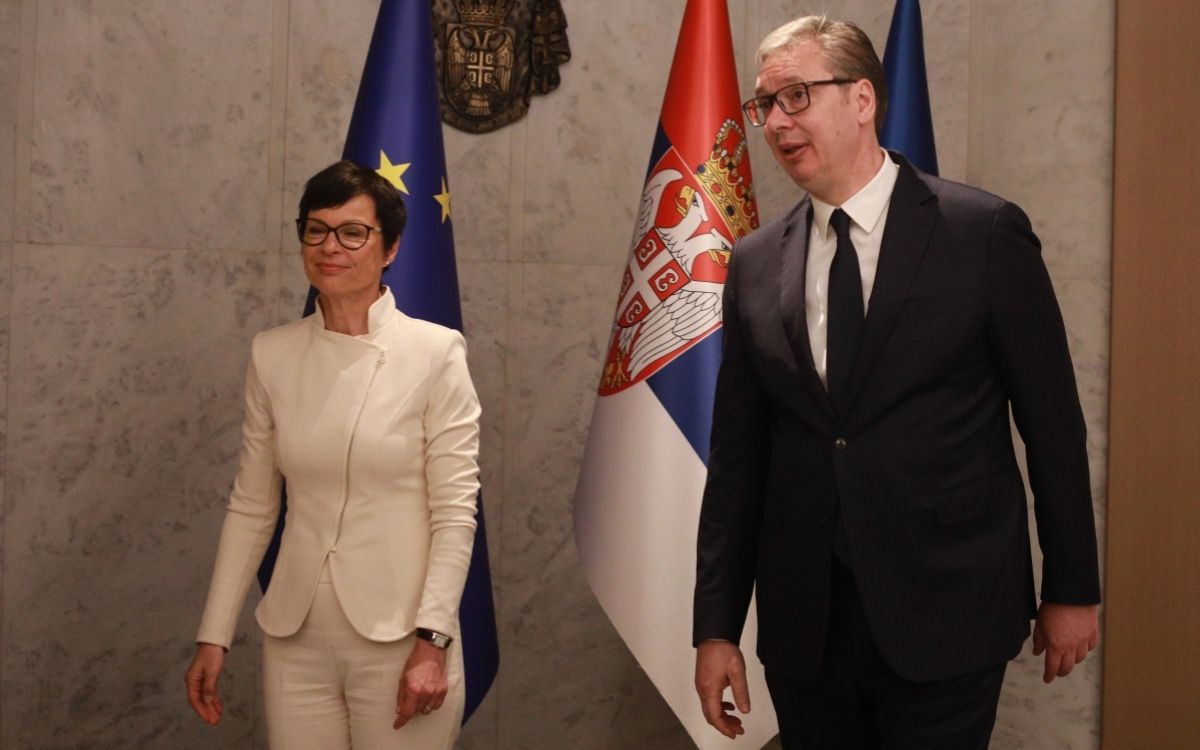
The Commissioner for Enlargement, Marta Kos, will reportedly announce today at a hearing in the European Parliament’s Foreign Affairs Committee that the European Union is freezing 1.5 billion euros intended for Serbia due to controversial judicial reforms adopted by Belgrade in January, writes Brussels-based Politico.
N1 has also confirmed that the EU will freeze money intended for Serbia because the country is regressing in pro-European reforms. EU Commissioner for Enlargement Marta Kos will officially announce this at today’s meeting of the European Parliament’s Committee on Foreign Affairs (AFET). The state will be left without 1.5 billion euros from the so-called “Growth Plan” due to controversial judicial reforms.
However, the final decision will be made after the Venice Commission announces its opinion on the so-called “Mrdić’s laws.”
Kos has already assessed that by adopting and implementing those laws, Serbia is regressing on its EU path and requested that their application be legally suspended.
Additionally, all six Western Balkan countries face the possibility of being deprived of more than 700 million euros.
As N1 learns, the entire Balkans is missing the opportunity to receive that money if it fails to fulfill reform tasks by June 30. These are reforms that were supposed to be completed by the end of June last year, but that deadline has since been moved.
Kos will warn of this possibility at today’s AFET meeting so that the states realize that time is running out.
Why are we being left without funds?
As our European correspondent reports, Mrdić’s laws are only one of the reasons why Serbia should be left without the sum of 1.5 billion euros.
There are, as he adds, several other reasons why Serbia has already lost part of the money, namely the failure to fulfill the reform agenda it promised to complete; media laws have not been finished, and OSCE election obstacles have not been fully implemented. Furthermore, the rule of law is also questionable.
Otherwise, official confirmation of the findings regarding the freezing of funds for Serbia is still awaited, and it should be announced during the afternoon.
“According to my information, Marta Kos plans to announce this at the meeting of the Foreign Affairs Committee of the European Parliament this afternoon. That meeting starts at 4:00 PM and lasts until 5:30 PM and is scheduled as a conversation between Marta Kos and representatives of the Foreign Affairs Committee regarding enlargement,” he states.
What I would add in this context is that enlargement and this penalizing of Serbia and the region will not be the only topics—as the region faces a loss of 700 million euros—but this affair…
Furthermore, the meeting will also serve the EPP, the main political group in the European Parliament, to question Marta Kos about her affiliation with Udba, given that it is a burning issue primarily in Slovenia and is circulating slightly through the Brussels “bubble,” although the focus remains on enlargement.
I told Serbian Speaker @anabrnabic that the recent steps taken by Serbia's authorities to curb the independence of its judiciary are a great concern.
— Marta Kos (@MartaKosEU) March 18, 2026
We expect the implementation of the new judiciary laws to be put on hold until the Venice Commission issues its opinion, and for… pic.twitter.com/caIPnigl2X
Urgent decision of the Government
On the day when European Commissioner for Enlargement Marta Kos is expected to announce that 1.5 billion euros from EU funds will be frozen for Serbia due to changes in a set of judicial laws proposed by SNS MP Uglješa Mrdić, the Government has ordered all state bodies that, when preparing laws or bylaws, they must pay special attention to the alignment of the proposed regulation with the legal acquis of the European Union, as well as whether the proposed regulation was previously consulted with the European Commission.
According to a statement from the Ministry of European Integration, led by Nemanja Starović, they will be the ones overseeing the implementation of these rules.
“Specifically, in the future, all proponents of regulations by which EU legal acquis are transposed will be obliged to obtain a prior opinion from the Ministry of European Integration, without whose check it will not be possible to adopt laws and bylaws relevant to Serbia’s EU accession process,” the Ministry’s statement reads.
Glad to welcome Rector of the University of Belgrade Vladan Đokić in Brussels today.
— Marta Kos (@MartaKosEU) April 20, 2026
Universities must remain places of critical thinking and open debate, free from any forms of intimidation.
I greatly value his commitment to defending the autonomy and dignity of the… pic.twitter.com/0XrM4u8gk2
Kos met with Rector Đokić
EU Commissioner for Enlargement Marta Kos met today with the Rector of the University of Belgrade, Vladan Đokić.
Kos wrote on the social network X that universities must remain places of critical thinking and open debate, free from any form of intimidation.
“I highly value his (Vladan Đokić) commitment to defending the autonomy and dignity of the University of Belgrade,” she stated, assessing that this is important for the democratic and European future of Serbia.
Kos and Đokić, according to N1’s information, were supposed to discuss the situation in Serbia, with an emphasis on student protests launched after the collapse of the canopy on November 1, 2024, as well as the situation at universities, the police raid on the Rectorate of the University of Belgrade, and also the election process, Serbia’s path toward the EU, and reforms.
N1’s European correspondent reports that this is the first official meeting of Rector Đokić with one of the high representatives and high-ranking officials of the European Union.
“This visit is not surprising. I hear comments immediately that Rector Đokić has become politically engaged, but this visit at this moment should be viewed in light of the fact that Serbia, within its negotiations, is also obligated to finish Chapter 26, which relates to education,” states the N1 correspondent.
Namely, it is not excluded that problems could arise regarding that chapter as well.
“The European Commission has already spoken out about the situation at universities and generally regarding education in Serbia, so it is not surprising that this visit ultimately took place. In the report for 2025, the European Commission says there was no progress in Chapter 26, that the quality of education was affected by protests, that working conditions for educators worsened, that there were a large number of dismissals, or rather non-renewals of labor contracts for professors and educators, and the European Commission demands respect for academic freedoms. Therefore, the situation at the university can be a reason to run into problems with Chapter 26,” the N1 correspondent reports.
MORE TOPICS:
TODAY WE CELEBRATE THE EASTER FOR THE DEAD: Here are the folk customs observed in Serbia!
Source: N1, Nova; Photo: ATA Images
 Add Serbian Times as your Google source