




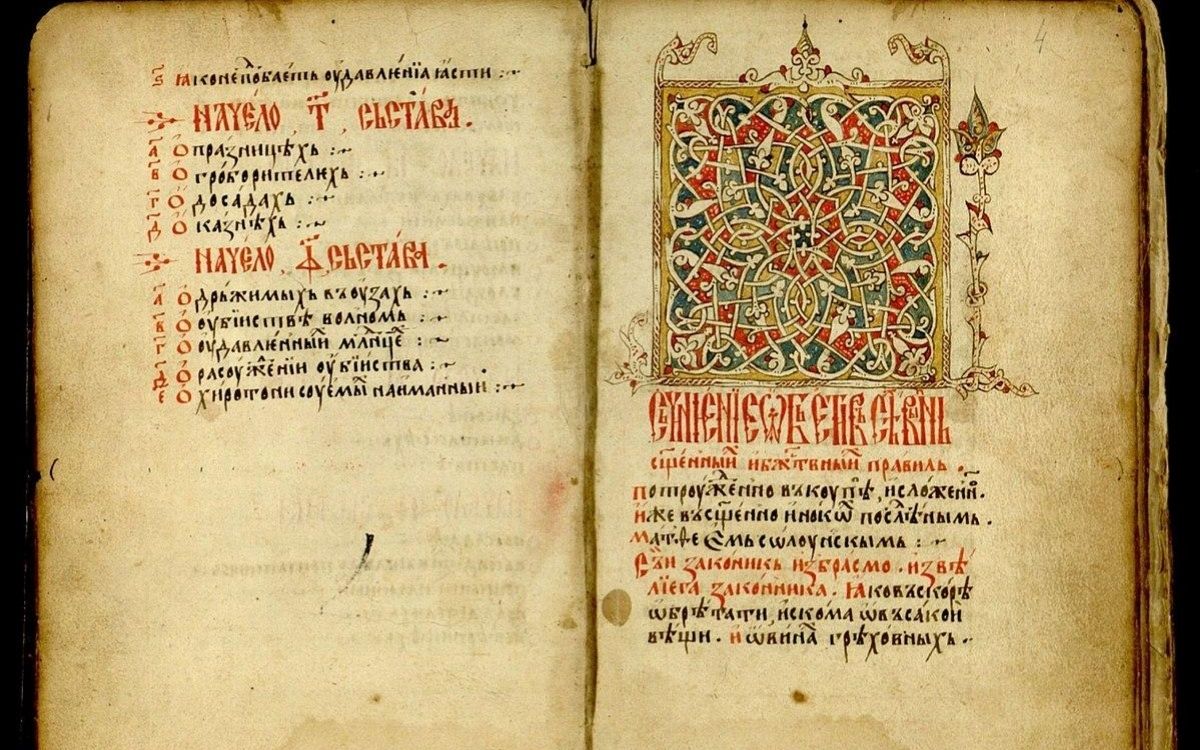
Dušan’s Code (The Code of the Pious Emperor Stefan) is the most significant legal monument of the Serbian state from the Nemanjić era. It was adopted at the assembly in Skopje in 1349 (the first 135 articles), and amended at the assembly in Serres in 1354 with another 66 articles, so that it has a total of 201 articles.
The original of Dušan’s Code has not been preserved, but numerous copies (over 20) have survived from the period between the 14th and 16th centuries. This testifies to its application not only in the Middle Ages, but also later under the Turks within the church.
Dušan’s Code was written in the vernacular, Old Serbian language, unlike other codes of that era which were written in Latin. Dušan’s Code is not entirely an original work; there are numerous sources from which the articles were taken: old Slavic and Serbian customary law, earlier charters of Serbian rulers, Byzantine law, statutes of coastal towns.
One of the most important tasks of Dušan’s Code was to strengthen Dušan’s vast state, to standardize the legal regulations of different areas of the empire, and to bring the newly conquered towns and areas closer together.
According to its content, Dušan’s Code represents a collection of regulations from various fields of law. Most of its regulations concern the organization of the state, the authorities — the ruler and the nobility, both secular and ecclesiastical, their obligations and rights, their mutual relations, and their relations with the sebrs.
After the regulations on state and social organization, Dušan’s Code contains mostly provisions on criminal offenses and punishments.
The Code mostly provides very strict punishments for theft and robbery, for arson inside and outside a village, for violating boundaries of others, and in general for violating the land property of others.
The Code prescribes punishments for criminal offenses against the person, for murder, for bodily injury, for rape, for insults by action and word.
Finally, Dušan’s Code, especially in its first articles, orders the punishment of all those who work against the church or do not respect church regulations, but at the same time it is strict towards church wrongdoings.
Thus, in Article 13, which is titled On Bishops, it says:
And metropolitans, and bishops, and abbots, are not to be appointed by bribes. And whoever is found to have appointed a metropolitan, or a bishop, or an abbot by bribe, let him be accursed, as well as the one who appointed him.
The Code regulates domestic violence, but also violence in general. In part 53, On Violence, it says:
If any nobleman takes a noblewoman by force, let both his hands be cut off and his nose slit; if a sebr takes a noblewoman by force, let him be hanged; if he takes his peer by force, let both his hands be cut off and his nose slit. (sebr – servant, author’s note)
Emperor Dušan in the 14th century provides for the death penalty only in the case of murdering family members:
If a nobleman kills a sebr in a town, or in a župa, or in a katun, let him pay a thousand perpers; if a sebr kills a nobleman, let both his hands be cut off and let him pay three hundred perpers.
Whoever is found to have killed his father, or mother, or brother, or his child, let that murderer be burned at the fire.
The Code also introduced a system of judicial jury, the size of which depended on the offense being tried…
From now on, let there be a jury for both much and little: for a great matter let there be twenty-four jurors, and for a lesser guilt twelve, and for a small matter six jurors. And these jurors are not authorized to reconcile anyone, but to acquit or again to condemn. And let every jury be in the church, and let the priest in vestments swear them in, and in the jury where the majority swear, and whom the majority acquits, those are to be believed.
Emperor Dušan abolished the trade in gold and the goldsmith trade, except in special cases:
Goldsmiths shall not be anywhere in the župas across the Emperor’s land, except in the market squares where the Emperor has appointed money to be minted.
MORE TOPICS:
Source: Serbian Times Photo:Wikimedia Creative Commons
 Add Serbian Times as your Google source