




There are awards that are not given for one achievement, one performance or one moment. They come as recognition of decades during which someone has selflessly shared their time, knowledge, talent and love with others.
One such award has gone to Branko Aleksić, a longtime member of the Serbian community in Chicago, an actor, musician and lover of poetry, theater and culture, who did not allow nearly three decades of life in America to distance him from the language and roots from which he came.
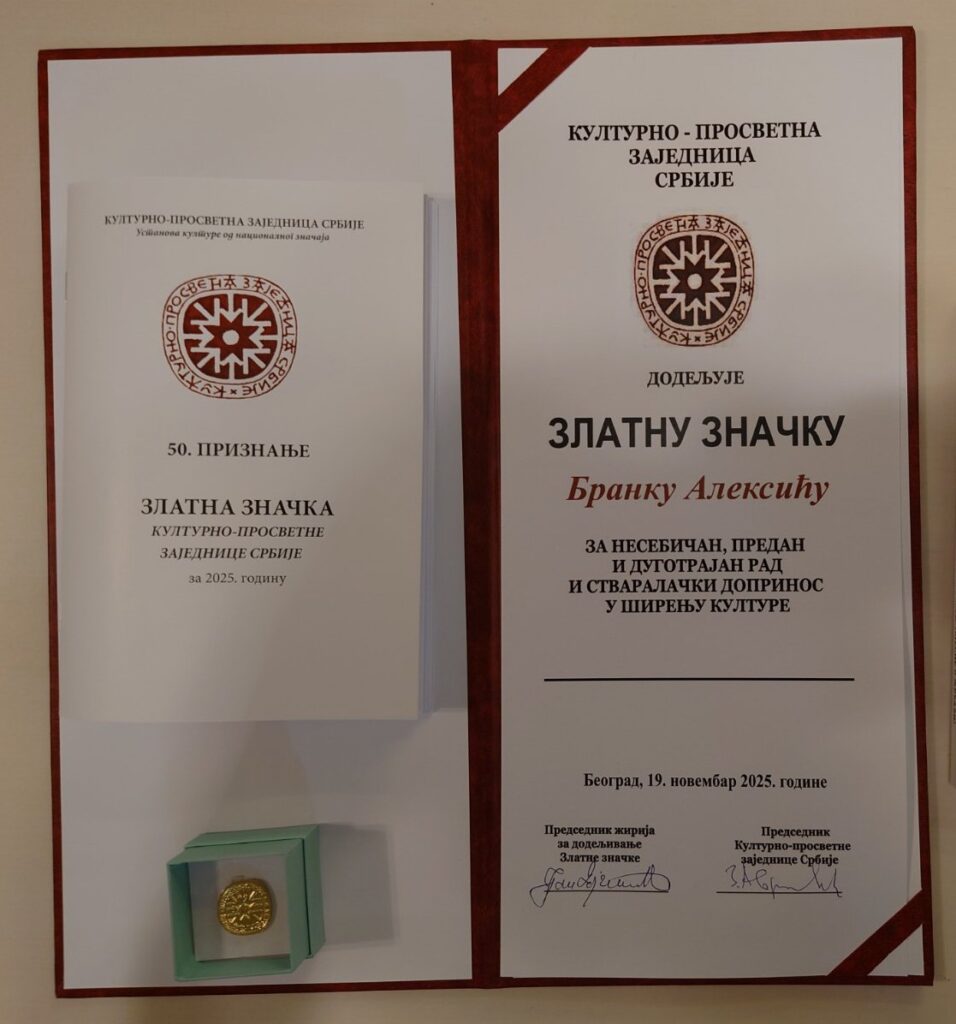
The Cultural and Educational Community of Serbia awarded him the Golden Badge, a recognition for selfless, dedicated and long-term work, as well as a creative contribution to the spread of culture.
His story, however, did not begin in Chicago. It began much earlier – with a guitar, school performances and verses by Mika Antić, Ljubivoje Ršumović, Pero Zubac, Yesenin, Mayakovsky and other poets. It continued through Valjevo, Belgrade and numerous stages, all the way to America, where art remained an integral part of his life.
For Chicago Dešavanja, Branko speaks about the Golden Badge, his artistic journey, Serbian theater in Chicago, preserving language and culture in the diaspora, as well as what he would tell young people today.
To begin with, what does the Golden Badge of the Cultural and Educational Community of Serbia represent, and how much does it mean to you to be among its recipients?
The Cultural and Educational Community of Serbia awarded me the Golden Badge for selfless, dedicated and long-term work, as well as a creative contribution to the spread of culture. The award has been presented for the past fifty years, with twenty recipients honored each year. On the occasion of its fiftieth anniversary, fifty people were awarded, and I had the good fortune and pleasure of being among them.
Your love for art began long before you came to America. What did that journey look like, and what do you do today?
It all began back in high school. At the gymnasium, I worked at the school radio station, organized poetry and acoustic music evenings, acted in school productions and at the Osa theater, sang in the gymnasium choir and in KUD Abrašević Valjevo. I played guitar, wrote poems and composed music for my own verses, as well as for the poetry of writers I loved – Mika Antić, Ljubivoje Ršumović, Pero Zubac, Yesenin, Mayakovsky, Dis, Duško Trifunović…
Almost every week I recorded a song for a youth program that aired on Radio Valjevo. I had concerts in Celje and Makarska, as well as in Priština while I was serving in the army.
For a short time, I worked professionally as a musician, but I quickly became tired of it and, after a concert in Celje, took a break of almost three years. I realized that I could not sell something I loved, that I was an amateur at heart and that I could only do what I loved when I felt inspired, because only then did what I was doing truly come from my soul.
I graduated from the Faculty of Law in Belgrade, got a job, and remained an amateur and volunteer in the arts. While playing guitar in KUD Gradac Valjevo, I came to America for a month. Since I had a six-month visa, I stayed to get to know this country a little better and, well, I have now been here for almost thirty years.
Alongside my job, and now in retirement, I act with Serbian Theatre Chicago and occasionally at the Mira Sremčević Theater. From time to time, I play and sing with my friend Dejan Glišović at various cultural events. Apparently, all of that was enough for me to be among the fifty people honored last year.
How did you find out that you had received the award, and were you able to attend the ceremony?
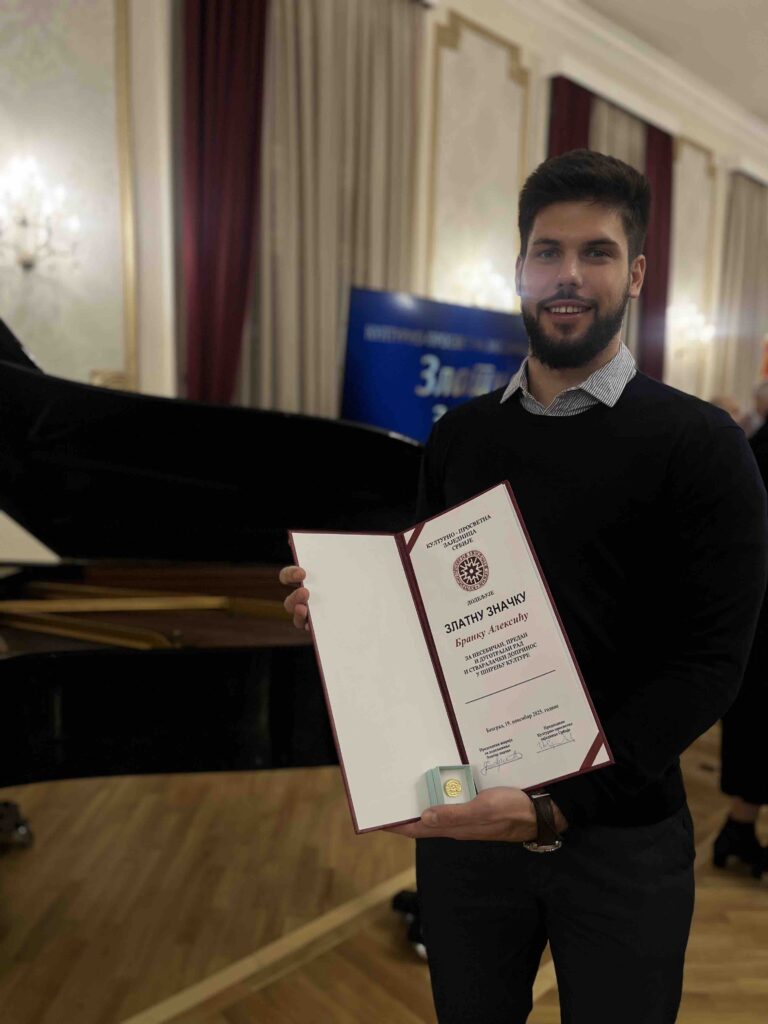
They informed me a week before the award ceremony and, despite my best efforts, I was unable to secure a plane ticket to attend. My son, who was in Serbia at the time, accepted the award on my behalf.
How important is it for Serbs in the diaspora to preserve their language and culture, and what role do our institutions in Chicago play in that?
When my son goes to Serbia, no one can tell that he completed all his schooling in America in English, including two university degrees. I believe that language is the fundamental characteristic of a people and that it should be nurtured. Without roots, you belong nowhere.
Theater plays a certain role in preserving Serbian culture, but I believe that the Sveti Sava Academy, a Serbian school that teaches children what some parents failed to teach them, plays an even greater role. I am extremely proud of that school.
I would say that our people are increasingly recognizing its value, because interest is so great that there have been waiting lists for enrollment. Because of this, the school had to add new classrooms in order to accommodate all the children.
What would you say to young people who are growing up or building their lives and careers in America?
Advice is an ungrateful thing, not to say useless. When you grow old, you know a lot, but few people listen to you, just as we, when we were young, did not listen to everything our elders told us because we thought we knew everything.
There is also the fact that we still live in our own time, while young people live in this present time, their own time. Nevertheless, I would advise them not to hide their origins and not to allow money to become their only goal in life. They should find time for hobbies and for the people they love. You only live once.
What comes next? Will audiences in Chicago soon have the opportunity to see you in new theater projects?
The theater in Skokie, where we performed most of our shows, was sold, so we are looking for a new venue. The plan was to present the play “Stories from the Park 2” in October, based on an original script by our director, Milan Andrijanić.
In March, I was supposed to try my hand at directing for the first time. My good friend, Šabac actor and director Ivan Tomašević, gave me permission to stage his play “Nušić’s Optimal Number.” It is a brilliant comedy, but I cannot reveal its content to you.
Whether the plan will come to fruition depends on whether we manage to find a new theater and available dates.
When culture is not a profession, but a way of life
Perhaps the essence of Branko’s story lies precisely in his statement that he is “an amateur at heart.” Art has never been just a job for him or something done for recognition. It was and remains a need – a guitar picked up when inspiration strikes, a stage stepped onto out of love, a song sung with friends and a desire to preserve the Serbian language and culture thousands of miles away from Serbia.
The Golden Badge therefore represents much more than an award. It is recognition of a journey that began back in his high school days, passed through theater, music, poetry and volunteering, and continued throughout nearly thirty years of life in America.
Perhaps the most important message of the entire story is precisely the one Branko shared with younger generations: Do not hide your origins, do not allow money to become your only goal, and find time for the things and people you love. Because – you only live once.
MORE TOPICS:
Source: Milena Stefanović / Chicago dešavanja, Foto: Privatna arhiva
 Add Serbian Times as your Google source