




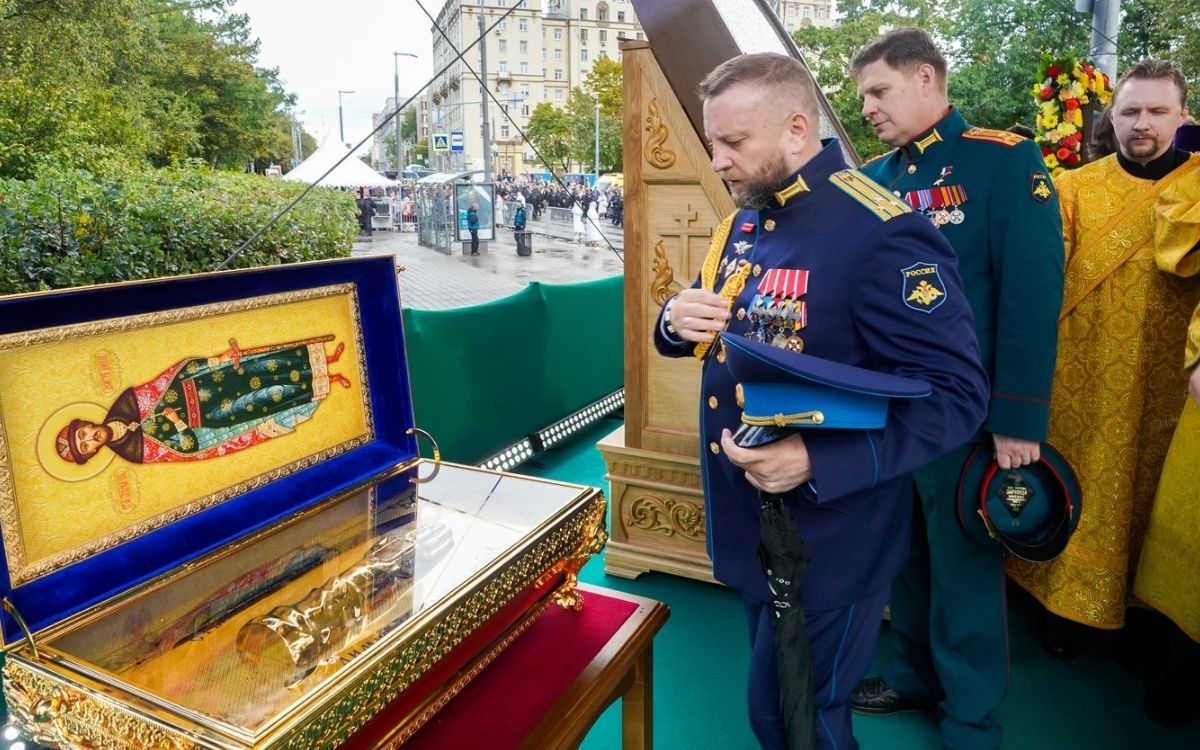
The Russian Orthodox Church has sent Russian soldiers fighting in Ukraine part of the remains of medieval prince Dmitry Donskoy, explaining that the relic should “spiritually strengthen” them and help them achieve victory, the Guardian reports.
A reliquary containing part of Donskoy’s right hand, the 14th-century prince celebrated in Russia for his victory over the Golden Horde in the Battle of Kulikovo in 1380, was first taken to Russian-controlled territory in the Donetsk region and then began a journey along the front line.
“The holy military commander is going where the fate of the motherland is being decided today, so that he may invisibly take his place in the same battle ranks alongside our defenders,” the Russian Orthodox Church said, the Guardian reports.
The relic was first brought to the Saur-Mogila war memorial in the Donetsk region, where senior representatives of the Russian Orthodox Church held a prayer service together with representatives of the Russian military.
Metropolitan Vladimir of Donetsk and Mariupol, appointed by the Russian Orthodox Church, said that the presence of the relic should help soldiers and civilians “mobilize their strength” and achieve victory over the enemy.
The Guardian notes that sending Donskoy’s remains to the front is another example of the strong support provided by the leadership of the Russian Orthodox Church for the war in Ukraine. Patriarch Kirill has repeatedly presented the war in religious terms since the beginning of the Russian invasion in February 2022.
Priests have been sent to military units and occupied Ukrainian territories, while churches across Russia have been instructed to read prayers asking God for victory.
Particular attention has been drawn to the fact that Dmitry Donskoy’s remains were officially discovered only last month, during the restoration of the Archangel Cathedral in the Moscow Kremlin, where generations of Russian princes and tsars are buried.
Russian President Vladimir Putin also attended the ceremony marking the opening of the tomb, having built very close relations with the Russian Orthodox Church during his more than two decades in power.
The decision to open the centuries-old tomb also drew criticism. The location of Donskoy’s burial had long been known, but the church had not attempted to exhume his remains even after he was canonized as a saint in 1988.
Orthodox priest and historian Alexander Zanemonec, who lives outside Russia, assessed that the decision to uncover the relics nearly four decades after his canonization was connected to the needs of wartime patriotism.
“By the fifth year of the war, the church leadership in Moscow began to wonder what else it could do to demonstrate support for what Russia calls the ‘special military operation,’” Zanemonec wrote for Carnegie.
In his assessment, portraying Dmitry Donskoy as a defender of the motherland fits into the Kremlin’s narrative that Russia is actually defending itself in Ukraine rather than waging a war of aggression against a neighboring country.
This is not the first time the Russian Orthodox Church has sent the relics of medieval military commanders to the Ukrainian front. Earlier this year, the remains of Alexander Nevsky, another medieval prince and military hero revered as a saint by the Russian Orthodox Church, were also sent to soldiers.
MORE TOPICS:
Source: Nova.rs, Foto: Sergei Vlasov / Russion Orthodox Church Press Servis via AP
 Add Serbian Times as your Google source